

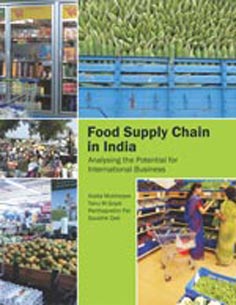
Food Supply Chain in India
Arpita Mukherjee‚ Tanu M. Goyal‚ Parthapratim Pal‚ Saubhik Deb
About the Book
India is one of the largest food and grocery markets in the world and a large consumer of food products. Despite having a rich raw material base for food products, high food price inflation is becoming a major challenge facing the country. There is a shortage of supply due to issues in the food supply chain. The food supply chain is fragmented and only seven per cent of the perishable products are being processed. To counter this, the Indian government is offering several incentives to private and foreign investors in the food processing sector reflecting the government’s intention to attract investment. The large and unsaturated Indian market has attracted a number of foreign companies yet the country has not been able to be a part of their global production networks. There is a need for reforms in the food supply chain to enable India to reach out to its unrealised potential.
Given this background, this report examines the opportunities and potential for international businesses in the food supply chain of India. The report tries to make international businesses better acquainted with the Indian market by providing detailed information about the central and state governments’ policies on the food supply chain. It highlights the barriers faced by international businesses in India and suggests a go-to-market strategy for international businesses. The report identifies the current and potential gains for India from the entry of foreign businesses and makes policy recommendation based on a clear understanding of the expectations and experiences of international businesses in India and global best practices.
About the Author(s) / Editor(s)
Arpita Mukherjee is a Professor at Indian Council for Research on International Economic Relations (ICRIER), New Delhi. She has several years of experience in policy-oriented research working closely with the governments in India and the UK. She has conducted studies for various international organisations and Indian industry associations. Her research is a key contributor to India’s negotiating strategies in the on-going Doha Round of WTO negotiations, in bilateral trade agreements and in domestic policy reforms. She has a PhD in Economics from the University of Portsmouth, UK. Her research interests include: services, WTO, bilateral/regional agreements; infrastructure, FDI, agriculture reforms, retail, migration and labour market programmes. She has over 80 publications including books, journals, working papers and government reports. Dr Mukherjee has presented her research at various international and national conferences.
Tanu M. Goyal is a Research Associate at ICRIER. Her research interests include trade in services, foreign direct investment issues and retail. She has over five years of research experience and has worked on projects for the Government of India, Asian Development Bank (ADB), European Commission (EC), Konrad-Adenauer-Stiftung (KAS), Italian Trade Commission, among others. She has extensively worked on international agreements and has authored reports providing negotiating strategy for the bilateral agreements being negotiated by the Indian government. She has published several international and national journal articles, book chapters, reports and other popular media articles on policy and trade issues. She has a Masters degree in Economics with specialisation in world economy, from Centre of Trade and Development (CITD), Jawaharlal Nehru University, New Delhi.
Parthapratim Pal is a faculty member in the Economics Group at the Indian Institute of Management Calcutta (IIMC). He has a PhD from Jawaharlal Nehru University in New Delhi. He has done his Masters and MPhil in Economics from the same university. He has worked in the areas of macroeconomics, development, financial markets and international economy. Before joining IIMC, Prof Pal worked with the ICRIER and the Indian Institute of Foreign Trade, New Delhi. He has published his works in various national and international books and journals. He has also worked as external consultant for organisations like TERI (The Energy and Resources Institute) and Ministry of Commerce, Government of India.
Saubhik Deb is an economist and independent consultant. He has a PhD in Economics from Rutgers University, USA and an MA and MPhil from Jawaharlal Nehru University, New Delhi. He has worked as an Economist with World Bank at Washington DC. He has also worked as external consultant for ADB and ICRIER. He is working in the areas of development economics and open-economy macroeconomics and has published his works in various national and international journals.
| Publisher | AF Press |
| Publication Date | 2014 |
| Number of Pages | 74 |
| ISBN |
9789332701380 |
Academic Foundation (AF), based in New Delhi, is India’s leading independent publisher of academic/scholarly books in Social Sciences, specialising in Economics—Development Economics and Indian Economy in particular, and allied subjects.
About the Book
India is one of the largest food and grocery markets in the world and a large consumer of food products. Despite having a rich raw material base for food products, high food price inflation is becoming a major challenge facing the country. There is a shortage of supply due to issues in the food supply chain. The food supply chain is fragmented and only seven per cent of the perishable products are being processed. To counter this, the Indian government is offering several incentives to private and foreign investors in the food processing sector reflecting the government’s intention to attract investment. The large and unsaturated Indian market has attracted a number of foreign companies yet the country has not been able to be a part of their global production networks. There is a need for reforms in the food supply chain to enable India to reach out to its unrealised potential.
Given this background, this report examines the opportunities and potential for international businesses in the food supply chain of India. The report tries to make international businesses better acquainted with the Indian market by providing detailed information about the central and state governments’ policies on the food supply chain. It highlights the barriers faced by international businesses in India and suggests a go-to-market strategy for international businesses. The report identifies the current and potential gains for India from the entry of foreign businesses and makes policy recommendation based on a clear understanding of the expectations and experiences of international businesses in India and global best practices.
About the Author(s) / Editor(s)
Arpita Mukherjee is a Professor at Indian Council for Research on International Economic Relations (ICRIER), New Delhi. She has several years of experience in policy-oriented research working closely with the governments in India and the UK. She has conducted studies for various international organisations and Indian industry associations. Her research is a key contributor to India’s negotiating strategies in the on-going Doha Round of WTO negotiations, in bilateral trade agreements and in domestic policy reforms. She has a PhD in Economics from the University of Portsmouth, UK. Her research interests include: services, WTO, bilateral/regional agreements; infrastructure, FDI, agriculture reforms, retail, migration and labour market programmes. She has over 80 publications including books, journals, working papers and government reports. Dr Mukherjee has presented her research at various international and national conferences.
Tanu M. Goyal is a Research Associate at ICRIER. Her research interests include trade in services, foreign direct investment issues and retail. She has over five years of research experience and has worked on projects for the Government of India, Asian Development Bank (ADB), European Commission (EC), Konrad-Adenauer-Stiftung (KAS), Italian Trade Commission, among others. She has extensively worked on international agreements and has authored reports providing negotiating strategy for the bilateral agreements being negotiated by the Indian government. She has published several international and national journal articles, book chapters, reports and other popular media articles on policy and trade issues. She has a Masters degree in Economics with specialisation in world economy, from Centre of Trade and Development (CITD), Jawaharlal Nehru University, New Delhi.
Parthapratim Pal is a faculty member in the Economics Group at the Indian Institute of Management Calcutta (IIMC). He has a PhD from Jawaharlal Nehru University in New Delhi. He has done his Masters and MPhil in Economics from the same university. He has worked in the areas of macroeconomics, development, financial markets and international economy. Before joining IIMC, Prof Pal worked with the ICRIER and the Indian Institute of Foreign Trade, New Delhi. He has published his works in various national and international books and journals. He has also worked as external consultant for organisations like TERI (The Energy and Resources Institute) and Ministry of Commerce, Government of India.
Saubhik Deb is an economist and independent consultant. He has a PhD in Economics from Rutgers University, USA and an MA and MPhil from Jawaharlal Nehru University, New Delhi. He has worked as an Economist with World Bank at Washington DC. He has also worked as external consultant for ADB and ICRIER. He is working in the areas of development economics and open-economy macroeconomics and has published his works in various national and international journals.
| Publisher | AF Press |
| Publication Date | 2014 |
| Number of Pages | 74 |
| ISBN |
9789332701380 |

Couldn't load pickup availability
Share
-

Curated Collections By AF Press
-

Premium Print Quality
-

Author-Centric Publishing
-

Trusted by Readers Nationwide


Food Supply Chain in India