


Development and Taxation
Parthasarathi Shome
About the Book
This volume is a collection of selected critical commentaries on various aspects of the Indian and global economies. The author has used a mix of verbal and graphical tools, comprising his thoughts on economic, political economy and social challenges and incorporating analysis, conclusions, and recommendations on those issues. The articles address macroeconomic concerns including the estimation of GDP, savings and growth, inflation and interest rates, financial markets, demonitisation of the currency, land acquisition, and others. They analyse fiscal policy and taxation matters including tax evasion and corruption, and the struggle to improve the ease of doing business. Emerging international economic relations including United Kingdom’s leaving the European Union and India’s economic and strategic relations with Japan, China, Latin America, and, last but not least, with Pakistan, are addressed. Issues emerging from the Group of 20 Nations (G20) are not ignored. On socio-economic aspects, India’s challenges and failures in designing and implementing a range of socio-economic policies are addressed. Health and palliative care, cleaning up India, quality deterioration in the Indian Railways, and the failure to educate Indian youth, are taken up. A selection of essays with political economy and socio-historical perspectives concludes with a final philosophical note—that thoughts can comprise ideas, thus summing up, as it were, the overall stance in the narrative of the included commentaries.
Praise for this book
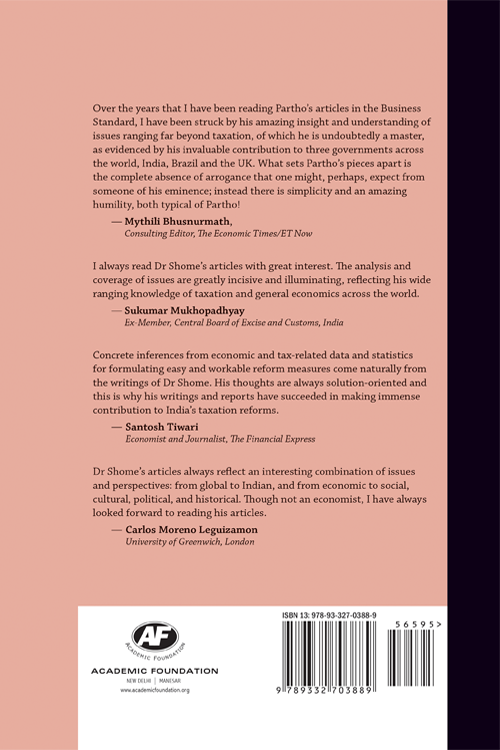
Over the years that I have been reading Partho’s articles in the Business Standard, I have been struck by his amazing insight and understanding of issues ranging far beyond taxation, of which he is undoubtedly a master, as evidenced by his invaluable contribution to three governments across the world, India, Brazil and the UK. What sets Partho’s pieces apart is the complete absence of arrogance that one might, perhaps, expect from someone of his eminence; instead there is simplicity and an amazing humility, both typical of Partho!
— Mythili Bhusnurmath
Consulting Editor, The Economic Times/ET Now
I always read Dr Shome’s articles with great interest. The analysis and coverage of issues are greatly incisive and illuminating, reflecting his wide ranging knowledge of taxation and general economics across the world.
— Sukumar Mukhopadhyay
Ex-Member, Central Board of Excise and Customs, India
Concrete inferences from economic and tax-related data and statistics for formulating easy and workable reform measures come naturally from the writings of Dr Shome. His thoughts are always solution-oriented and this is why his writings and reports have succeeded in making immense contribution to India’s taxation reforms.
— Santosh Tiwari
Economist and Journalist, The Financial Express
Dr Shome’s articles always reflect an interesting combination of issues and perspectives: from global to Indian, and from economic to social, cultural, political, and historical. Though not an economist, I have always looked forward to reading his articles.
— Carlos Moreno Leguizamon
University of Greenwich, London
About the Author(s) / Editor(s)
Parthasarathi Shome is Chairman, International Tax Research and Analysis Foundation (ITRAF), Bengaluru. Prior to that he was Adviser (Minister of State) to the Indian Finance Minister, and Chief Economist, Her Majesty’s Revenue and Customs (HMRC), United Kingdom. Earlier he was Chief of Tax Policy, International Monetary Fund (IMF), and Professor of Economics, The American University, Washington DC. He received the highest civilian honour of the Brazilian Government, Commander of the Order of the Southern Cross, and the Jeanne S. Mattersdorf Award of the National Tax Association of America as “an outstanding student in the field of taxation and public finance” for his PhD thesis from Southern Methodist University.
Contents in Detail
| Publisher | AF Press |
| Publication Date | 2017 |
| Number of Pages | 326 |
| ISBN |
9789332703889 |
Academic Foundation (AF), based in New Delhi, is India’s leading independent publisher of academic/scholarly books in Social Sciences, specialising in Economics—Development Economics and Indian Economy in particular, and allied subjects.
About the Book
This volume is a collection of selected critical commentaries on various aspects of the Indian and global economies. The author has used a mix of verbal and graphical tools, comprising his thoughts on economic, political economy and social challenges and incorporating analysis, conclusions, and recommendations on those issues. The articles address macroeconomic concerns including the estimation of GDP, savings and growth, inflation and interest rates, financial markets, demonitisation of the currency, land acquisition, and others. They analyse fiscal policy and taxation matters including tax evasion and corruption, and the struggle to improve the ease of doing business. Emerging international economic relations including United Kingdom’s leaving the European Union and India’s economic and strategic relations with Japan, China, Latin America, and, last but not least, with Pakistan, are addressed. Issues emerging from the Group of 20 Nations (G20) are not ignored. On socio-economic aspects, India’s challenges and failures in designing and implementing a range of socio-economic policies are addressed. Health and palliative care, cleaning up India, quality deterioration in the Indian Railways, and the failure to educate Indian youth, are taken up. A selection of essays with political economy and socio-historical perspectives concludes with a final philosophical note—that thoughts can comprise ideas, thus summing up, as it were, the overall stance in the narrative of the included commentaries.
Praise for this book
Over the years that I have been reading Partho’s articles in the Business Standard, I have been struck by his amazing insight and understanding of issues ranging far beyond taxation, of which he is undoubtedly a master, as evidenced by his invaluable contribution to three governments across the world, India, Brazil and the UK. What sets Partho’s pieces apart is the complete absence of arrogance that one might, perhaps, expect from someone of his eminence; instead there is simplicity and an amazing humility, both typical of Partho!
— Mythili Bhusnurmath
Consulting Editor, The Economic Times/ET Now
I always read Dr Shome’s articles with great interest. The analysis and coverage of issues are greatly incisive and illuminating, reflecting his wide ranging knowledge of taxation and general economics across the world.
— Sukumar Mukhopadhyay
Ex-Member, Central Board of Excise and Customs, India
Concrete inferences from economic and tax-related data and statistics for formulating easy and workable reform measures come naturally from the writings of Dr Shome. His thoughts are always solution-oriented and this is why his writings and reports have succeeded in making immense contribution to India’s taxation reforms.
— Santosh Tiwari
Economist and Journalist, The Financial Express
Dr Shome’s articles always reflect an interesting combination of issues and perspectives: from global to Indian, and from economic to social, cultural, political, and historical. Though not an economist, I have always looked forward to reading his articles.
— Carlos Moreno Leguizamon
University of Greenwich, London
About the Author(s) / Editor(s)
Parthasarathi Shome is Chairman, International Tax Research and Analysis Foundation (ITRAF), Bengaluru. Prior to that he was Adviser (Minister of State) to the Indian Finance Minister, and Chief Economist, Her Majesty’s Revenue and Customs (HMRC), United Kingdom. Earlier he was Chief of Tax Policy, International Monetary Fund (IMF), and Professor of Economics, The American University, Washington DC. He received the highest civilian honour of the Brazilian Government, Commander of the Order of the Southern Cross, and the Jeanne S. Mattersdorf Award of the National Tax Association of America as “an outstanding student in the field of taxation and public finance” for his PhD thesis from Southern Methodist University.
Contents in Detail
| Publisher | AF Press |
| Publication Date | 2017 |
| Number of Pages | 326 |
| ISBN |
9789332703889 |

Couldn't load pickup availability
Share

-

Curated Collections By AF Press
-

Premium Print Quality
-

Author-Centric Publishing
-

Trusted by Readers Nationwide


Development and Taxation