


Roadmap to Address Vitamin D Deficiency in India
Arpita Mukherjee‚ Aashish Chaudhry‚ Latika Khatwani‚ Trishali Khanna‚ Pallavi Verma
Regular price
₹ 1,995.00
Sale price
₹ 1,995.00
Regular price
Save ₹ -1,995
Unit price
per
Praise for this book
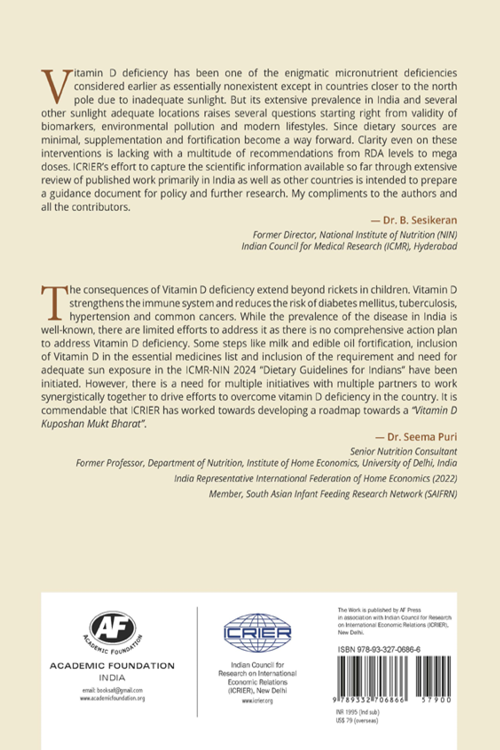
Vitamin D deficiency has been one of the enigmatic micronutrient deficiencies considered earlier as essentially nonexistent except in countries closer to the north pole due to inadequate sunlight. But its extensive prevalence in India and several other sunlight adequate locations raises several questions starting right from validity of biomarkers, environmental pollution and modern lifestyles. Since dietary sources are minimal, supplementation and fortification become a way forward. Clarity even on these interventions is lacking with a multitude of recommendations from RDA levels to mega doses. ICRIER’s effort to capture the scientific information available so far through extensive review of published work primarily in India as well as other countries is intended to prepare a guidance document for policy and further research. My compliments to the authors and all the contributors.
— Dr. B. Sesikeran
Former Director, National Institute of Nutrition (NIN)
Indian Council for Medical Research (ICMR), Hyderabad
The consequences of Vitamin D deficiency extend beyond rickets in children. Vitamin D strengthens the immune system and reduces the risk of diabetes mellitus, tuberculosis, hypertension and common cancers. While the prevalence of the disease in India is well-known, there are limited efforts to address it as there is no comprehensive action plan to address Vitamin D deficiency. Some steps like milk and edible oil fortification, inclusion of Vitamin D in the essential medicines list and inclusion of the requirement and need for adequate sun exposure in the ICMR-NIN 2024 “Dietary Guidelines for Indians” have been initiated. However, there is a need for multiple initiatives with multiple partners to work synergistically together to drive efforts to overcome vitamin D deficiency in the country. It is commendable that ICRIER has worked towards developing a roadmap towards a “Vitamin D Kuposhan Mukt Bharat”.
— Dr. Seema Puri
Senior Nutrition Consultant
Former Professor, Department of Nutrition, Institute of Home Economics, University of Delhi, India
India Representative International Federation of Home Economics (2022)
Member, South Asian Infant Feeding Research Network (SAIFRN)
About the Authors
Dr. Arpita Mukherjee is a Professor at ICRIER. She has over 30 years of experience in policy-oriented research, working closely with the Government of India and policymakers in the European Commission and its member states, the United States of America (USA), the Association of Southeast Asian Nations (ASEAN) and in East Asian countries. She has conducted over 60 sector specfic studies for various governments, international organisations, industry associations, non-government organisations and companies.
Her areas of expertise include trade, investment and trade facilitation, services, agriculture and manufacturing supply chains (domestic and cross-border), and special economic zones/economic corridors. She specialises in sector and product-specific market trends, go-to market strategy and government policies.
Dr. Mukherjee has a PhD in Economics from the University of Portsmouth, UK, and prior to joining ICRIER, she worked with the UK-based think-tank Policy Studies Institute and taught at the University of Portsmouth. She has over 80 publications including in national and international refereed journals, books and book chapters and government reports. Dr. Mukherjee is a member of various government committees and policy panels and is on the editorial board of 10 journals. She has presented her work in various conferences and seminars and is on the advisory board of industry associations and non-government organisations. She is a regular contributor to newspapers and magazines.
Dr. Aashish Chaudhry is the Founder & Director of ANVKA Foundation, an NGO that has been instrumental in social welfare through free health awareness and aid programs. He is also the Managing Director of Aakash Healthcare Pvt. Ltd. Under his leadership, Aakash Healthcare launched its flagship hospital in Dwarka, New Delhi, in 2017, which has established an excellent reputation in a short span.
The brand expanded its services by opening a multi-speciality unit in Agra, UP, in 2023. Plans are underway to launch a hospital in Gurugram, Haryana, and a specialized Cancer Unit in Dwarka, New Delhi.
He specializes in business planning and healthcare management. He graduated from Maulana Azad Medical College and earned a post-graduation degree in Orthopaedics from Lady Hardinge Medical College. He holds an MRCS certification from the Royal College of Surgeons in Glasgow and a DIP.SICOT from Gothenburg, Sweden. Additionally, he has a Healthcare Management certificate from ISB Hyderabad and has been awarded an honorary Doctorate in Literature from Chitkara University.
As an accomplished orthopaedic surgeon, he specializes in minimally invasive knee and hip replacements. He proactively collaborates with NGOs to provide quality healthcare in rural areas through free mega health camps and super-specialty OPDs. His passion is evident in the Pink Bones initiative, which offers free treatment to children with bone deformities.
He has previously held leadership roles in PHDCCI and ASSOCHAM. He is an active member of the IMA and DMA and serves as an Advisory Board Member for the Centre of Excellence for Additive Manufacturing and the AKG Foundation for Innovation & Entrepreneurship. Additionally, he has authored numerous peer-reviewed papers and is a sought-after speaker at health forums.
Ms. Latika Khatwani is a Research Assistant at ICRIER with a keen interest in international trade, public health, and agriculture. She has previously interned at NITI Aayog in the Economics & Finance vertical and at the Ministry of Commerce and Industry, gaining valuable experience in policy research and trade analysis.
Ms. Khatwani holds an M.A. in Economics with specialisation in trade and finance from the Indian Institute of Foreign Trade (IIFT). She completed her undergraduate studies at the Shyama Prasad Mukherjee College (SPMC), University of Delhi, where she was awarded the Principal’s Medal for securing the top position in her class. Beyond her professional commitments, she is the Co-founder and Vice President of Girl Up Aurum, a United Nations initiative dedicated to advancing equal rights for young girls in developing nations.
Ms. Trishali Khanna is a Research Assistant at ICRIER. Her areas of interest include international trade, development economics, and policy-making. She has more than three years of research and teaching experience. At ICRIER, Ms. Khanna is working on multiple projects, which aim to facilitate domestic reforms, implement the United Nations’ Sustainable Development Goals and India’s integration in international trade. Her role involves conducting literature review, analysing data, and evaluating policies to support evidence-based decision-making. She co-organised the 1st Asia Pacific E-commerce Policy Summit in association with ESCAP and MSL, 2024.
Ms. Khanna has an MA (Economics) from Indira Gandhi National Open University (IGNOU). Ms. Khanna is University Grant Commission NET Qualified in Economics. In addition to holding a patent in Methods and Systems for Automated Assessment of Sales Performance of Individuals, Ms. Khanna has 2 Scopus, 2 ABDC and 1 Web of Science journal publications. She has presented her work at nine national and international conferences.
Dr. Pallavi Verma currently leads the Branding, Digital Marketing, and Corporate Communication Department at Aakash Healthcare, Dwarka, New Delhi. With a decade of experience as a dedicated healthcare consultant in the field of maternity care and neonatal well-being at the mother and child unit, she has developed a profound understanding of the widespread impact of Vitamin D deficiency, particularly among the vulnerable group, women and children—the pillars of their families.
Passionate about public health, Dr. Verma actively advocates for awareness around lifestyle diseases and wellness preventive agendas. She collaborates with NGOs, engages with media houses, and participates in impactful conferences to drive meaningful conversations on these critical issues.
Working closely with the core team at Aakash Healthcare and Dr. Aashish Chaudhry, she is deeply involved in grassroots initiatives to educate communities about silent epidemics. Through digital media and strategic collaborations with various organisations, she strives to develop and implement innovative healthcare programs that empower people to take charge of their well-being.
Contents in Detail
| Publisher | AF Press |
| Publication Date | 2025 |
| Number of Pages | 114 |
| ISBN |
9789332706866 |
READ MORE
Academic Foundation (AF), based in New Delhi, is India’s leading independent publisher of academic/scholarly books in Social Sciences, specialising in Economics—Development Economics and Indian Economy in particular, and allied subjects.
Praise for this book
Vitamin D deficiency has been one of the enigmatic micronutrient deficiencies considered earlier as essentially nonexistent except in countries closer to the north pole due to inadequate sunlight. But its extensive prevalence in India and several other sunlight adequate locations raises several questions starting right from validity of biomarkers, environmental pollution and modern lifestyles. Since dietary sources are minimal, supplementation and fortification become a way forward. Clarity even on these interventions is lacking with a multitude of recommendations from RDA levels to mega doses. ICRIER’s effort to capture the scientific information available so far through extensive review of published work primarily in India as well as other countries is intended to prepare a guidance document for policy and further research. My compliments to the authors and all the contributors.
— Dr. B. Sesikeran
Former Director, National Institute of Nutrition (NIN)
Indian Council for Medical Research (ICMR), Hyderabad
The consequences of Vitamin D deficiency extend beyond rickets in children. Vitamin D strengthens the immune system and reduces the risk of diabetes mellitus, tuberculosis, hypertension and common cancers. While the prevalence of the disease in India is well-known, there are limited efforts to address it as there is no comprehensive action plan to address Vitamin D deficiency. Some steps like milk and edible oil fortification, inclusion of Vitamin D in the essential medicines list and inclusion of the requirement and need for adequate sun exposure in the ICMR-NIN 2024 “Dietary Guidelines for Indians” have been initiated. However, there is a need for multiple initiatives with multiple partners to work synergistically together to drive efforts to overcome vitamin D deficiency in the country. It is commendable that ICRIER has worked towards developing a roadmap towards a “Vitamin D Kuposhan Mukt Bharat”.
— Dr. Seema Puri
Senior Nutrition Consultant
Former Professor, Department of Nutrition, Institute of Home Economics, University of Delhi, India
India Representative International Federation of Home Economics (2022)
Member, South Asian Infant Feeding Research Network (SAIFRN)
About the Authors
Dr. Arpita Mukherjee is a Professor at ICRIER. She has over 30 years of experience in policy-oriented research, working closely with the Government of India and policymakers in the European Commission and its member states, the United States of America (USA), the Association of Southeast Asian Nations (ASEAN) and in East Asian countries. She has conducted over 60 sector specfic studies for various governments, international organisations, industry associations, non-government organisations and companies.
Her areas of expertise include trade, investment and trade facilitation, services, agriculture and manufacturing supply chains (domestic and cross-border), and special economic zones/economic corridors. She specialises in sector and product-specific market trends, go-to market strategy and government policies.
Dr. Mukherjee has a PhD in Economics from the University of Portsmouth, UK, and prior to joining ICRIER, she worked with the UK-based think-tank Policy Studies Institute and taught at the University of Portsmouth. She has over 80 publications including in national and international refereed journals, books and book chapters and government reports. Dr. Mukherjee is a member of various government committees and policy panels and is on the editorial board of 10 journals. She has presented her work in various conferences and seminars and is on the advisory board of industry associations and non-government organisations. She is a regular contributor to newspapers and magazines.
Dr. Aashish Chaudhry is the Founder & Director of ANVKA Foundation, an NGO that has been instrumental in social welfare through free health awareness and aid programs. He is also the Managing Director of Aakash Healthcare Pvt. Ltd. Under his leadership, Aakash Healthcare launched its flagship hospital in Dwarka, New Delhi, in 2017, which has established an excellent reputation in a short span.
The brand expanded its services by opening a multi-speciality unit in Agra, UP, in 2023. Plans are underway to launch a hospital in Gurugram, Haryana, and a specialized Cancer Unit in Dwarka, New Delhi.
He specializes in business planning and healthcare management. He graduated from Maulana Azad Medical College and earned a post-graduation degree in Orthopaedics from Lady Hardinge Medical College. He holds an MRCS certification from the Royal College of Surgeons in Glasgow and a DIP.SICOT from Gothenburg, Sweden. Additionally, he has a Healthcare Management certificate from ISB Hyderabad and has been awarded an honorary Doctorate in Literature from Chitkara University.
As an accomplished orthopaedic surgeon, he specializes in minimally invasive knee and hip replacements. He proactively collaborates with NGOs to provide quality healthcare in rural areas through free mega health camps and super-specialty OPDs. His passion is evident in the Pink Bones initiative, which offers free treatment to children with bone deformities.
He has previously held leadership roles in PHDCCI and ASSOCHAM. He is an active member of the IMA and DMA and serves as an Advisory Board Member for the Centre of Excellence for Additive Manufacturing and the AKG Foundation for Innovation & Entrepreneurship. Additionally, he has authored numerous peer-reviewed papers and is a sought-after speaker at health forums.
Ms. Latika Khatwani is a Research Assistant at ICRIER with a keen interest in international trade, public health, and agriculture. She has previously interned at NITI Aayog in the Economics & Finance vertical and at the Ministry of Commerce and Industry, gaining valuable experience in policy research and trade analysis.
Ms. Khatwani holds an M.A. in Economics with specialisation in trade and finance from the Indian Institute of Foreign Trade (IIFT). She completed her undergraduate studies at the Shyama Prasad Mukherjee College (SPMC), University of Delhi, where she was awarded the Principal’s Medal for securing the top position in her class. Beyond her professional commitments, she is the Co-founder and Vice President of Girl Up Aurum, a United Nations initiative dedicated to advancing equal rights for young girls in developing nations.
Ms. Trishali Khanna is a Research Assistant at ICRIER. Her areas of interest include international trade, development economics, and policy-making. She has more than three years of research and teaching experience. At ICRIER, Ms. Khanna is working on multiple projects, which aim to facilitate domestic reforms, implement the United Nations’ Sustainable Development Goals and India’s integration in international trade. Her role involves conducting literature review, analysing data, and evaluating policies to support evidence-based decision-making. She co-organised the 1st Asia Pacific E-commerce Policy Summit in association with ESCAP and MSL, 2024.
Ms. Khanna has an MA (Economics) from Indira Gandhi National Open University (IGNOU). Ms. Khanna is University Grant Commission NET Qualified in Economics. In addition to holding a patent in Methods and Systems for Automated Assessment of Sales Performance of Individuals, Ms. Khanna has 2 Scopus, 2 ABDC and 1 Web of Science journal publications. She has presented her work at nine national and international conferences.
Dr. Pallavi Verma currently leads the Branding, Digital Marketing, and Corporate Communication Department at Aakash Healthcare, Dwarka, New Delhi. With a decade of experience as a dedicated healthcare consultant in the field of maternity care and neonatal well-being at the mother and child unit, she has developed a profound understanding of the widespread impact of Vitamin D deficiency, particularly among the vulnerable group, women and children—the pillars of their families.
Passionate about public health, Dr. Verma actively advocates for awareness around lifestyle diseases and wellness preventive agendas. She collaborates with NGOs, engages with media houses, and participates in impactful conferences to drive meaningful conversations on these critical issues.
Working closely with the core team at Aakash Healthcare and Dr. Aashish Chaudhry, she is deeply involved in grassroots initiatives to educate communities about silent epidemics. Through digital media and strategic collaborations with various organisations, she strives to develop and implement innovative healthcare programs that empower people to take charge of their well-being.
Contents in Detail
| Publisher | AF Press |
| Publication Date | 2025 |
| Number of Pages | 114 |
| ISBN |
9789332706866 |

Expected delivery date:
18 Oct
Usually ready in 2-3 days.
Couldn't load pickup availability
Share

-

Curated Collections By AF Press
-

Premium Print Quality
-

Author-Centric Publishing
-

Trusted by Readers Nationwide


Roadmap to Address Vitamin D Deficien...
Regular price
₹ 1,995.00
Sale price
₹ 1,995.00
Regular price
Unit price
per