Economic Reforms and Rural Development in India
G. Parthasarathy‚ G. Nancharaiah
About the Book
SINCE 1991 Indian economy has been exposed to economic liberalisation and globalisation in line with structural adjustment and stabilisation policies initiated by IMF and World Bank. Structural adjustment policy advocated privatisation, import liberalisation, and export-led growth while stabilisation policy emphasises reduction in fiscal deficit through withdrawal of subsidies given to industry, trade and agriculture. There has been a shift in the Indian economic policy from State-oriented development strategy to market-oriented development, leaving the decisions of production and distribution to the market signals. This policy became controversial as some argued in favour of it while others argued against it.
In this book, Prof. G. Parthasarathy has rigorously analysed the pros and cons of structural adjustment and liberalisation policies and empirically examined its effects on rural development at national and state level, in terms of agricultural growth, employment opportunities, wages and reduction in rural poverty.
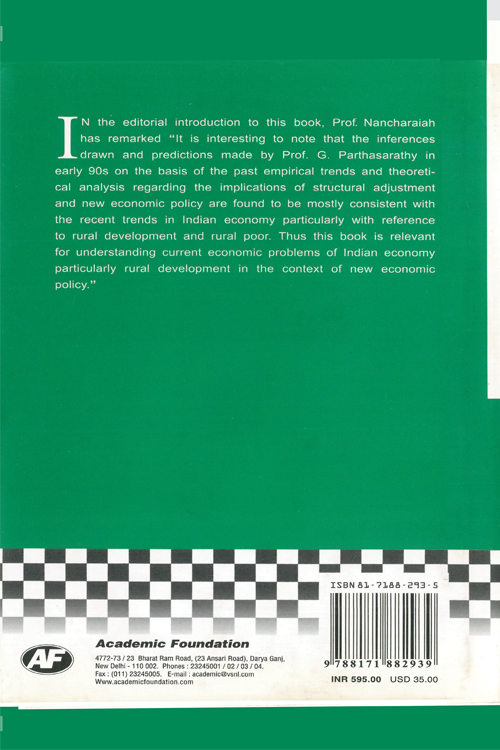
IN the editorial introduction to this book, Prof. Nancharaiah has remarked “It is interesting to note that the inferences drawn and predictions made by Prof. G. Parthasarathy in early 90s on the basis of the past empirical trends and theoretical analysis regarding the implications of structural adjustment and new economic policy are found to be mostly consistent with the recent trends in Indian economy particularly with reference to rural development and rural poor. Thus this book is relevant for understanding current economic problems of Indian economy particularly rural development in the context of new economic policy."
Praise for this book
The author “virtually endorses the anti-economic reforms lobby’s hypothesis... the author is not just expressing his opinion; he is basing his arguments on logic and data.”
— Business Standard
About the Author(s) / Editor(s)
G. Parthasarathy (born May 19, 1928) did his M.A in Economics from Madras University (1949) and Ph.D in Agricultural Economics, University of Wisconsin, Madison, USA, 1958.
G. Parthasarathy was Professor and Head, Department of Applied Economics, Andhra University; Director, Institute of Development and Planning Studies, Visakhapatnam (1992-2001); was on the State Planning Board, Government of Andhra Pradesh (1989-92); was Consultant FAO and UNDP. Presently, he is President, Indian Society of Agricultural Marketing.
Prof. Parthasarathy has published a number of books and articles.
G. Nancharaiah, currently Vice-Chancellor of Babasaheb Bhimrao Ambedkar University, Lucknow, did M.A. and Ph.D in Economics from Andhra University. He has taught post-graduate students for 26 years at different universities (Andhra University, University of Hyderabad, and Bombay University). He was Professor and Head, Department of Economics, University of Hyderabad; was a Fulbright scholar and also worked at University of California, USA.
Dr. Nancharaiah authored a book entitled "Land and Caste" and has a number of monographs, and research papers to his credit. He is on the Governing Body of Giri Institute of Development Studies and on the Academic Council of Rohilkhand University.
Contents in Detail
1.Structural Adjustment and Rural Development :
A Survey of Recent Literature
• Fundamental Objective and Trade-Off between Growth and
Poverty in the Short-Run
• Structural Adjustments: Contraction in Investment vs. Social Expenditure
• Adjustment through Expenditure Switching towards Tradeables
• Structural Adjustments and Policies for Protecting the Poor
• Structural Adjustments and the Role of the State
• Price Policies, Export of Foodgrains and the Poor
• Structural Adjustments and Labour Markets
• Structural Adjustments V/s Distortions in Policies
• Newly Poor V/s Chronically Poor and Structural Adjustment
• Domestic Structural Adjustment as Complimentary to International
Adjustment in International Trade
• Structural Adjustment and the Role of the State in Agriculture
• Freeing the Land Market: Capital Flows into Land V/s Landlessness
• Structural Adjustment and Labour Market
• Structural Adjustment and Aggregate Demand
• Structural Adjustment and the Informal Sector
• Structural Adjustments: Theoretical Constraints and Experience
• Assessment of Indian Experience of Structural Adjustment and Poverty
• Structural Adjustment in Agriculture: A View Point on the Needed Reform
2.Social Security and Structural Adjustment
• Introduction
• Food Security
• Public Intervention and Food Security
• Structural Adjustment & Food Security
• Employment Security
• Employment Security & Structural Adjustment
• The Period of Economic Reform & Employment
• Health Security
• Expenditure Compression in the Health Sector
• Summary & Conclusions
3.Safety Nets for Vulnerable Sections
• Structural Adjustment Explained
• The Controversy Over Structural Adjustment and Its Impact on Poor
• Stabilisation Policies and Inflation
• Impact of Inflation on Vulnerable Sections
• Other Macro-Economic Shocks: The Case of Handloom Weavers
• Structural Reforms, in the Medium-Term & Long-Term and
Employment in the Unorganised Sector
• Public Distribution as a Safety Net:A Review
• Reason for No Purchase/Part Purchase from PDS
• Issues in Revamping Public Distribution System
• Public Employment and Other Safety Nets
• Summary and Conclusion
4.New Economic Policy and Rural Employment
• Withdrawal of Subsidies and Rural Employment
• Liberalisation of Industrial and Trade Policies and Their Impact
on Rural Employment
• Potential Areas of Employment
• Scope for Government Sponsored Employment Programmes and
Modifications Required in their Conceptual Framework
5.Agricultural Exports - (in the Context of Liberalisation and
Globalisation of Agricultural Trade)
• Objectives
• Review of Earlier Studies on Trends in Agricultural Trade
• Variations in Foreign Trade in Agricultural Commodities
Between the Post and Pre Liberalisation Periods
• Variations in Total Agricultural Exports and Total Agricultural Imports
• Agricultural Imports
• Variations in Exports of Individual Agricultural Commodities
• Rate of Growth: Post-Liberalisation Period Compared to
Pre-Liberalisation Period
• India’s Share in World Exports
• Liberalisation – Production & Exports
• Direction of India’s Trade
• Unit Value Index of Exports in India: Trends
• Trends in Exports in Post-Liberalisation Period and Critical issues
• Globalisation of World Trade Under Uruguay Round Negotiations
and Its Impact on Indian Agricultural Trade
• Summary and Conclusions
6.Rural Poverty and Economic Reforms :
Opportunities and Constraints
• Trends in Rural Poverty: An Analysis: Review of Trends; Agricultural
Growth and Rural Poverty in A.P.; Poverty Alleviation Programmes and
Rural Poverty; Growth Versus Public Intervention; Regional and Other
Aspects of Incidence of Rural Poverty and the Characteristics of Rural
Poverty at the beginning of Economic Reform; Level of Social
Development in Andhra Pradesh at the Beginning of Economic Reforms
• Opportunities and Constraints of Economic Reforms: Review, Growth,
Allocation, Trade, Reduced Inflation, Conclusion;
Empirical Examination
• Rate of Inflation: Pre and Post-Reform Periods
• Employment
• Occupational Shifts; Post-Reform Period
• Trends within Rural Areas
• Trends in Per Capita NSDP
• Occupational Shifts by Gender
• Incidence of Rural Poverty in 1990-91 in Andhra Pradesh
• Outlook for the Rural Poor in the Medium Term
• Growth, Demand and Supply Constraints
• Need for Group Action by the Poor
• Displacement Effects of Growth
• Competition of the Poor with Big Industry and Producers
• Backward Areas and Backwash Effects of Market Forces
• Elasticity of Employment to Output
• Access to Institutional Credit to Poor
• Reforms in Land Market
• Terms of Trade and Exports
• Industrial Projects and Rehabilitation for the Poor
7.Employment and Unemployment of Youth.
• Introduction
• Dimensions of Youth
• Employment Growth in 1980s and 1990s
• Sector-wise Growth of Employment
• Changes in Employment and Unemployment Pattern
• Changes in Work Participation Rates
• Sector-wise Changes in Employment
• Changes in Status of Employment
• Changes in Unemployment
• Regional Dimensions of Youth Unemployment
• Regional Dimensions of Work Participation Rates Among Youth
• Unemployment Among Youth as Ratio of Overall Unemployment:
State-wise Analysis
• Explanation of Variations in Youth Unemployment Rates: Regression
Results
• Major Findings
8.Unorganised Sector and Public Policy
- (in the Context of Structural Adjustment)
• The Theme
• Conceptualization of Unorganised Sector
• Magnitude, Trends and Composition of Employment within
Organised and Unorganised Sectors
• Relative Efficiency — Unorganised Sector vis-a-vis Organised Sector
• Earlier Policies to Strengthen the Unorganised Sector: A Critique
• The Political Economy of Unorganised Industry
• Inadequate Public Support to Unorganised Sector
• Structural Adjustment and Impact on Unorganised Sector
• Policy Directions
| Publisher | AF Press |
| Publication Date | 2003 |
| Number of Pages | 288 |
| ISBN |
8171882935 |
Academic Foundation (AF), based in New Delhi, is India’s leading independent publisher of academic/scholarly books in Social Sciences, specialising in Economics—Development Economics and Indian Economy in particular, and allied subjects.
About the Book
SINCE 1991 Indian economy has been exposed to economic liberalisation and globalisation in line with structural adjustment and stabilisation policies initiated by IMF and World Bank. Structural adjustment policy advocated privatisation, import liberalisation, and export-led growth while stabilisation policy emphasises reduction in fiscal deficit through withdrawal of subsidies given to industry, trade and agriculture. There has been a shift in the Indian economic policy from State-oriented development strategy to market-oriented development, leaving the decisions of production and distribution to the market signals. This policy became controversial as some argued in favour of it while others argued against it.
In this book, Prof. G. Parthasarathy has rigorously analysed the pros and cons of structural adjustment and liberalisation policies and empirically examined its effects on rural development at national and state level, in terms of agricultural growth, employment opportunities, wages and reduction in rural poverty.
IN the editorial introduction to this book, Prof. Nancharaiah has remarked “It is interesting to note that the inferences drawn and predictions made by Prof. G. Parthasarathy in early 90s on the basis of the past empirical trends and theoretical analysis regarding the implications of structural adjustment and new economic policy are found to be mostly consistent with the recent trends in Indian economy particularly with reference to rural development and rural poor. Thus this book is relevant for understanding current economic problems of Indian economy particularly rural development in the context of new economic policy."
Praise for this book
The author “virtually endorses the anti-economic reforms lobby’s hypothesis... the author is not just expressing his opinion; he is basing his arguments on logic and data.”
— Business Standard
About the Author(s) / Editor(s)
G. Parthasarathy (born May 19, 1928) did his M.A in Economics from Madras University (1949) and Ph.D in Agricultural Economics, University of Wisconsin, Madison, USA, 1958.
G. Parthasarathy was Professor and Head, Department of Applied Economics, Andhra University; Director, Institute of Development and Planning Studies, Visakhapatnam (1992-2001); was on the State Planning Board, Government of Andhra Pradesh (1989-92); was Consultant FAO and UNDP. Presently, he is President, Indian Society of Agricultural Marketing.
Prof. Parthasarathy has published a number of books and articles.
G. Nancharaiah, currently Vice-Chancellor of Babasaheb Bhimrao Ambedkar University, Lucknow, did M.A. and Ph.D in Economics from Andhra University. He has taught post-graduate students for 26 years at different universities (Andhra University, University of Hyderabad, and Bombay University). He was Professor and Head, Department of Economics, University of Hyderabad; was a Fulbright scholar and also worked at University of California, USA.
Dr. Nancharaiah authored a book entitled "Land and Caste" and has a number of monographs, and research papers to his credit. He is on the Governing Body of Giri Institute of Development Studies and on the Academic Council of Rohilkhand University.
Contents in Detail
1.Structural Adjustment and Rural Development :
A Survey of Recent Literature
• Fundamental Objective and Trade-Off between Growth and
Poverty in the Short-Run
• Structural Adjustments: Contraction in Investment vs. Social Expenditure
• Adjustment through Expenditure Switching towards Tradeables
• Structural Adjustments and Policies for Protecting the Poor
• Structural Adjustments and the Role of the State
• Price Policies, Export of Foodgrains and the Poor
• Structural Adjustments and Labour Markets
• Structural Adjustments V/s Distortions in Policies
• Newly Poor V/s Chronically Poor and Structural Adjustment
• Domestic Structural Adjustment as Complimentary to International
Adjustment in International Trade
• Structural Adjustment and the Role of the State in Agriculture
• Freeing the Land Market: Capital Flows into Land V/s Landlessness
• Structural Adjustment and Labour Market
• Structural Adjustment and Aggregate Demand
• Structural Adjustment and the Informal Sector
• Structural Adjustments: Theoretical Constraints and Experience
• Assessment of Indian Experience of Structural Adjustment and Poverty
• Structural Adjustment in Agriculture: A View Point on the Needed Reform
2.Social Security and Structural Adjustment
• Introduction
• Food Security
• Public Intervention and Food Security
• Structural Adjustment & Food Security
• Employment Security
• Employment Security & Structural Adjustment
• The Period of Economic Reform & Employment
• Health Security
• Expenditure Compression in the Health Sector
• Summary & Conclusions
3.Safety Nets for Vulnerable Sections
• Structural Adjustment Explained
• The Controversy Over Structural Adjustment and Its Impact on Poor
• Stabilisation Policies and Inflation
• Impact of Inflation on Vulnerable Sections
• Other Macro-Economic Shocks: The Case of Handloom Weavers
• Structural Reforms, in the Medium-Term & Long-Term and
Employment in the Unorganised Sector
• Public Distribution as a Safety Net:A Review
• Reason for No Purchase/Part Purchase from PDS
• Issues in Revamping Public Distribution System
• Public Employment and Other Safety Nets
• Summary and Conclusion
4.New Economic Policy and Rural Employment
• Withdrawal of Subsidies and Rural Employment
• Liberalisation of Industrial and Trade Policies and Their Impact
on Rural Employment
• Potential Areas of Employment
• Scope for Government Sponsored Employment Programmes and
Modifications Required in their Conceptual Framework
5.Agricultural Exports - (in the Context of Liberalisation and
Globalisation of Agricultural Trade)
• Objectives
• Review of Earlier Studies on Trends in Agricultural Trade
• Variations in Foreign Trade in Agricultural Commodities
Between the Post and Pre Liberalisation Periods
• Variations in Total Agricultural Exports and Total Agricultural Imports
• Agricultural Imports
• Variations in Exports of Individual Agricultural Commodities
• Rate of Growth: Post-Liberalisation Period Compared to
Pre-Liberalisation Period
• India’s Share in World Exports
• Liberalisation – Production & Exports
• Direction of India’s Trade
• Unit Value Index of Exports in India: Trends
• Trends in Exports in Post-Liberalisation Period and Critical issues
• Globalisation of World Trade Under Uruguay Round Negotiations
and Its Impact on Indian Agricultural Trade
• Summary and Conclusions
6.Rural Poverty and Economic Reforms :
Opportunities and Constraints
• Trends in Rural Poverty: An Analysis: Review of Trends; Agricultural
Growth and Rural Poverty in A.P.; Poverty Alleviation Programmes and
Rural Poverty; Growth Versus Public Intervention; Regional and Other
Aspects of Incidence of Rural Poverty and the Characteristics of Rural
Poverty at the beginning of Economic Reform; Level of Social
Development in Andhra Pradesh at the Beginning of Economic Reforms
• Opportunities and Constraints of Economic Reforms: Review, Growth,
Allocation, Trade, Reduced Inflation, Conclusion;
Empirical Examination
• Rate of Inflation: Pre and Post-Reform Periods
• Employment
• Occupational Shifts; Post-Reform Period
• Trends within Rural Areas
• Trends in Per Capita NSDP
• Occupational Shifts by Gender
• Incidence of Rural Poverty in 1990-91 in Andhra Pradesh
• Outlook for the Rural Poor in the Medium Term
• Growth, Demand and Supply Constraints
• Need for Group Action by the Poor
• Displacement Effects of Growth
• Competition of the Poor with Big Industry and Producers
• Backward Areas and Backwash Effects of Market Forces
• Elasticity of Employment to Output
• Access to Institutional Credit to Poor
• Reforms in Land Market
• Terms of Trade and Exports
• Industrial Projects and Rehabilitation for the Poor
7.Employment and Unemployment of Youth.
• Introduction
• Dimensions of Youth
• Employment Growth in 1980s and 1990s
• Sector-wise Growth of Employment
• Changes in Employment and Unemployment Pattern
• Changes in Work Participation Rates
• Sector-wise Changes in Employment
• Changes in Status of Employment
• Changes in Unemployment
• Regional Dimensions of Youth Unemployment
• Regional Dimensions of Work Participation Rates Among Youth
• Unemployment Among Youth as Ratio of Overall Unemployment:
State-wise Analysis
• Explanation of Variations in Youth Unemployment Rates: Regression
Results
• Major Findings
8.Unorganised Sector and Public Policy
- (in the Context of Structural Adjustment)
• The Theme
• Conceptualization of Unorganised Sector
• Magnitude, Trends and Composition of Employment within
Organised and Unorganised Sectors
• Relative Efficiency — Unorganised Sector vis-a-vis Organised Sector
• Earlier Policies to Strengthen the Unorganised Sector: A Critique
• The Political Economy of Unorganised Industry
• Inadequate Public Support to Unorganised Sector
• Structural Adjustment and Impact on Unorganised Sector
• Policy Directions
| Publisher | AF Press |
| Publication Date | 2003 |
| Number of Pages | 288 |
| ISBN |
8171882935 |
Couldn't load pickup availability
Share

-
Curated Collections By AF Press
-
Premium Print Quality
-
Author-Centric Publishing
-
Trusted by Readers Nationwide
Economic Reforms and Rural Developmen...