

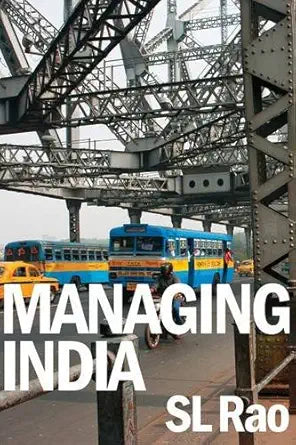
Managing India
S.L. Rao
About the Book
This book considers what we must do to make India a consistently improving socio-economy. Despite many creative ideas from dedicated leaders, we remain a very poor country.
There is little manufacturing, a stumbling agriculture, and around 300 million or so people with limited access to food, none to electricity and practically none to health and education. The primary reason for this is poor implementation of good ideas and policies. Effective implementation requires an understanding of the environment (political, social and economic), institutions and how they work, clear output targets, and systems to monitor, implement and change course when necessary. This is what good management is all about. India has not lacked in ideas for improving the economy and the society, but in managing them. The book looks at the context and suggests actions in different areas to improve the management of India.
About the Author(s) / Editor(s)
S.L Rao has spent 33 years in senior positions in multinational companies (HUL, Warner Lambert and Beardsell) and as independent management consultant. He was President, All India Management Association (1985); Executive Chairman, National Management Programme (1986-1988); Director-General, National Council of Applied Economic Research (1990-1996) and first Chairman of Central Electricity Regulatory Commission (1998-2001).
He is presently a columnist in the Deccan Herald (Bangalore), the Financial Express, and the Telegraph (Calcutta), apart from other publications.
He is Distinguished Fellow Emeritus at TERI. For many years, his influential column “ECOPINION” appeared in the Economic Times.
He has authored/edited 15 books, written many papers and hundreds of articles on economy, management, energy and governance.
His earlier book is titled Powering India: A Decade of Policies and Regulation (Academic Foundation, 2011).
Contents in Detail
| Publisher | AF Press |
| Publication Date | 2015 |
| Number of Pages | 244 |
| ISBN |
9789332703056 |
Academic Foundation (AF), based in New Delhi, is India’s leading independent publisher of academic/scholarly books in Social Sciences, specialising in Economics—Development Economics and Indian Economy in particular, and allied subjects.
About the Book
This book considers what we must do to make India a consistently improving socio-economy. Despite many creative ideas from dedicated leaders, we remain a very poor country.
There is little manufacturing, a stumbling agriculture, and around 300 million or so people with limited access to food, none to electricity and practically none to health and education. The primary reason for this is poor implementation of good ideas and policies. Effective implementation requires an understanding of the environment (political, social and economic), institutions and how they work, clear output targets, and systems to monitor, implement and change course when necessary. This is what good management is all about. India has not lacked in ideas for improving the economy and the society, but in managing them. The book looks at the context and suggests actions in different areas to improve the management of India.
About the Author(s) / Editor(s)
S.L Rao has spent 33 years in senior positions in multinational companies (HUL, Warner Lambert and Beardsell) and as independent management consultant. He was President, All India Management Association (1985); Executive Chairman, National Management Programme (1986-1988); Director-General, National Council of Applied Economic Research (1990-1996) and first Chairman of Central Electricity Regulatory Commission (1998-2001).
He is presently a columnist in the Deccan Herald (Bangalore), the Financial Express, and the Telegraph (Calcutta), apart from other publications.
He is Distinguished Fellow Emeritus at TERI. For many years, his influential column “ECOPINION” appeared in the Economic Times.
He has authored/edited 15 books, written many papers and hundreds of articles on economy, management, energy and governance.
His earlier book is titled Powering India: A Decade of Policies and Regulation (Academic Foundation, 2011).
Contents in Detail
| Publisher | AF Press |
| Publication Date | 2015 |
| Number of Pages | 244 |
| ISBN |
9789332703056 |

Couldn't load pickup availability
Share
-

Curated Collections By AF Press
-

Premium Print Quality
-

Author-Centric Publishing
-

Trusted by Readers Nationwide


Managing India