


Aadhaar
Govind Kelkar‚ Dev Nathan‚ E. Revathi‚ Swati Sain Gupta
About the Book
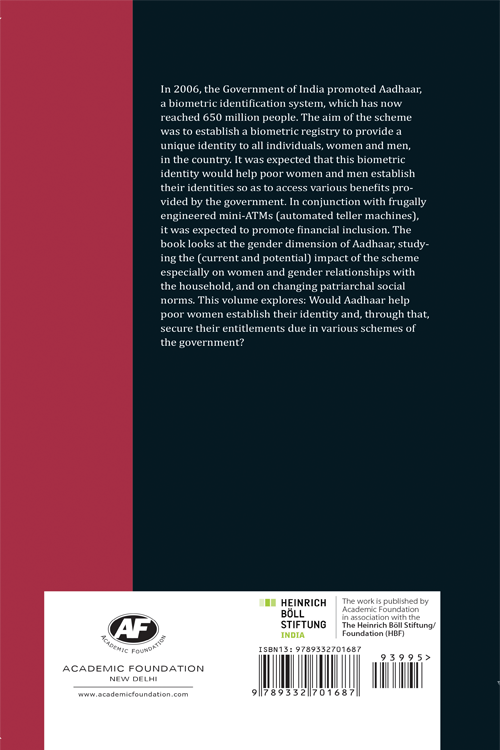
In 2006, the Government of India promoted Aadhaar, a biometric identification system, which has now reached 650 million people. The aim of the scheme was to establish a biometric registry to provide a unique identity to all individuals, women and men, in the country.
It was expected that this biometric identity would help poor women and men establish their identities so as to access various benefits provided by the government. In conjunction with frugally engineered mini-ATMs (automated teller machines), it was expected to promote financial inclusion. The book looks at the gender dimension of Aadhaar, studying the (current and potential) impact of the scheme especially on women and gender relationships with the household, and on changing patriarchal social norms. This volume explores: Would Aadhaar help poor women establish their identity and, through that, secure their entitlements due in various schemes of the government?
About the Author(s) / Editor(s)
Govind Kelkar is a senior advisor to Landesa, India. She formerly headed Women’s Economic Empowerment Unit at UN Women, South Asia Office, New Delhi. She has authored and co-authored 12 books, 48 research papers, and has been a founder-editor of Gender, Technology and Development Journal.
Dev Nathan is professor at the Institute for Human Development, Delhi and Visiting Research Fellow at Duke University, USA. He is also an editor of the series: Development Trajectories in Global Value Chains.
E. Revathi is Professor at the Centre for Economic and Social Studies (CESS), Hyderabad, Telangana State. Her areas of research are: development studies, agriculture, gender studies and regional inequalities, with attention to land and women’s empowerment.
Swati Sain Gupta is an international development professional who has worked in and led several development organisations in Latin America, Europe and India. Currently she coordinates PLATFORMA, the network of European local and regional governments.
Contents in Detail
List of Abbreviations
Preface
Acknowledgements
1. Introduction
Background
What is Aadhaar?
Enrolment
Biometric Identification System
Women’s Independent Identity with Aadhaar
2. Need for Identification
3. Women’s Autonomous Identity and Agency
4. Aadhaar Implementation in Andhra Pradesh
Aadhaar-Enabled Payment Systems
Aadhaar in the Context of Gender Relations
Women’s Identity and Empowerment
5. Aadhaar Implementation in Jharkhand
Aadhaar Project in the State
Aadhaar Enrolment Status in the Field
Fieldwork Sites
Aadhaar in the Context of Gender Relations
Aadhaar Awareness and Wage Payments
6. Aadhaar Identity and Access to Public Services
Financial Inclusion
Access to Public Services
MGNREGS Payments
Questioning Aadhaar Technology
Necessary Safeguards
7. Efficiency: Service Providers and Service Receivers
Cash Transfers/DBTs and Subsidies
Migration
Costs and Benefits of Aadhaar
8. Two Types of Convergence and a Third
Formalisation of Rights
9. Identity, Equality and Empowerment
Identity Construction and Changes in Gendered Structures
Gender Factor in Aadhaar Enrolment
Awareness about Aadhaar Identity
10. Conclusions: Improving Women’ Capabilities
with Identity and Technoogy
References
| Publisher | AF Press |
| Publication Date | 2014 |
| Number of Pages | 112 |
| ISBN |
9789332701687 |
Academic Foundation (AF), based in New Delhi, is India’s leading independent publisher of academic/scholarly books in Social Sciences, specialising in Economics—Development Economics and Indian Economy in particular, and allied subjects.
About the Book
In 2006, the Government of India promoted Aadhaar, a biometric identification system, which has now reached 650 million people. The aim of the scheme was to establish a biometric registry to provide a unique identity to all individuals, women and men, in the country.
It was expected that this biometric identity would help poor women and men establish their identities so as to access various benefits provided by the government. In conjunction with frugally engineered mini-ATMs (automated teller machines), it was expected to promote financial inclusion. The book looks at the gender dimension of Aadhaar, studying the (current and potential) impact of the scheme especially on women and gender relationships with the household, and on changing patriarchal social norms. This volume explores: Would Aadhaar help poor women establish their identity and, through that, secure their entitlements due in various schemes of the government?
About the Author(s) / Editor(s)
Govind Kelkar is a senior advisor to Landesa, India. She formerly headed Women’s Economic Empowerment Unit at UN Women, South Asia Office, New Delhi. She has authored and co-authored 12 books, 48 research papers, and has been a founder-editor of Gender, Technology and Development Journal.
Dev Nathan is professor at the Institute for Human Development, Delhi and Visiting Research Fellow at Duke University, USA. He is also an editor of the series: Development Trajectories in Global Value Chains.
E. Revathi is Professor at the Centre for Economic and Social Studies (CESS), Hyderabad, Telangana State. Her areas of research are: development studies, agriculture, gender studies and regional inequalities, with attention to land and women’s empowerment.
Swati Sain Gupta is an international development professional who has worked in and led several development organisations in Latin America, Europe and India. Currently she coordinates PLATFORMA, the network of European local and regional governments.
Contents in Detail
List of Abbreviations
Preface
Acknowledgements
1. Introduction
Background
What is Aadhaar?
Enrolment
Biometric Identification System
Women’s Independent Identity with Aadhaar
2. Need for Identification
3. Women’s Autonomous Identity and Agency
4. Aadhaar Implementation in Andhra Pradesh
Aadhaar-Enabled Payment Systems
Aadhaar in the Context of Gender Relations
Women’s Identity and Empowerment
5. Aadhaar Implementation in Jharkhand
Aadhaar Project in the State
Aadhaar Enrolment Status in the Field
Fieldwork Sites
Aadhaar in the Context of Gender Relations
Aadhaar Awareness and Wage Payments
6. Aadhaar Identity and Access to Public Services
Financial Inclusion
Access to Public Services
MGNREGS Payments
Questioning Aadhaar Technology
Necessary Safeguards
7. Efficiency: Service Providers and Service Receivers
Cash Transfers/DBTs and Subsidies
Migration
Costs and Benefits of Aadhaar
8. Two Types of Convergence and a Third
Formalisation of Rights
9. Identity, Equality and Empowerment
Identity Construction and Changes in Gendered Structures
Gender Factor in Aadhaar Enrolment
Awareness about Aadhaar Identity
10. Conclusions: Improving Women’ Capabilities
with Identity and Technoogy
References
| Publisher | AF Press |
| Publication Date | 2014 |
| Number of Pages | 112 |
| ISBN |
9789332701687 |

Couldn't load pickup availability
Share

-

Curated Collections By AF Press
-

Premium Print Quality
-

Author-Centric Publishing
-

Trusted by Readers Nationwide


Aadhaar