

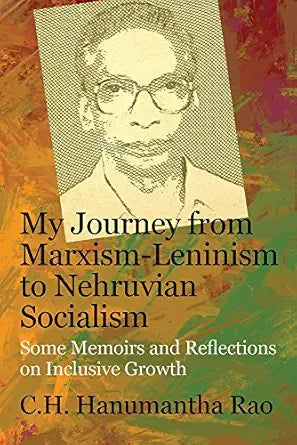
My Journey from Marxism-Leninism to Nehruvian Socialism
C.H. HANUMANTHA Rao
About the Book
This insightful and inspiring book by C.H. Hanumantha Rao portrays the socioeconomic situation and participation of the author in the major events since the mid-1940s focusing on the ideological struggle experienced by him, and on development policies and strategies. The changes in the author’s outlook from a Marxist in his student days to a Nehruvian have been marked by serious introspections in the light of contending ideological positions. He discusses issues he faced as member, Planning Commission, under the leadership of Prime Ministers Mrs Indira Gandhi and Shri Rajiv Gandhi, relating to economic planning and policies in India in the light of the Nehruvian perspective of a mixed economy with socialist orientation within a democratic set-up where private sector and markets have a significant place. Globalisation and economic reforms in India in the wake of the breakdown of centralised planning in the former socialist countries and the relevance of Nehruvian model for evolving a balanced approach to reforms by addressing the problems of poverty and inequality are discussed in detail. It also includes his essays on ‘inclusive growth’ written over the last three years.
An informed memoir by one of the most respected and eminent economist of modern India, the book would be of interest to university teachers, policy makers, legislators, students as well as general readers.
Praise for this book
Delighted that responding to our urging, Professor Rao penned his memoirs: several fascinating journeys; for example, from a Princely State to free India, from Bharath to India; from a communist to a liberal pragmatist; from a single state for Telugus to bifurcation. Forthright and matter of fact in the narration, the book reflects the personality of the author—a scholar with a kind heart, generosity, integrity and dignity. An informative, inspiring and insightful book—a valuable addition to literature on India @ 70.
—Dr Y. Venugopal Reddy, Former Governor, Reserve Bank of India.
C.H. Hanumantha Rao is a distinguished economist and a committed scholar, enriched by time spent in the public policy domain, who has devoted his professional lifetime to the study of India. This book is about his ideological and intellectual journey over seven decades, which also provides a perceptive analysis of economy, polity and society in India since independence. There are two essential messages that emerge: the concern for efficiency must be balanced with a concern for equity, just as the quest for economic growth must be balanced with a quest for social development; growth can be inclusive only if it creates employment and improves the wellbeing of people. It is an engaging read which should be of interest to teachers, students and researchers in economics, as well as policymakers in development.
—Deepak Nayyar, Emeritus Professor of Economics, Jawaharlal Nehru University, New Delhi, Former Chief Economic Adviser, Government of India, and former Vice Chancellor, University of Delhi.
Most fascinating story of an academician engaged in practical encounter with India’s economic development, tracing paradigm shift from a Nehruvian socialism, to globalisation and economic reforms, down to socially inclusive pro-poor growth to deal with poverty, and inequality. Deeply insightful with a lesson to avoid two extreme on the left and the right, and relevance of balanced approach.
—Sukhadeo Thorat, Professor Emeritus, Centre for the Study of Regional Development, School of Social Sciences, Jawaharlal Nehru University, New Delhi; Managing Trustee, Indian Institute of Dalit Studies, New Delhi; Former Chairman of University Grants Commission, and Indian Council of Social Science Research.
About the Author(s) / Editor(s)
C.H. Hanumantha Rao holds a PhD from the Delhi School of Economics, University of Delhi (1962). He was Post-Doctoral Fellow, Department of Economics, University of Chicago (1966-67) and Fellow, Institute of Economic Growth, University of Delhi (1961-1992). He has been Hon. Professor, Centre for Economic and Social Studies, Hyderabad since 1992. His areas of interest are: Agricultural Economics, Development Planning and Policy. He has been a member of the Planning Commission, Finance Commission, on the Board of Directors of the RBI; Member, National Advisory Council; and Chancellor, University of Hyderabad. He was awarded ‘Padma Bhushan’ by the President of India in 2004 in the field of literature and education.
Contents in Detail
| Publisher | AF Press |
| Publication Date | 2018 |
| Number of Pages | 310 |
| ISBN |
9789332704350 |
Academic Foundation (AF), based in New Delhi, is India’s leading independent publisher of academic/scholarly books in Social Sciences, specialising in Economics—Development Economics and Indian Economy in particular, and allied subjects.
About the Book
This insightful and inspiring book by C.H. Hanumantha Rao portrays the socioeconomic situation and participation of the author in the major events since the mid-1940s focusing on the ideological struggle experienced by him, and on development policies and strategies. The changes in the author’s outlook from a Marxist in his student days to a Nehruvian have been marked by serious introspections in the light of contending ideological positions. He discusses issues he faced as member, Planning Commission, under the leadership of Prime Ministers Mrs Indira Gandhi and Shri Rajiv Gandhi, relating to economic planning and policies in India in the light of the Nehruvian perspective of a mixed economy with socialist orientation within a democratic set-up where private sector and markets have a significant place. Globalisation and economic reforms in India in the wake of the breakdown of centralised planning in the former socialist countries and the relevance of Nehruvian model for evolving a balanced approach to reforms by addressing the problems of poverty and inequality are discussed in detail. It also includes his essays on ‘inclusive growth’ written over the last three years.
An informed memoir by one of the most respected and eminent economist of modern India, the book would be of interest to university teachers, policy makers, legislators, students as well as general readers.
Praise for this book
Delighted that responding to our urging, Professor Rao penned his memoirs: several fascinating journeys; for example, from a Princely State to free India, from Bharath to India; from a communist to a liberal pragmatist; from a single state for Telugus to bifurcation. Forthright and matter of fact in the narration, the book reflects the personality of the author—a scholar with a kind heart, generosity, integrity and dignity. An informative, inspiring and insightful book—a valuable addition to literature on India @ 70.
—Dr Y. Venugopal Reddy, Former Governor, Reserve Bank of India.
C.H. Hanumantha Rao is a distinguished economist and a committed scholar, enriched by time spent in the public policy domain, who has devoted his professional lifetime to the study of India. This book is about his ideological and intellectual journey over seven decades, which also provides a perceptive analysis of economy, polity and society in India since independence. There are two essential messages that emerge: the concern for efficiency must be balanced with a concern for equity, just as the quest for economic growth must be balanced with a quest for social development; growth can be inclusive only if it creates employment and improves the wellbeing of people. It is an engaging read which should be of interest to teachers, students and researchers in economics, as well as policymakers in development.
—Deepak Nayyar, Emeritus Professor of Economics, Jawaharlal Nehru University, New Delhi, Former Chief Economic Adviser, Government of India, and former Vice Chancellor, University of Delhi.
Most fascinating story of an academician engaged in practical encounter with India’s economic development, tracing paradigm shift from a Nehruvian socialism, to globalisation and economic reforms, down to socially inclusive pro-poor growth to deal with poverty, and inequality. Deeply insightful with a lesson to avoid two extreme on the left and the right, and relevance of balanced approach.
—Sukhadeo Thorat, Professor Emeritus, Centre for the Study of Regional Development, School of Social Sciences, Jawaharlal Nehru University, New Delhi; Managing Trustee, Indian Institute of Dalit Studies, New Delhi; Former Chairman of University Grants Commission, and Indian Council of Social Science Research.
About the Author(s) / Editor(s)
C.H. Hanumantha Rao holds a PhD from the Delhi School of Economics, University of Delhi (1962). He was Post-Doctoral Fellow, Department of Economics, University of Chicago (1966-67) and Fellow, Institute of Economic Growth, University of Delhi (1961-1992). He has been Hon. Professor, Centre for Economic and Social Studies, Hyderabad since 1992. His areas of interest are: Agricultural Economics, Development Planning and Policy. He has been a member of the Planning Commission, Finance Commission, on the Board of Directors of the RBI; Member, National Advisory Council; and Chancellor, University of Hyderabad. He was awarded ‘Padma Bhushan’ by the President of India in 2004 in the field of literature and education.
Contents in Detail
| Publisher | AF Press |
| Publication Date | 2018 |
| Number of Pages | 310 |
| ISBN |
9789332704350 |

Couldn't load pickup availability
Share
-

Curated Collections By AF Press
-

Premium Print Quality
-

Author-Centric Publishing
-

Trusted by Readers Nationwide


My Journey from Marxism-Leninism to N...