

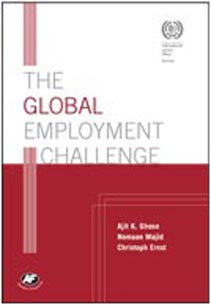
The Global Employment Challenge
Ajit K. Ghose‚ Nomann Majid‚ Christoph Ernst
About the Book
The world faces a huge challenge of creating productive jobs for its expanding labour force. Unlike the challenge of sustaining global economic growth or that of correcting global trade imbalances, this global employment challenge is barely recognized and its nature and magnitude are certainly not well understood. Indeed, there is a widespread (though rarely stated) belief that even in an era of globalization employment remains a national concern, so that there can be no such thing as a global employment challenge. Yet the employment challenge today is global in several important respects. Inadequate availability of productive jobs is now a worldwide phenomenon. Global forces – cross-border flows of trade, capital and labour – have significant con - sequences for employment in individual countries. Also, international policies are now as important as national policies for expanding opportunities for productive employment in less developed countries, which is where most of the world’s workers live and where almost all of the world’s new workers will live.
This study is about the nature and magnitude of the global employment challenge and about ways of meeting that challenge. It seeks to provide (i) an assessment of the current state of employment in the world, (ii) a review of the developments since 1990, (iii) an analysis of the interactions among structural factors, global forces and national policies that explain those developments, and (iv) a perspective on the policy responses required from the international community and national governments.
The International Labour Organization :
The International Labour Organization was founded in 1919 to promote social justice and, thereby, to contribute to universal and lasting peace. Its tripartite structure is unique among agencies affiliated to the United Nations; the ILO's Governing Body includes representatives of governments, and of employers' and workers' organizations. These three constituencies are active participants in regional and other meetings sponsored by the ILO, as well as in the International Labour Conference a world forum that meets annually to discuss social and labour questions.
Over the years the ILO has issued for adoption by member States a widely respected code of international labour Conventions and Recommendations on freedom of association, employment, social policy, conditions of work, social security, industrial relations and labour administration, and child labour, among others.
The ILO provides expert advice and technical assistance to member States through a network of offices and multidisciplinary teams in over 40 countries. This assistance takes the form of labour rights and industrial relations counselling, employment promotion, training in small business development, project management, advice on social security, workplace safety and working conditions, the compiling and dissemination of labour statistics, and workers' education.
About the Author(s) / Editor(s)
Ajit K. Ghosh
Nomann Majid
Chiristoph Ernst
Contents in Detail
| Publisher | AF Press |
| Publication Date | 2008 |
| Number of Pages | 290 |
| ISBN |
9788171887019 |
Academic Foundation (AF), based in New Delhi, is India’s leading independent publisher of academic/scholarly books in Social Sciences, specialising in Economics—Development Economics and Indian Economy in particular, and allied subjects.
About the Book
The world faces a huge challenge of creating productive jobs for its expanding labour force. Unlike the challenge of sustaining global economic growth or that of correcting global trade imbalances, this global employment challenge is barely recognized and its nature and magnitude are certainly not well understood. Indeed, there is a widespread (though rarely stated) belief that even in an era of globalization employment remains a national concern, so that there can be no such thing as a global employment challenge. Yet the employment challenge today is global in several important respects. Inadequate availability of productive jobs is now a worldwide phenomenon. Global forces – cross-border flows of trade, capital and labour – have significant con - sequences for employment in individual countries. Also, international policies are now as important as national policies for expanding opportunities for productive employment in less developed countries, which is where most of the world’s workers live and where almost all of the world’s new workers will live.
This study is about the nature and magnitude of the global employment challenge and about ways of meeting that challenge. It seeks to provide (i) an assessment of the current state of employment in the world, (ii) a review of the developments since 1990, (iii) an analysis of the interactions among structural factors, global forces and national policies that explain those developments, and (iv) a perspective on the policy responses required from the international community and national governments.
The International Labour Organization :
The International Labour Organization was founded in 1919 to promote social justice and, thereby, to contribute to universal and lasting peace. Its tripartite structure is unique among agencies affiliated to the United Nations; the ILO's Governing Body includes representatives of governments, and of employers' and workers' organizations. These three constituencies are active participants in regional and other meetings sponsored by the ILO, as well as in the International Labour Conference a world forum that meets annually to discuss social and labour questions.
Over the years the ILO has issued for adoption by member States a widely respected code of international labour Conventions and Recommendations on freedom of association, employment, social policy, conditions of work, social security, industrial relations and labour administration, and child labour, among others.
The ILO provides expert advice and technical assistance to member States through a network of offices and multidisciplinary teams in over 40 countries. This assistance takes the form of labour rights and industrial relations counselling, employment promotion, training in small business development, project management, advice on social security, workplace safety and working conditions, the compiling and dissemination of labour statistics, and workers' education.
About the Author(s) / Editor(s)
Ajit K. Ghosh
Nomann Majid
Chiristoph Ernst
Contents in Detail
| Publisher | AF Press |
| Publication Date | 2008 |
| Number of Pages | 290 |
| ISBN |
9788171887019 |

Couldn't load pickup availability
Share
-

Curated Collections By AF Press
-

Premium Print Quality
-

Author-Centric Publishing
-

Trusted by Readers Nationwide


The Global Employment Challenge