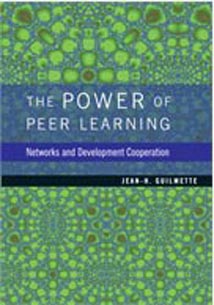
The Power of Peer Learning
Networks and Development Cooperation
Jean-h Guilmette
Networks and Development Cooperation
About the Book
An ancient Chinese proverb tells us “Give a man a fish and you feed him for a day. Teach a man to fish and you feed him for a lifetime.” The same can be said for development assistance. Solutions provided by outside “experts” are often rejected or politely shelved. However, solutions based on the principle of “self-help” are far more likely to take root.
This book explores the self-help, peer learning approach of the Organisation for Economic Co-operation and Development (OECD), comparing it with that of IDRC. It focuses on the importance of networks to development and growth, and demonstrates that network management is fundamentally different from the management of companies, organizations, or other bodies that fall under a single authority.
The book will be of interest to planners, policymakers, and researchers in the industrialised and developing worlds, and particularly in the new and emerging democracies of Eastern Europe.
About the Author(s) / Editor(s)
Jean-H. Guilmette served as the Director of IDRC’s division for Central and Eastern Europe initiatives from 1995 to 2005. He is former Executive Director of the African Development Bank, Director of the OECD’s Sahel Club, and Director General of the Strategic Planning Unit in the Africa and Middle-East branch of the Canadian International Development Agency.
Contents in Detail
List of Tables and Boxes
Foreword
Preface
Acknowledgements
Acronyms and Abbreviations
1. The Conceptual Framework
Section 1: Alliances and Cooperation:Emergence
of a New Post-War Paradigm
1.1 Fifteen Hundred Years of War
1.2 Five Characteristics of the New Paradigm
1.3 Overall Impact of the New Paradigm
1.4 Role of Human Rights and Democratic Governance
in Functioning of OECD Methodologies
Section 2: From Paradigm Shift to Institutional Activities
2.1 Multilateral Organizations with Universal Membership
2.2 International and Regional Organizations
with Limited Membership
2.3 The North Atlantic Treaty Organization (NATO)
2.4 International Policy Regimes and
Coordinating Institutions
Section 3: International Development Cooperation
3.1 The Marshall Plan
3.2 The Colombo Plan
3.3 Official Development Assistance (ODA)
3.4 Aid and the International Projection of Ideas
3.5 Aid Volumes and Impact
Section 4: The Cooperation Paradigm and the
Former Eastern Bloc
4.1 The ‘Magic’ of the Market
4.2 Reform: A Complex, Multifaceted Process
4.3 Need for New and Relevant Aid Instruments
Section 5: Relevance of the IDRC and OECD Experience
to Eastern European Countries
2. Development and Networks as Instruments for Change
Section 1: Experiences in Development
1.1 Lessons Learned from the Japanese Experience
Section 2: Era of Cooperative Undertakings
2.1 Informal Networks
2.2 Multinational and Formal Networks
Section 3: The Case of Former Soviet Countries
Section 4: Scientific Networks: IDRC Experience
Part 1: IDRC and Scientific Networks
4.1.1 Background
4.1.2 IDRC’s Legal Foundation
4.1.3 IDRC’s Vision
4.1.4 IDRC’s Methodology
4.1.5 Assessing IDRC Sponsored Networks
4.1.6 Linkage between Research, Networks
and Policy Setting
Part 2: IDRC and the Dnieper River
4.2.1 Introduction
4.2.2 Learning to Work in Terra Incognita
Section 5: Components of the EMDU Program
and Immediate Results
5.1 Water Pollution Control
Section 6: Effects of the Program on Policy Formulation
6.1 Expanding Policy Capacities
6.2 Program’s Impact
Section 7: Moving Toward Regional Networks and
Management of the GEF Program
3. OECD’s Basic Rules of Conduct—A Sociology
of its Institutional Culture
Introduction
Section 1: Foundations of the OECD’s Institutional Culture
1.1 Historical Background
1.2 OECD’s Basic Rules of Conduct or the Values
of the Institution
1.3 OECD Structure and Functions
1.4 Economics Department
1.5 OECD’s Basic Rules of Conduct
1.6 OECD’s ‘Etiquette’ or Unwritten Behavioural Principles
Section 2: A Network Driven by Peer Pressure
2.1 Peer Pressure
Section 3: Consensual Discipline and Dynamic Tension
3.1 Maintaining Balance
3.2 Mechanisms for Softening the Rigours of Consensus
Section 4: Policy Process, Blending Negotiations and Research
4.1 Defining a Common Agenda through ‘Preliminary Inquiry’
4.2 Establishing Reliable and Comparable Databases
4.3 Analyzing the Data
4.5 Forecasting
4.6 Recommendations
4.7 Peer Review
Section 5: Supportive Policies
5.1 Personnel Policy
5.2 Role of a ‘Wise Director’
5.3 Publication Policy
Section 6: Adapting the OECD Methodology to a
New Cultural Environment
6.1 Respect for Essential Linkages
6.2 Introduction of New Values
Section 7: Summary and Conclusions
4. OECD Techniques for Managing the Iterative Policy Process within a Multicultural Environment
Section 1: The Policy Process
1.1 What is a ‘Policy’?
1.2 OECD Influence in National Policy Drafting
Section 2: Arriving at Policy Consensus within a Cross-Cultural Environment
2.1 Development and Culture
2.2 The Balance of Social Systems: Weights, Drifts and Counterweights
2.3 Bonthous’ Four Key Dimensions for Gathering Intelligence
2.4 Defining a ‘Story Line’
Section 3: Managing the Negotiation Process
3.1 Roles Ascribed to Various Actors
Section 4: Syntax for Key Documents
4.1 The Annotated Agenda
4.2 The Syntax for Summary Record
4.3 The Syntax of the Communiqué
4.4 The Syntax of Peer Reviews
Section 5: Organization of Meetings: From Workshops and Seminars to Committees and Plenary
5.1 Expectations and Results
5.2 The Agenda as a Management Tool
5.3 Time Management
5.4 Real Cost of an International Seminar
5.5 Managing Workshop Meetings: Room Set-up
5. Why Does it Work?
Section 1: OECD and Complexity
1.1 The Nature of Complexity
1.2 Complexity, Diversity and Adaptation
1.3 The Creation of OECD: An Injection of Simplicity and Intelligence
Section 2: Examples of What Works and What Doesn’t
2.1 OECD and Health: Facing Complexity
2.2 The Bribery Convention, an Unambiguous Success Story
3.3 The Multilateral Agreement on Investment (MAI), A bridge too far…
3.4 The Club du Sahel: A Unique Experiment
Section 3: Conclusion
Post Face: This Leaves a Few Haunting Questions
Appendix: Glossary
References
| Publisher | AF Press |
| Publication Date | 2007 |
| Number of Pages | 258 |
| ISBN |
8171886221 |
Academic Foundation (AF), based in New Delhi, is India’s leading independent publisher of academic/scholarly books in Social Sciences, specialising in Economics—Development Economics and Indian Economy in particular, and allied subjects.
About the Book
An ancient Chinese proverb tells us “Give a man a fish and you feed him for a day. Teach a man to fish and you feed him for a lifetime.” The same can be said for development assistance. Solutions provided by outside “experts” are often rejected or politely shelved. However, solutions based on the principle of “self-help” are far more likely to take root.
This book explores the self-help, peer learning approach of the Organisation for Economic Co-operation and Development (OECD), comparing it with that of IDRC. It focuses on the importance of networks to development and growth, and demonstrates that network management is fundamentally different from the management of companies, organizations, or other bodies that fall under a single authority.
The book will be of interest to planners, policymakers, and researchers in the industrialised and developing worlds, and particularly in the new and emerging democracies of Eastern Europe.
About the Author(s) / Editor(s)
Jean-H. Guilmette served as the Director of IDRC’s division for Central and Eastern Europe initiatives from 1995 to 2005. He is former Executive Director of the African Development Bank, Director of the OECD’s Sahel Club, and Director General of the Strategic Planning Unit in the Africa and Middle-East branch of the Canadian International Development Agency.
Contents in Detail
List of Tables and Boxes
Foreword
Preface
Acknowledgements
Acronyms and Abbreviations
1. The Conceptual Framework
Section 1: Alliances and Cooperation:Emergence
of a New Post-War Paradigm
1.1 Fifteen Hundred Years of War
1.2 Five Characteristics of the New Paradigm
1.3 Overall Impact of the New Paradigm
1.4 Role of Human Rights and Democratic Governance
in Functioning of OECD Methodologies
Section 2: From Paradigm Shift to Institutional Activities
2.1 Multilateral Organizations with Universal Membership
2.2 International and Regional Organizations
with Limited Membership
2.3 The North Atlantic Treaty Organization (NATO)
2.4 International Policy Regimes and
Coordinating Institutions
Section 3: International Development Cooperation
3.1 The Marshall Plan
3.2 The Colombo Plan
3.3 Official Development Assistance (ODA)
3.4 Aid and the International Projection of Ideas
3.5 Aid Volumes and Impact
Section 4: The Cooperation Paradigm and the
Former Eastern Bloc
4.1 The ‘Magic’ of the Market
4.2 Reform: A Complex, Multifaceted Process
4.3 Need for New and Relevant Aid Instruments
Section 5: Relevance of the IDRC and OECD Experience
to Eastern European Countries
2. Development and Networks as Instruments for Change
Section 1: Experiences in Development
1.1 Lessons Learned from the Japanese Experience
Section 2: Era of Cooperative Undertakings
2.1 Informal Networks
2.2 Multinational and Formal Networks
Section 3: The Case of Former Soviet Countries
Section 4: Scientific Networks: IDRC Experience
Part 1: IDRC and Scientific Networks
4.1.1 Background
4.1.2 IDRC’s Legal Foundation
4.1.3 IDRC’s Vision
4.1.4 IDRC’s Methodology
4.1.5 Assessing IDRC Sponsored Networks
4.1.6 Linkage between Research, Networks
and Policy Setting
Part 2: IDRC and the Dnieper River
4.2.1 Introduction
4.2.2 Learning to Work in Terra Incognita
Section 5: Components of the EMDU Program
and Immediate Results
5.1 Water Pollution Control
Section 6: Effects of the Program on Policy Formulation
6.1 Expanding Policy Capacities
6.2 Program’s Impact
Section 7: Moving Toward Regional Networks and
Management of the GEF Program
3. OECD’s Basic Rules of Conduct—A Sociology
of its Institutional Culture
Introduction
Section 1: Foundations of the OECD’s Institutional Culture
1.1 Historical Background
1.2 OECD’s Basic Rules of Conduct or the Values
of the Institution
1.3 OECD Structure and Functions
1.4 Economics Department
1.5 OECD’s Basic Rules of Conduct
1.6 OECD’s ‘Etiquette’ or Unwritten Behavioural Principles
Section 2: A Network Driven by Peer Pressure
2.1 Peer Pressure
Section 3: Consensual Discipline and Dynamic Tension
3.1 Maintaining Balance
3.2 Mechanisms for Softening the Rigours of Consensus
Section 4: Policy Process, Blending Negotiations and Research
4.1 Defining a Common Agenda through ‘Preliminary Inquiry’
4.2 Establishing Reliable and Comparable Databases
4.3 Analyzing the Data
4.5 Forecasting
4.6 Recommendations
4.7 Peer Review
Section 5: Supportive Policies
5.1 Personnel Policy
5.2 Role of a ‘Wise Director’
5.3 Publication Policy
Section 6: Adapting the OECD Methodology to a
New Cultural Environment
6.1 Respect for Essential Linkages
6.2 Introduction of New Values
Section 7: Summary and Conclusions
4. OECD Techniques for Managing the Iterative Policy Process within a Multicultural Environment
Section 1: The Policy Process
1.1 What is a ‘Policy’?
1.2 OECD Influence in National Policy Drafting
Section 2: Arriving at Policy Consensus within a Cross-Cultural Environment
2.1 Development and Culture
2.2 The Balance of Social Systems: Weights, Drifts and Counterweights
2.3 Bonthous’ Four Key Dimensions for Gathering Intelligence
2.4 Defining a ‘Story Line’
Section 3: Managing the Negotiation Process
3.1 Roles Ascribed to Various Actors
Section 4: Syntax for Key Documents
4.1 The Annotated Agenda
4.2 The Syntax for Summary Record
4.3 The Syntax of the Communiqué
4.4 The Syntax of Peer Reviews
Section 5: Organization of Meetings: From Workshops and Seminars to Committees and Plenary
5.1 Expectations and Results
5.2 The Agenda as a Management Tool
5.3 Time Management
5.4 Real Cost of an International Seminar
5.5 Managing Workshop Meetings: Room Set-up
5. Why Does it Work?
Section 1: OECD and Complexity
1.1 The Nature of Complexity
1.2 Complexity, Diversity and Adaptation
1.3 The Creation of OECD: An Injection of Simplicity and Intelligence
Section 2: Examples of What Works and What Doesn’t
2.1 OECD and Health: Facing Complexity
2.2 The Bribery Convention, an Unambiguous Success Story
3.3 The Multilateral Agreement on Investment (MAI), A bridge too far…
3.4 The Club du Sahel: A Unique Experiment
Section 3: Conclusion
Post Face: This Leaves a Few Haunting Questions
Appendix: Glossary
References
| Publisher | AF Press |
| Publication Date | 2007 |
| Number of Pages | 258 |
| ISBN |
8171886221 |
Couldn't load pickup availability
Share
-
Curated Collections By AF Press
-
Premium Print Quality
-
Author-Centric Publishing
-
Trusted by Readers Nationwide
The Power of Peer Learning