

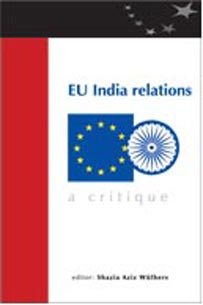
EU India relations
Shazia Aziz Wülbers (Ed.)
About the Book
India and the European Union have stepped up efforts to improve relations, especially since the first EU India Summit of 2000. However, there seems to be a growing gap between their expectations from each other in most areas and their perceptions of the world order. What are the reasons for this state of affairs? Do they have the capacity to become ‘strategic partners’ in the near future? Will India prefer the US to the EU after the implementation of the India-US nuclear deal? Would the EU and India be able to settle their differences on human rights issues? ... Read inside what distinguished scholars and experts have to say.
About the Author(s) / Editor(s)
Shazia Aziz Wülbers Editor of EuroIndia Publications and Board member of the EuroIndia Centre. She is also attached to Centre of International Research and Studies at Sciences Po.
Contributors
Annegret Bendiek
Research Associate, German Institute for International and Security Affairs Berlin, Germany.
Surya Kumar Bose
Director, Bose Information Technology, Hamburg, Germany and member of EuroIndia Centre.
Anne Coulon
Deputy Team leader in New Delhi, India on the EU project titled “EU India Trade and Investment Development Programme”. She is also attached to the Centre for European Studies at the University of Limerick, Ireland.
Rajendra K. Jain
Professor and Director, Europe Area Studies Programme, Centre for European Studies, School of International Studies, Jawaharlal Nehru University, New Delhi.
Sateesh Kulkarni
Director, Corporate Catalyst India Pvt Ltd., New Delhi, India.
C. Raja Mohan
India’s leading Foreign and Security Analyst and Professor at the S. Rajaratnam School of International Studies at Nanyang Technological University, Singapore.
Sudhanshu Rai
Department of Informatics, Copenhagen Business School, Frederiksberg, Denmark, and member of EuroIndia Centre.
Clemens Spiess
Lecturer, South Asia Institute, University of Heidelberg, Germany and former Country Director of the Böll Foundation, New Delhi, India.
Mario Telo
Director, Institut d’Etudes Européennes, Université Libre de Bruxelles and founder member of European Commission’s Garnet network of excellence.
Klaus Julian Voll
Head, India-Europe-Consultancy; former diplomat in the German Embassy in New Delhi and Representative of the Friedrich-Ebert-Foundation in India.
Christian Wagner
Senior Research Associate, German Institute for International and Security Affairs, Berlin, Germany.
Hans Georg Wieck
Chairman, German India Society and Advisory Council of Intelligence Round Table.
Contents in Detail
| Publisher | AF Press |
| Publication Date | 2008 |
| Number of Pages | 200 |
| ISBN |
9788171886968 |
Academic Foundation (AF), based in New Delhi, is India’s leading independent publisher of academic/scholarly books in Social Sciences, specialising in Economics—Development Economics and Indian Economy in particular, and allied subjects.
About the Book
India and the European Union have stepped up efforts to improve relations, especially since the first EU India Summit of 2000. However, there seems to be a growing gap between their expectations from each other in most areas and their perceptions of the world order. What are the reasons for this state of affairs? Do they have the capacity to become ‘strategic partners’ in the near future? Will India prefer the US to the EU after the implementation of the India-US nuclear deal? Would the EU and India be able to settle their differences on human rights issues? ... Read inside what distinguished scholars and experts have to say.
About the Author(s) / Editor(s)
Shazia Aziz Wülbers Editor of EuroIndia Publications and Board member of the EuroIndia Centre. She is also attached to Centre of International Research and Studies at Sciences Po.
Contributors
Annegret Bendiek
Research Associate, German Institute for International and Security Affairs Berlin, Germany.
Surya Kumar Bose
Director, Bose Information Technology, Hamburg, Germany and member of EuroIndia Centre.
Anne Coulon
Deputy Team leader in New Delhi, India on the EU project titled “EU India Trade and Investment Development Programme”. She is also attached to the Centre for European Studies at the University of Limerick, Ireland.
Rajendra K. Jain
Professor and Director, Europe Area Studies Programme, Centre for European Studies, School of International Studies, Jawaharlal Nehru University, New Delhi.
Sateesh Kulkarni
Director, Corporate Catalyst India Pvt Ltd., New Delhi, India.
C. Raja Mohan
India’s leading Foreign and Security Analyst and Professor at the S. Rajaratnam School of International Studies at Nanyang Technological University, Singapore.
Sudhanshu Rai
Department of Informatics, Copenhagen Business School, Frederiksberg, Denmark, and member of EuroIndia Centre.
Clemens Spiess
Lecturer, South Asia Institute, University of Heidelberg, Germany and former Country Director of the Böll Foundation, New Delhi, India.
Mario Telo
Director, Institut d’Etudes Européennes, Université Libre de Bruxelles and founder member of European Commission’s Garnet network of excellence.
Klaus Julian Voll
Head, India-Europe-Consultancy; former diplomat in the German Embassy in New Delhi and Representative of the Friedrich-Ebert-Foundation in India.
Christian Wagner
Senior Research Associate, German Institute for International and Security Affairs, Berlin, Germany.
Hans Georg Wieck
Chairman, German India Society and Advisory Council of Intelligence Round Table.
Contents in Detail
| Publisher | AF Press |
| Publication Date | 2008 |
| Number of Pages | 200 |
| ISBN |
9788171886968 |

Couldn't load pickup availability
Share
-

Curated Collections By AF Press
-

Premium Print Quality
-

Author-Centric Publishing
-

Trusted by Readers Nationwide


EU India relations