

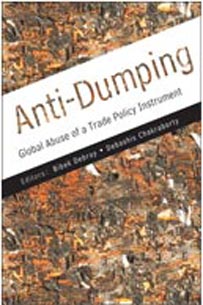
Anti-Dumping: Global Abuse of a Trade Policy Instrument
Bibek Debroy (Ed.)‚ Debashis Chakraborty (Ed.)
About the Book
The increasing use of anti-dumping measures covering a wide range of sectors, both by developed and developing countries in recent years, indicates a policy substitution to protect domestic industries in the face of tariff reforms. While the developing countries are demanding special and different treatment to protect their interest against a possible misuse of this provision by their developed counterparts, many of them also rank among the major violators. In this scenario, a systemic review and subsequent modification/ scrapping of the anti-dumping agreement is the need of the hour. Responding to this need the Hong Kong Ministerial declaration (December 2005) has noted that negotiations on anti-dumping should, as appropriate, "clarify and improve the rules" in three major concern areas (determination of dumping, procedures and the level, scope and duration of adopted measures).
The eight chapters in the current volume focus on the current scenario in select developed and developing countries, use of this provision in intra-developing country trade and analysis of anti-dumping cases lodged at the WTO dispute settlement body.
The discussions in the volume significantly contribute in the ongoing debate and serve as an important input for current negotiations.
About the Author(s) / Editor(s)
Bibek Debroy is Secretary General, PHD Chamber of Commerce and Industry, New Delhi. He is a professional economist and was educated in Presidency College (Calcutta), Delhi School of Economics and Trinity College (Cambridge). He has worked at Presidency College (Calcutta), Gokhle Institute of Politics and Economics (Pune), Indian Institute of Foreign Trade (Delhi), National Council of Applied Economic Research (Delhi) and as a Consultant, Department of Economic Affairs, Ministry of Finance, Government of India. He has been the Director of the Rajiv Gandhi Institute for Contemporary Studies (RGICS), Rajiv Gandhi Foundation, New Delhi. He was also the Director for a project known as LARGE, set up by the Ministry of Finance and UNDP to examine legal reforms. He is the author and editor of several books, papers and popular articles and has been consulting editor and columnist with Business Standard. Bibek Debroy's special interests are international trade (in particular the WTO), law reform and the political economy of liberalisation in India. He has been listed in many bibliographies and has been a member of several government committees.
Debashis Chakraborty is Assistant Professor at Indian Institute of Foreign Trade, New Delhi. Debashis has been educated at University of Calcutta and Centre for International Trade and Development, JNU. He has worked on issues pertaining to international trade policy, WTO issues and Indian economic development, and presented and published his research at various academic and policy forums in India and abroad. He has earlier worked in Rajiv Gandhi Institute for Contemporary Studies (RGICS), New Delhi as a researcher. Debashis has recently edited two titles on WTO and is currently working on a manuscript relating to contract farming in India.
Contributors
Cengiz Bahçekapili
Assistant Professor, Department of Economics, Marmara University, Bahçelievler-Istanbul, Turkey.
Debashis Chakraborty
Assistant Professor, Indian Institute of Foreign Trade, New Delhi.
Murat Çokgezen
Associate Professor, Department of Economics, Marmara University, Bahçelievler-Istanbul, Turkey.
Bibek Debroy
Secretary General, PHD Chamber of Commerce and Industry, New Delhi.
Fredrik Erixon
Chief Economist, Swedish Think Tank Timbro, Stockholm.
Daniel Ikenson
Associate Director, Center for Trade Policy Studies, Cato Institute, Washington DC.
Kofi Oteng Kufuor
Reader, School of Law, University of East London, London.
Yuefen Li
Senior Economic Affairs Officer in the Division on Globalization and Development Strategies at UNCTAD, Geneva and Guest Professor at Tsinghua University, China.
Brink Lindsey
Vice President for Research, Cato Institute, Washington DC and a Contributing Editor at Reason magazine.
K.D. Raju
Deputy Secretary, PHD Chamber of Commerce and Industry, New Delhi.
Nicola Theron
Co-founder and the Managing Director, Econex, Cape Town and a Senior Lecturer at the Department of Economics, University of Stellenbosch, South Africa.
Contents in Detail
| Publisher | AF Press |
| Publication Date | 2007 |
| Number of Pages | 208 |
| ISBN |
8171885896 |
Academic Foundation (AF), based in New Delhi, is India’s leading independent publisher of academic/scholarly books in Social Sciences, specialising in Economics—Development Economics and Indian Economy in particular, and allied subjects.
About the Book
The increasing use of anti-dumping measures covering a wide range of sectors, both by developed and developing countries in recent years, indicates a policy substitution to protect domestic industries in the face of tariff reforms. While the developing countries are demanding special and different treatment to protect their interest against a possible misuse of this provision by their developed counterparts, many of them also rank among the major violators. In this scenario, a systemic review and subsequent modification/ scrapping of the anti-dumping agreement is the need of the hour. Responding to this need the Hong Kong Ministerial declaration (December 2005) has noted that negotiations on anti-dumping should, as appropriate, "clarify and improve the rules" in three major concern areas (determination of dumping, procedures and the level, scope and duration of adopted measures).
The eight chapters in the current volume focus on the current scenario in select developed and developing countries, use of this provision in intra-developing country trade and analysis of anti-dumping cases lodged at the WTO dispute settlement body.
The discussions in the volume significantly contribute in the ongoing debate and serve as an important input for current negotiations.
About the Author(s) / Editor(s)
Bibek Debroy is Secretary General, PHD Chamber of Commerce and Industry, New Delhi. He is a professional economist and was educated in Presidency College (Calcutta), Delhi School of Economics and Trinity College (Cambridge). He has worked at Presidency College (Calcutta), Gokhle Institute of Politics and Economics (Pune), Indian Institute of Foreign Trade (Delhi), National Council of Applied Economic Research (Delhi) and as a Consultant, Department of Economic Affairs, Ministry of Finance, Government of India. He has been the Director of the Rajiv Gandhi Institute for Contemporary Studies (RGICS), Rajiv Gandhi Foundation, New Delhi. He was also the Director for a project known as LARGE, set up by the Ministry of Finance and UNDP to examine legal reforms. He is the author and editor of several books, papers and popular articles and has been consulting editor and columnist with Business Standard. Bibek Debroy's special interests are international trade (in particular the WTO), law reform and the political economy of liberalisation in India. He has been listed in many bibliographies and has been a member of several government committees.
Debashis Chakraborty is Assistant Professor at Indian Institute of Foreign Trade, New Delhi. Debashis has been educated at University of Calcutta and Centre for International Trade and Development, JNU. He has worked on issues pertaining to international trade policy, WTO issues and Indian economic development, and presented and published his research at various academic and policy forums in India and abroad. He has earlier worked in Rajiv Gandhi Institute for Contemporary Studies (RGICS), New Delhi as a researcher. Debashis has recently edited two titles on WTO and is currently working on a manuscript relating to contract farming in India.
Contributors
Cengiz Bahçekapili
Assistant Professor, Department of Economics, Marmara University, Bahçelievler-Istanbul, Turkey.
Debashis Chakraborty
Assistant Professor, Indian Institute of Foreign Trade, New Delhi.
Murat Çokgezen
Associate Professor, Department of Economics, Marmara University, Bahçelievler-Istanbul, Turkey.
Bibek Debroy
Secretary General, PHD Chamber of Commerce and Industry, New Delhi.
Fredrik Erixon
Chief Economist, Swedish Think Tank Timbro, Stockholm.
Daniel Ikenson
Associate Director, Center for Trade Policy Studies, Cato Institute, Washington DC.
Kofi Oteng Kufuor
Reader, School of Law, University of East London, London.
Yuefen Li
Senior Economic Affairs Officer in the Division on Globalization and Development Strategies at UNCTAD, Geneva and Guest Professor at Tsinghua University, China.
Brink Lindsey
Vice President for Research, Cato Institute, Washington DC and a Contributing Editor at Reason magazine.
K.D. Raju
Deputy Secretary, PHD Chamber of Commerce and Industry, New Delhi.
Nicola Theron
Co-founder and the Managing Director, Econex, Cape Town and a Senior Lecturer at the Department of Economics, University of Stellenbosch, South Africa.
Contents in Detail
| Publisher | AF Press |
| Publication Date | 2007 |
| Number of Pages | 208 |
| ISBN |
8171885896 |

Couldn't load pickup availability
Share
-

Curated Collections By AF Press
-

Premium Print Quality
-

Author-Centric Publishing
-

Trusted by Readers Nationwide


Anti-Dumping: Global Abuse of a Trade...