


Demonetisation
Uma Kapila (Ed.)
Foreword: Uma Kapila (Ed.)
About the Book
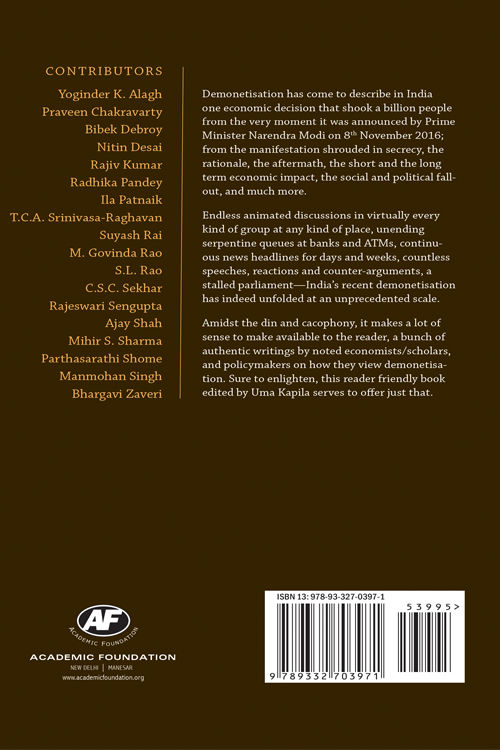
Demonetisation has come to describe in India one economic decision that shook a billion people from the very moment it was announced by Prime Minister Narendra Modi on 8th November 2016; from the manifestation shrouded in secrecy, the rationale, the aftermath, the short and the long term economic impact, the social and political fall-out, and much more.
Endless animated discussions in virtually every kind of group at any kind of place, unending serpentine queues at banks and ATMs, continuous news headlines for days and weeks, countless speeches, reactions and counter-arguments, a stalled parliament—India’s recent demonetisation has indeed unfolded at an unprecedented scale.
Amidst the din and cacophony, it makes a lot of sense to make available to the reader, a bunch of authentic writings by noted economists/scholars, and policymakers on how they view demonetisation. Sure to enlighten, this reader friendly book edited by Uma Kapila serves to offer just that.
About the Author(s) / Editor(s)
Uma Kapila has taught Indian Economy to undergraduate students for over forty-two years. She retired as Reader from the Department of Economics, Miranda House, University of Delhi. Presently, she is Senior Editor, Academic Foundation. An Honours Graduate from Miranda House, University of Delhi and MA and PhD from Delhi School of Economics, Dr Uma Kapila has also served on the Planning Commission Study Group on “Agricultural Strategies in the Eastern Region of India for the Seventh Five Year Plan” (Perspective Planning Division). She is the author of the book Oilseeds Economy of India (1982) published by the Institute of Economic Growth, Delhi. She is also the author/editor of textbooks on Indian economy and has edited, and co-edited with Raj Kapila, a number of books on India’s economy, banking and finance. Her widely acclaimed edited volume entitled Indian Economy Since Independence (also published by Academic Foundation) serves as reference text across several universities, and is currently running into 27th edition
Contributors
Yoginder K. Alagh
Praveen Chakravarty
Bibek Debroy
Nitin Desai
Rajiv Kumar
Radhika Pandey
Ila Patnaik
T.C.A. Srinivasa-Raghavan
Suyash Rai
M. Govinda Rao
S.L. Rao
C.S.C. Sekhar
Rajeswari Sengupta
Ajay Shah
Mihir S. Sharma
Parthasarathi Shome
Manmohan Singh
Bhargavi Zaveri
Contents in Detail
About the Editor/Contributors| Publisher | AF Press |
| Publication Date | 2017 |
| Number of Pages | 150 |
| ISBN |
9789332703971 |
Academic Foundation (AF), based in New Delhi, is India’s leading independent publisher of academic/scholarly books in Social Sciences, specialising in Economics—Development Economics and Indian Economy in particular, and allied subjects.
About the Book
Demonetisation has come to describe in India one economic decision that shook a billion people from the very moment it was announced by Prime Minister Narendra Modi on 8th November 2016; from the manifestation shrouded in secrecy, the rationale, the aftermath, the short and the long term economic impact, the social and political fall-out, and much more.
Endless animated discussions in virtually every kind of group at any kind of place, unending serpentine queues at banks and ATMs, continuous news headlines for days and weeks, countless speeches, reactions and counter-arguments, a stalled parliament—India’s recent demonetisation has indeed unfolded at an unprecedented scale.
Amidst the din and cacophony, it makes a lot of sense to make available to the reader, a bunch of authentic writings by noted economists/scholars, and policymakers on how they view demonetisation. Sure to enlighten, this reader friendly book edited by Uma Kapila serves to offer just that.
About the Author(s) / Editor(s)
Uma Kapila has taught Indian Economy to undergraduate students for over forty-two years. She retired as Reader from the Department of Economics, Miranda House, University of Delhi. Presently, she is Senior Editor, Academic Foundation. An Honours Graduate from Miranda House, University of Delhi and MA and PhD from Delhi School of Economics, Dr Uma Kapila has also served on the Planning Commission Study Group on “Agricultural Strategies in the Eastern Region of India for the Seventh Five Year Plan” (Perspective Planning Division). She is the author of the book Oilseeds Economy of India (1982) published by the Institute of Economic Growth, Delhi. She is also the author/editor of textbooks on Indian economy and has edited, and co-edited with Raj Kapila, a number of books on India’s economy, banking and finance. Her widely acclaimed edited volume entitled Indian Economy Since Independence (also published by Academic Foundation) serves as reference text across several universities, and is currently running into 27th edition
Contributors
Yoginder K. Alagh
Praveen Chakravarty
Bibek Debroy
Nitin Desai
Rajiv Kumar
Radhika Pandey
Ila Patnaik
T.C.A. Srinivasa-Raghavan
Suyash Rai
M. Govinda Rao
S.L. Rao
C.S.C. Sekhar
Rajeswari Sengupta
Ajay Shah
Mihir S. Sharma
Parthasarathi Shome
Manmohan Singh
Bhargavi Zaveri
Contents in Detail
About the Editor/Contributors| Publisher | AF Press |
| Publication Date | 2017 |
| Number of Pages | 150 |
| ISBN |
9789332703971 |

Couldn't load pickup availability
Share

-

Curated Collections By AF Press
-

Premium Print Quality
-

Author-Centric Publishing
-

Trusted by Readers Nationwide


Demonetisation