


Corporate Governance, Corporate Social
R.K. Mishra‚ Stuart Locke
About the Book
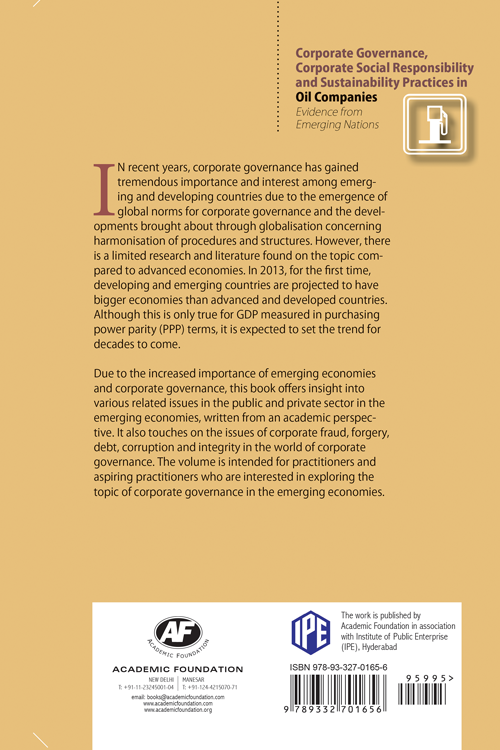
In recent years, corporate governance has gained tremendous importance and interest among emerging and developing countries due to the emergence of global norms for corporate governance and the developments brought about through globalisation concerning harmonisation of procedures and structures. However, there is a limited research and literature found on the topic compared to advanced economies. In 2013, for the first time, developing and emerging countries are projected to have bigger economies than advanced and developed countries. Although this is only true for GDP measured in purchasing power parity (PPP) terms, it is expected to set the trend for decades to come.
Due to the increased importance of emerging economies and corporate governance, this book offers insight into various related issues in the public and private sector in the emerging economies, written from an academic perspective. It also touches on the issues of corporate fraud, forgery, debt, corruption and integrity in the world of corporate governance. The volume is intended for practitioners and aspiring practitioners who are interested in exploring the topic of corporate governance in the emerging economies.
About the Author(s) / Editor(s)
Geeta Rani Duppati is Senior Lecturer, Department of Finance, Waikato University, New Zealand and also Visiting Professor, Institute of Public Enterprise (IPE), Hyderabad, India. Apart from teaching, her research interests include: performance appraisal of state level public enterprises, corporate governance, public and private enterprises, mergers and acquisitions and CSR/sustainability studies. She has taught at undergraduate, graduate and postgraduate levels at Addis Ababa University and Debub University in Ethiopia; Asmara University and Asmara Commercial College in Asmara, Eritrea, and Aukland University of Technology, Auckland and University of Waikato, New Zealand.
R.K. Mishra, Senior Professor and Director, IPE, Hyderabad, did his PhD from University of Rajasthan. A Visiting Fellow at London Business School (UK), he also studied for International Teachers programme at SDA Bocconi, Milan. Dr Mishra taught at the University of Bradford and was a Visiting Professor at Maison Des Sciences De L’ Hommes, Paris and Faculty of Economics, University of Ljubljana, Slovenia. His areas of interest include: corporate governance, international management, international finance, public-private partnership and restructuring and environmental administration.
Stuart Locke is Professor, Department of Finance, University of Waikato, New Zealand. Dr Locke has a background in finance, economics and chartered accountancy. His current research interests are in corporate governance in mature and emerging markets across the spectrum from small businesses, cooperatives, voluntary, state sector and listed public companies. He continues to publish widely in academic journals, participates regularly in media events, public speaking at conventions and is a Board member of his local Chamber of Commerce
contents in details
List of Tables, Figures and Appendices
Preface
| Publisher | AF Press |
| Publication Date | 2015 |
| Number of Pages | 245 |
| ISBN |
9789332701656 |
Academic Foundation (AF), based in New Delhi, is India’s leading independent publisher of academic/scholarly books in Social Sciences, specialising in Economics—Development Economics and Indian Economy in particular, and allied subjects.
About the Book
In recent years, corporate governance has gained tremendous importance and interest among emerging and developing countries due to the emergence of global norms for corporate governance and the developments brought about through globalisation concerning harmonisation of procedures and structures. However, there is a limited research and literature found on the topic compared to advanced economies. In 2013, for the first time, developing and emerging countries are projected to have bigger economies than advanced and developed countries. Although this is only true for GDP measured in purchasing power parity (PPP) terms, it is expected to set the trend for decades to come.
Due to the increased importance of emerging economies and corporate governance, this book offers insight into various related issues in the public and private sector in the emerging economies, written from an academic perspective. It also touches on the issues of corporate fraud, forgery, debt, corruption and integrity in the world of corporate governance. The volume is intended for practitioners and aspiring practitioners who are interested in exploring the topic of corporate governance in the emerging economies.
About the Author(s) / Editor(s)
Geeta Rani Duppati is Senior Lecturer, Department of Finance, Waikato University, New Zealand and also Visiting Professor, Institute of Public Enterprise (IPE), Hyderabad, India. Apart from teaching, her research interests include: performance appraisal of state level public enterprises, corporate governance, public and private enterprises, mergers and acquisitions and CSR/sustainability studies. She has taught at undergraduate, graduate and postgraduate levels at Addis Ababa University and Debub University in Ethiopia; Asmara University and Asmara Commercial College in Asmara, Eritrea, and Aukland University of Technology, Auckland and University of Waikato, New Zealand.
R.K. Mishra, Senior Professor and Director, IPE, Hyderabad, did his PhD from University of Rajasthan. A Visiting Fellow at London Business School (UK), he also studied for International Teachers programme at SDA Bocconi, Milan. Dr Mishra taught at the University of Bradford and was a Visiting Professor at Maison Des Sciences De L’ Hommes, Paris and Faculty of Economics, University of Ljubljana, Slovenia. His areas of interest include: corporate governance, international management, international finance, public-private partnership and restructuring and environmental administration.
Stuart Locke is Professor, Department of Finance, University of Waikato, New Zealand. Dr Locke has a background in finance, economics and chartered accountancy. His current research interests are in corporate governance in mature and emerging markets across the spectrum from small businesses, cooperatives, voluntary, state sector and listed public companies. He continues to publish widely in academic journals, participates regularly in media events, public speaking at conventions and is a Board member of his local Chamber of Commerce
contents in details
List of Tables, Figures and Appendices
Preface
| Publisher | AF Press |
| Publication Date | 2015 |
| Number of Pages | 245 |
| ISBN |
9789332701656 |

Couldn't load pickup availability
Share

-

Curated Collections By AF Press
-

Premium Print Quality
-

Author-Centric Publishing
-

Trusted by Readers Nationwide


Corporate Governance, Corporate Social