

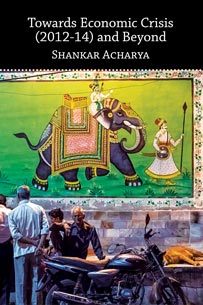
Towards Economic Crisis (2012-14) and Beyond
Shankar Acharya
About the Book
WHY did India’s stellar economic growth at 8 per cent plus in the eight years, 2003-2011, collapse to 5 per cent or less by 2012-13? What were the key policy failures, of commission and omission,that brought about this sharp slowdown? Now, in 2015, with a new government with a seemingly strong political mandate, why is it proving so difficult to revive the earlier strong momentum of economic development? How should the new government tackle the deep legacy problems of the past? In the new global context, is slower economic growth inevitable?
These are some of the many critical economic issues explored in the 39 essays by Shankar Acharya, written in the three and a half years between November 2011 and July 2015.
Praise for this book
This book is by far the best exposition of recent developments in, and prospects for Indian economy.The exposition is simple, but scholarly; concise but comprehensive; forthright but elegant; with enviable insights and impressive foresight.”
—Y. Venugopal Reddy
Chairman, Fourteenth Finance Commission and
former Governor, Reserve Bank of India.
“Shankar Acharya, former Chief Economic Adviser to the Government of India, is the authoritative guide to the Indian economy and economic policy-making. The present collection of columns reveals his outstanding virtues of resolute independence, meticulous research, rigorous argument and sober judgement. Read and learn.”
—Martin Wolf
Associate Editor and Chief Economics Commentator,
Financial Times.
“Shankar Acharya is one of India’s leading economists, and this volume brings together his prescient views on India’s important economic challenges.These lucid essays show a rare mastery of the open economy macroeconomics. He was ahead of the curve in signalling to the fiscal and monetary authorities the impending crisis as well as in outlining the required policy measures. A must read for policy as well as the academic community “
—Vijay Kelkar
Chairman, National Institute of Public Finance and Policy,
New Delhi and former Finance Secretary, Government of India.
“Shankar Acharya is one of India’s most respected macro economists and in this collection he gives us 36 snapshots of the economy over the past three years. Even those who disagree with some of the snapshots on some points will concede that they are insightful and thought provoking. Any one interested in the Indian economy in general will find this very rich fare indeed, covering all the key issues that have surfaced in this very eventful period.”
—Montek Ahluwalia
Former Deputy Chairman, Planning Commission,
Government of India.
About the Author(s) / Editor(s)
As Chief Economic Advisor to the Government of India (1993-2001), Shankar Acharya was deeply involved in the economic reforms of the 1990s. He later served as a Member of the Prime Minister’s Advisory Council (2001-2003), the Twelfth Finance Commission (2004) and the National Security Advisory Board (2009-2013). Earlier he worked in the World Bank, where he led the World Development Report team for 1979 and was Research Adviser to the Bank. He has authored nine books and numerous scholarly articles.
Currently he is Honorary Professor at the Indian Council for Research on International Economic Relations (ICRIER) and serves on the boards of other research organisations, some corporates, charities and the Reserve Bank’s Advisory Committee on Monetary Policy. He has a PhD from Harvard University and BA from Oxford.
Contents in Detail
| Publisher | AF Press |
| Publication Date | 2015 |
| Number of Pages | 182 |
| ISBN |
9789332703131 |
Academic Foundation (AF), based in New Delhi, is India’s leading independent publisher of academic/scholarly books in Social Sciences, specialising in Economics—Development Economics and Indian Economy in particular, and allied subjects.
About the Book
WHY did India’s stellar economic growth at 8 per cent plus in the eight years, 2003-2011, collapse to 5 per cent or less by 2012-13? What were the key policy failures, of commission and omission,that brought about this sharp slowdown? Now, in 2015, with a new government with a seemingly strong political mandate, why is it proving so difficult to revive the earlier strong momentum of economic development? How should the new government tackle the deep legacy problems of the past? In the new global context, is slower economic growth inevitable?
These are some of the many critical economic issues explored in the 39 essays by Shankar Acharya, written in the three and a half years between November 2011 and July 2015.
Praise for this book
This book is by far the best exposition of recent developments in, and prospects for Indian economy.The exposition is simple, but scholarly; concise but comprehensive; forthright but elegant; with enviable insights and impressive foresight.”
—Y. Venugopal Reddy
Chairman, Fourteenth Finance Commission and
former Governor, Reserve Bank of India.
“Shankar Acharya, former Chief Economic Adviser to the Government of India, is the authoritative guide to the Indian economy and economic policy-making. The present collection of columns reveals his outstanding virtues of resolute independence, meticulous research, rigorous argument and sober judgement. Read and learn.”
—Martin Wolf
Associate Editor and Chief Economics Commentator,
Financial Times.
“Shankar Acharya is one of India’s leading economists, and this volume brings together his prescient views on India’s important economic challenges.These lucid essays show a rare mastery of the open economy macroeconomics. He was ahead of the curve in signalling to the fiscal and monetary authorities the impending crisis as well as in outlining the required policy measures. A must read for policy as well as the academic community “
—Vijay Kelkar
Chairman, National Institute of Public Finance and Policy,
New Delhi and former Finance Secretary, Government of India.
“Shankar Acharya is one of India’s most respected macro economists and in this collection he gives us 36 snapshots of the economy over the past three years. Even those who disagree with some of the snapshots on some points will concede that they are insightful and thought provoking. Any one interested in the Indian economy in general will find this very rich fare indeed, covering all the key issues that have surfaced in this very eventful period.”
—Montek Ahluwalia
Former Deputy Chairman, Planning Commission,
Government of India.
About the Author(s) / Editor(s)
As Chief Economic Advisor to the Government of India (1993-2001), Shankar Acharya was deeply involved in the economic reforms of the 1990s. He later served as a Member of the Prime Minister’s Advisory Council (2001-2003), the Twelfth Finance Commission (2004) and the National Security Advisory Board (2009-2013). Earlier he worked in the World Bank, where he led the World Development Report team for 1979 and was Research Adviser to the Bank. He has authored nine books and numerous scholarly articles.
Currently he is Honorary Professor at the Indian Council for Research on International Economic Relations (ICRIER) and serves on the boards of other research organisations, some corporates, charities and the Reserve Bank’s Advisory Committee on Monetary Policy. He has a PhD from Harvard University and BA from Oxford.
Contents in Detail
| Publisher | AF Press |
| Publication Date | 2015 |
| Number of Pages | 182 |
| ISBN |
9789332703131 |

Couldn't load pickup availability
Share
-

Curated Collections By AF Press
-

Premium Print Quality
-

Author-Centric Publishing
-

Trusted by Readers Nationwide


Towards Economic Crisis (2012-14) and...