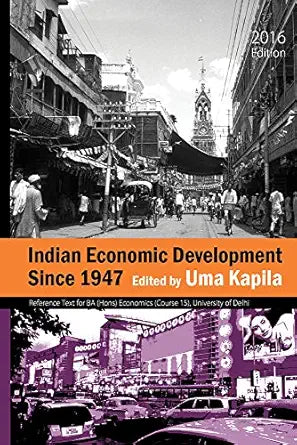
Indian Economic Development Since 1947
2016-17 EDITION
Uma Kapila (Ed.)
2016-17 EDITION
About the Book
Reference Text for BA (Hons) Economics (Course 15), University of Delhi
About the Author(s) / Editor(s)
UMA KAPILA, author/editor of several other books, has taught Indian Economy to undergraduate students for over forty-two years. She retired as Reader from the Department of Economics, Miranda House, University of Delhi. Presently, she is Senior Editor, Academic Foundation.
An Honours Graduate from Miranda House, University of Delhi and M.A. and Ph.D. from Delhi School of Economics, Dr. Uma Kapila has also served on the Planning Commission Study Group on “Agricultural Strategies in the Eastern Region of India for the Seventh Five Year Plan” (Perspective Planning Division).
Dr. Uma Kapila is the author of the book Oilseeds Economy of India (1982) published by the Institute of Economic Growth, Delhi. She is also the author/editor of two other textbooks on Indian economy, one meant for B.A. (Hons.) Economics, and the other for B.A.(Programme) and B.Com (Hons.) and Honours other than Economics. She has edited, and co-edited with Raj Kapila, a number of books on India’s economy, banking and finance.
Contributors
Pulapre Balakrishnan, Professor of Economics,
Ashoka University, Kundli, Haryana.
Aditya Bhattacharjea, Professor and Head, Department of Economics,
Delhi School of Economics, University of Delhi, Delhi.
Achin Chakraborty, Professor and Director,
Institute of Development Studies, Kolkata.
Simon Deakin, Professor of Law,
University of Cambridge, England.
S. Mahendra Dev, Director (Vice Chancellor), Indira Gandhi Institute of
Development Research, Mumbai.
Biswajit Dhar, Professor, Centre of Economic Studies and Planning,
School of Social Sciences, Jawaharlal Nehru University, New Delhi.
Bishwanath Goldar, ICSSR National Fellow, affiliated to IEG;
Chairman, Standing Committee on Industrial Statistics; Chairman,
Working Group on Producer Price Index (PPP), Government of India.
Antara Haldar, University Lecturer, Empirical Legal Studies,
University of Cambaridge, England.
K. Kanagasabapathy, Independent Economic Consultant;
formerly Director EPW Research Foundation, Mumbai.
Uma Kapila, Reader (Retd.), Department of Economics, Miranda House,
University of Delhi. Presently, Senior Editor, Academic Foundation, New Delhi.
Vijay Kelkar, Chairman, India Development Foundation, New Delhi.
Formerly Chairman 13th Finance Commission, Govt. of India.
K.L. Krishna, Chairman, Madras Institute of Development Studies, Chennai; Member,
Centre for Development Economics, Delhi School of Economics, Delhi.
R. Krishnaswamy, EPW Research Foundation,
Economic and Political Weekly, Mumbai.
Nagesh Kumar, Head, UN-ESCAP South and
South-West Asia Office, New Delhi.
Dipak Mazumdar, Munk Center for International Studies, University of Toronto;
Visiting Professor, Institute for Human Development, New Delhi.
R. Nagaraj, Professor, Indira Gandhi Institute of Development Research, Mumbai.
Manoj Panda, Director, Institute of Economic Growth, University of Delhi, Delhi.
N. Chandrasekhara Rao, Professor, Institute of Economic Growth, University of Delhi, Delhi.
Sandip Sarkar, Professor, Institute for Human Development, New Delhi.
M.H. Bala Subrahmanya, Professor & Chairman, Department of Management Studies,
Indian Institute of Science, Bangalore.
Vishakha G. Tilak, EPW Research Foundation, Economic and Political Weekly, Mumbai.
Contents in Detail
Preface
Contributors
PART I
MACROECONOMIC POLICIES AND
THEIR IMPACT
1. Indian Economy: Then and Now
Uma Kapila
• The Colonial Regime
• The India of 1947
• The Agrarian Scene
• The State of Indian Industry and its Structure
• A New India
• A Short History of Fast Growth
2. The Great Reversal: A Macro Story
Pulapre Balakrishnan
• The Facts
• Relevance of Global Factors
• Accounting for the Regime Change
• The Role of Macroeconomic Policy
• Inflation Targeting
• Some Considerations for Near-Term PoliIcy
3. Macroeconomic Developments and
Challenges for Growth
Manoj Panda
• Introduction
• Macroeconomic Developments
• Policy Challenges for High Growth
• Conclusion
4. Monetary, Fiscal and Budgetary Developments:
Policies and their Impact
Uma Kapila
• Monetary Policy
• Fiscal Policy
• Recent Fiscal Performance
• Medium-Term Fiscal Framework
• Conclusions
5. A Rethink on India’s Foreign Trade Policy
K. Kanagasabapathy, Vishakha G. Tilak and
R. Krishnaswamy
• India’s Place in Global Trade
• Direction and Composition
• Strategic Rethink
6. India’s New Foreign Trade Policy: Pluses and Minuses
Biswajit Dhar
• ‘Whole-of-Government’ Approach
• Three Issues Highlighted
• SEZ Failure
• Regional Trade Agreements
7. How Should India Reform Its Labour Laws?
Simon Deakin and Antara Haldar
• Introduction
• Developments in the Theory of Labour Regulation
• Empirical Evidence on the Economic Effects of
Labour Laws
• The Gujarat Model
• Conclusions
8. Reforming Labour Market in States:
Revisiting the Futility Thesis
Achin Chakraborty
• How Rigid is the Labour Market?
• The Logic of Flexibility
• What Flexibility Cannot Achieve
• Concluding Remarks
PART II
INDIAN AGRICULTURE:
POLICIES AND PERFORMANCE
9. Indian Agriculture: Policies and Performance (Ed. Notes)
• Introduction
• Linkages between Agriculture and Other Sectors
• The Institutional Context
• The New Technology
• Three Phases of Green Revolution
• Reform Period
• Deceleration in Agriculture Growth
• Emerging Imbalances
• Cereals Production and Build up of Stocks
• Secondary Agriculture: A Driver for Growth of
Primary Agriculture
• Reforming the Three ‘I’s: Investments, Incentives,
and Institutions
• Challenges and Outlook 180
10. Agricultural Development in India:
Performance, Issues and Policies
S. Mahendra Dev
• Performance of Agriculture
• Policies Since Independence
• Issues and Policies for Higher Growth,
Equity and Sustainability
• Conclusion
11. Accelerating Agricultural Productivity
Growth in India: An Overview
World Bank Group
• The Conundrums of Contemporary Agriculture
• Trends in Agricultural Performance at the
National and Subnational Level
• An International Perspective on India’s
Structural Transformation
• A Micro-level Perspective on India’s
Structural Transformation
• Did the Drivers of Growth Change
Qualitatively in the 2000s?
• Messages and Implications
• Evolution of Productivity at the National,
State, Household, and Farm Levels
• Technology, Yield Gaps, and Growth Prospects
• Livestock Subsector: Significant Opportunities
and Policy Priorities
• Investments in Agriculture for Growth
and Sustainability
• Marketing and Market Reform:
Unfinished Business
• Beyond the Farm: Exploiting the Potential for
Food Processing
• Transforming Agriculture in LIS: Challenges and
Priorities for Bihar and Odisha
12. The Context and Conundrums of
Contemporary Agriculture
World Bank Group
• India’s Food Security Puzzle
• Persistent Food Price Rise
• Trade Policy and Cereal Prices
• Food Grain Management and Food Prices
• Rising Real Rural Wages
• Persistent Questions about the
Sustainability of Growth
13. Agricultural Price Policy, Farm Profitability
and Food Security
S. Mahendra Dev and N. Chandrasekhara Rao
• Trends in Costs and Yields
• Trends in MSPs and Prices Realised by Farmers
• Relationship between Costs, Prices
Realised and MSP
• Returns to Farming
• Increased Role of Price Policy
• Concluding Observations
PART III
INDUSTRY
14. Policies and Performance in Industry (Ed. Notes)
• The Industrial Scene at Independence
• Industrial Control Regime
• The Policy Regime in the 1990s
• New Economic Policy
• Opening up to Foreign Investment
• Public Sector Reforms, Privatisation and
Infrastructure
• Industrial Policy Objectives for the
Twelfth Plan and Beyond
• Trends and Pattern of Industrial Growth
• Policy Regimes and Pattern of Growth
• Recent Industrial Growth, 2008-09 to 2013-14
• Industrial-sector Performance Based on Revised
GDP Estimates 2012-13 to 2015-16
• Why has Growth Moderated?
• Challenges Arising from Government Policies
• Micro, Small and Medium Enterprises (MSMEs)
• Role of MSEs in Indian Economy
• Status and Key Challenges
• Public Sector
• Privatisation
• Foreign Direct Investment (FDI)
15. Industrial Performance, 1991-2008: A Review
R. Nagaraj
• Introduction
• Industrial Performance After 1991-92
• Why Did the Reforms Fail to Deliver the
Expected Results?
• What Should Be Done Now?
• Conclusions
16. Productivity Growth Performance in India:
Review and New Approach
K.L. Krishna and Bishwanath Goldar
• Introduction
• Evolution of the Productivity Literature in India
• Conventional Methodology of Productivity
Measurement
• Productivity in Manufacturing
• Productivity in Agriculture
• Productivity in Services
• Inter-Sectoral Perspective
• Productivity Studies for the Aggregate Economy
• Improving on Past Productivity Research:
The India KLEMS Project
• Some major Findings from the India KLEMS
Report for the period 1980-2008
• Further Work in the India KLEMS Project
• Summary and Conclusions
17. Of Omissions and Commissions:
India’s Competition Laws
Aditya Bhattacharjea
• Introduction
• The MRTP Act, 1969-2009
• The Competition Act, 2002
• Postscript (2016)
18. Small-scale Industrialisation under Globalisation:
Is the Tide Turning Around?
M.H. Bala Subrahmanya
• Introduction
• Globalisation and Domestic Economic Reforms:
Implications and Impact on the SSI
• SSI Performance in the Globalisation Era
• Inferences and Conclusions (in the Context of
Recent Policy Initiatives)
19. On Strategies for Disinvestment and Privatisation
Vijay Kelkar
• Public versus Private Ownership
• Privatisation
20. Foreign Direct and Portfolio Investments
Flows and Development: A Perspective on Indian Experience
Nagesh Kumar
• The Context
• Evolution of Policy Regime Towards FDI and
FPIs in India
• Foreign Direct Investment Flows and
Their Quality
• FPI Inflows and Their Impact
• India as an Emerging Source of FDI Outflows
• Concluding Remarks and Policy Lessons
21. The Employment Problem in India and the
Phenomenon of the Missing Middle
Dipak Mazumdar and Sandip Sarkar
• Trends in the Industrial Structure of Employment
• Employment Growth in the Tertiary Sector in
India in a Comparative Context
• Dualism in Indian Manufacturing
• Why is Dualism a Problem for
Manufacturing Growth?
• Causes of the Emergence and Persistence
of Dualism
• Conclusion
PART IV
SERVICES
22. Trends and Performance in Services (Ed. Notes)
• Introduction
• Growth and Sectoral Shares, Cross-Country
Evidence and Indian Experience
• World Services Trade
• Factors Underlying the Services Growth
• India’s Services Employment
• India’s Services Trade
• Foreign Direct Investment in India’s Service Sector
• Liberalisation of Services in India
• India and Trade Negotiations in Services
• Conclusion
| Publisher | AF Press |
| Publication Date | 2016 |
| Number of Pages | 494 |
| ISBN |
9789332703735 |
Academic Foundation (AF), based in New Delhi, is India’s leading independent publisher of academic/scholarly books in Social Sciences, specialising in Economics—Development Economics and Indian Economy in particular, and allied subjects.
About the Book
Reference Text for BA (Hons) Economics (Course 15), University of Delhi
About the Author(s) / Editor(s)
UMA KAPILA, author/editor of several other books, has taught Indian Economy to undergraduate students for over forty-two years. She retired as Reader from the Department of Economics, Miranda House, University of Delhi. Presently, she is Senior Editor, Academic Foundation.
An Honours Graduate from Miranda House, University of Delhi and M.A. and Ph.D. from Delhi School of Economics, Dr. Uma Kapila has also served on the Planning Commission Study Group on “Agricultural Strategies in the Eastern Region of India for the Seventh Five Year Plan” (Perspective Planning Division).
Dr. Uma Kapila is the author of the book Oilseeds Economy of India (1982) published by the Institute of Economic Growth, Delhi. She is also the author/editor of two other textbooks on Indian economy, one meant for B.A. (Hons.) Economics, and the other for B.A.(Programme) and B.Com (Hons.) and Honours other than Economics. She has edited, and co-edited with Raj Kapila, a number of books on India’s economy, banking and finance.
Contributors
Pulapre Balakrishnan, Professor of Economics,
Ashoka University, Kundli, Haryana.
Aditya Bhattacharjea, Professor and Head, Department of Economics,
Delhi School of Economics, University of Delhi, Delhi.
Achin Chakraborty, Professor and Director,
Institute of Development Studies, Kolkata.
Simon Deakin, Professor of Law,
University of Cambridge, England.
S. Mahendra Dev, Director (Vice Chancellor), Indira Gandhi Institute of
Development Research, Mumbai.
Biswajit Dhar, Professor, Centre of Economic Studies and Planning,
School of Social Sciences, Jawaharlal Nehru University, New Delhi.
Bishwanath Goldar, ICSSR National Fellow, affiliated to IEG;
Chairman, Standing Committee on Industrial Statistics; Chairman,
Working Group on Producer Price Index (PPP), Government of India.
Antara Haldar, University Lecturer, Empirical Legal Studies,
University of Cambaridge, England.
K. Kanagasabapathy, Independent Economic Consultant;
formerly Director EPW Research Foundation, Mumbai.
Uma Kapila, Reader (Retd.), Department of Economics, Miranda House,
University of Delhi. Presently, Senior Editor, Academic Foundation, New Delhi.
Vijay Kelkar, Chairman, India Development Foundation, New Delhi.
Formerly Chairman 13th Finance Commission, Govt. of India.
K.L. Krishna, Chairman, Madras Institute of Development Studies, Chennai; Member,
Centre for Development Economics, Delhi School of Economics, Delhi.
R. Krishnaswamy, EPW Research Foundation,
Economic and Political Weekly, Mumbai.
Nagesh Kumar, Head, UN-ESCAP South and
South-West Asia Office, New Delhi.
Dipak Mazumdar, Munk Center for International Studies, University of Toronto;
Visiting Professor, Institute for Human Development, New Delhi.
R. Nagaraj, Professor, Indira Gandhi Institute of Development Research, Mumbai.
Manoj Panda, Director, Institute of Economic Growth, University of Delhi, Delhi.
N. Chandrasekhara Rao, Professor, Institute of Economic Growth, University of Delhi, Delhi.
Sandip Sarkar, Professor, Institute for Human Development, New Delhi.
M.H. Bala Subrahmanya, Professor & Chairman, Department of Management Studies,
Indian Institute of Science, Bangalore.
Vishakha G. Tilak, EPW Research Foundation, Economic and Political Weekly, Mumbai.
Contents in Detail
Preface
Contributors
PART I
MACROECONOMIC POLICIES AND
THEIR IMPACT
1. Indian Economy: Then and Now
Uma Kapila
• The Colonial Regime
• The India of 1947
• The Agrarian Scene
• The State of Indian Industry and its Structure
• A New India
• A Short History of Fast Growth
2. The Great Reversal: A Macro Story
Pulapre Balakrishnan
• The Facts
• Relevance of Global Factors
• Accounting for the Regime Change
• The Role of Macroeconomic Policy
• Inflation Targeting
• Some Considerations for Near-Term PoliIcy
3. Macroeconomic Developments and
Challenges for Growth
Manoj Panda
• Introduction
• Macroeconomic Developments
• Policy Challenges for High Growth
• Conclusion
4. Monetary, Fiscal and Budgetary Developments:
Policies and their Impact
Uma Kapila
• Monetary Policy
• Fiscal Policy
• Recent Fiscal Performance
• Medium-Term Fiscal Framework
• Conclusions
5. A Rethink on India’s Foreign Trade Policy
K. Kanagasabapathy, Vishakha G. Tilak and
R. Krishnaswamy
• India’s Place in Global Trade
• Direction and Composition
• Strategic Rethink
6. India’s New Foreign Trade Policy: Pluses and Minuses
Biswajit Dhar
• ‘Whole-of-Government’ Approach
• Three Issues Highlighted
• SEZ Failure
• Regional Trade Agreements
7. How Should India Reform Its Labour Laws?
Simon Deakin and Antara Haldar
• Introduction
• Developments in the Theory of Labour Regulation
• Empirical Evidence on the Economic Effects of
Labour Laws
• The Gujarat Model
• Conclusions
8. Reforming Labour Market in States:
Revisiting the Futility Thesis
Achin Chakraborty
• How Rigid is the Labour Market?
• The Logic of Flexibility
• What Flexibility Cannot Achieve
• Concluding Remarks
PART II
INDIAN AGRICULTURE:
POLICIES AND PERFORMANCE
9. Indian Agriculture: Policies and Performance (Ed. Notes)
• Introduction
• Linkages between Agriculture and Other Sectors
• The Institutional Context
• The New Technology
• Three Phases of Green Revolution
• Reform Period
• Deceleration in Agriculture Growth
• Emerging Imbalances
• Cereals Production and Build up of Stocks
• Secondary Agriculture: A Driver for Growth of
Primary Agriculture
• Reforming the Three ‘I’s: Investments, Incentives,
and Institutions
• Challenges and Outlook 180
10. Agricultural Development in India:
Performance, Issues and Policies
S. Mahendra Dev
• Performance of Agriculture
• Policies Since Independence
• Issues and Policies for Higher Growth,
Equity and Sustainability
• Conclusion
11. Accelerating Agricultural Productivity
Growth in India: An Overview
World Bank Group
• The Conundrums of Contemporary Agriculture
• Trends in Agricultural Performance at the
National and Subnational Level
• An International Perspective on India’s
Structural Transformation
• A Micro-level Perspective on India’s
Structural Transformation
• Did the Drivers of Growth Change
Qualitatively in the 2000s?
• Messages and Implications
• Evolution of Productivity at the National,
State, Household, and Farm Levels
• Technology, Yield Gaps, and Growth Prospects
• Livestock Subsector: Significant Opportunities
and Policy Priorities
• Investments in Agriculture for Growth
and Sustainability
• Marketing and Market Reform:
Unfinished Business
• Beyond the Farm: Exploiting the Potential for
Food Processing
• Transforming Agriculture in LIS: Challenges and
Priorities for Bihar and Odisha
12. The Context and Conundrums of
Contemporary Agriculture
World Bank Group
• India’s Food Security Puzzle
• Persistent Food Price Rise
• Trade Policy and Cereal Prices
• Food Grain Management and Food Prices
• Rising Real Rural Wages
• Persistent Questions about the
Sustainability of Growth
13. Agricultural Price Policy, Farm Profitability
and Food Security
S. Mahendra Dev and N. Chandrasekhara Rao
• Trends in Costs and Yields
• Trends in MSPs and Prices Realised by Farmers
• Relationship between Costs, Prices
Realised and MSP
• Returns to Farming
• Increased Role of Price Policy
• Concluding Observations
PART III
INDUSTRY
14. Policies and Performance in Industry (Ed. Notes)
• The Industrial Scene at Independence
• Industrial Control Regime
• The Policy Regime in the 1990s
• New Economic Policy
• Opening up to Foreign Investment
• Public Sector Reforms, Privatisation and
Infrastructure
• Industrial Policy Objectives for the
Twelfth Plan and Beyond
• Trends and Pattern of Industrial Growth
• Policy Regimes and Pattern of Growth
• Recent Industrial Growth, 2008-09 to 2013-14
• Industrial-sector Performance Based on Revised
GDP Estimates 2012-13 to 2015-16
• Why has Growth Moderated?
• Challenges Arising from Government Policies
• Micro, Small and Medium Enterprises (MSMEs)
• Role of MSEs in Indian Economy
• Status and Key Challenges
• Public Sector
• Privatisation
• Foreign Direct Investment (FDI)
15. Industrial Performance, 1991-2008: A Review
R. Nagaraj
• Introduction
• Industrial Performance After 1991-92
• Why Did the Reforms Fail to Deliver the
Expected Results?
• What Should Be Done Now?
• Conclusions
16. Productivity Growth Performance in India:
Review and New Approach
K.L. Krishna and Bishwanath Goldar
• Introduction
• Evolution of the Productivity Literature in India
• Conventional Methodology of Productivity
Measurement
• Productivity in Manufacturing
• Productivity in Agriculture
• Productivity in Services
• Inter-Sectoral Perspective
• Productivity Studies for the Aggregate Economy
• Improving on Past Productivity Research:
The India KLEMS Project
• Some major Findings from the India KLEMS
Report for the period 1980-2008
• Further Work in the India KLEMS Project
• Summary and Conclusions
17. Of Omissions and Commissions:
India’s Competition Laws
Aditya Bhattacharjea
• Introduction
• The MRTP Act, 1969-2009
• The Competition Act, 2002
• Postscript (2016)
18. Small-scale Industrialisation under Globalisation:
Is the Tide Turning Around?
M.H. Bala Subrahmanya
• Introduction
• Globalisation and Domestic Economic Reforms:
Implications and Impact on the SSI
• SSI Performance in the Globalisation Era
• Inferences and Conclusions (in the Context of
Recent Policy Initiatives)
19. On Strategies for Disinvestment and Privatisation
Vijay Kelkar
• Public versus Private Ownership
• Privatisation
20. Foreign Direct and Portfolio Investments
Flows and Development: A Perspective on Indian Experience
Nagesh Kumar
• The Context
• Evolution of Policy Regime Towards FDI and
FPIs in India
• Foreign Direct Investment Flows and
Their Quality
• FPI Inflows and Their Impact
• India as an Emerging Source of FDI Outflows
• Concluding Remarks and Policy Lessons
21. The Employment Problem in India and the
Phenomenon of the Missing Middle
Dipak Mazumdar and Sandip Sarkar
• Trends in the Industrial Structure of Employment
• Employment Growth in the Tertiary Sector in
India in a Comparative Context
• Dualism in Indian Manufacturing
• Why is Dualism a Problem for
Manufacturing Growth?
• Causes of the Emergence and Persistence
of Dualism
• Conclusion
PART IV
SERVICES
22. Trends and Performance in Services (Ed. Notes)
• Introduction
• Growth and Sectoral Shares, Cross-Country
Evidence and Indian Experience
• World Services Trade
• Factors Underlying the Services Growth
• India’s Services Employment
• India’s Services Trade
• Foreign Direct Investment in India’s Service Sector
• Liberalisation of Services in India
• India and Trade Negotiations in Services
• Conclusion
| Publisher | AF Press |
| Publication Date | 2016 |
| Number of Pages | 494 |
| ISBN |
9789332703735 |
Couldn't load pickup availability
Share
Book Launch Event
-
Curated Collections By AF Press
-
Premium Print Quality
-
Author-Centric Publishing
-
Trusted by Readers Nationwide
Indian Economic Development Since 1947