


Capital Formation in Indian Agriculture
Nusrat Akber‚ Kirtti Ranjan Paltasingh
About the Book
This book delves into a broad spectrum of issues related to capital formation in Indian agriculture. Through empirical examination, it establishes that a decline in investment, particularly public investment, is the primary cause of prolonged stagnation in the growth of Indian agriculture. It further explores the crowding-in/out hypothesis between public and private investment, revealing that public investments in various forms—such as the expansion of surface irrigation, connectivity, rural electrification, and storage—tend to induce more private investment due to their complementary nature.
The book expresses concern over the secular decline in public investment, juxtaposed with the mounting input subsidies for fertilizers, power, credit, and irrigation. By analyzing the comparative returns from these two types of public expenditures on Indian farms, it finds that the marginal returns from public investment, in the form of Total Factor Productivity (TFP) increases, are significantly higher than those from any input subsidies, although irrigation subsidies do offer some benefits. Consequently, the book recommends a gradual rationalization of input subsidies coupled with a rapid increase in public investment. This work will be invaluable to agricultural policymakers and researchers interested in the multifaceted aspects of Indian agriculture.
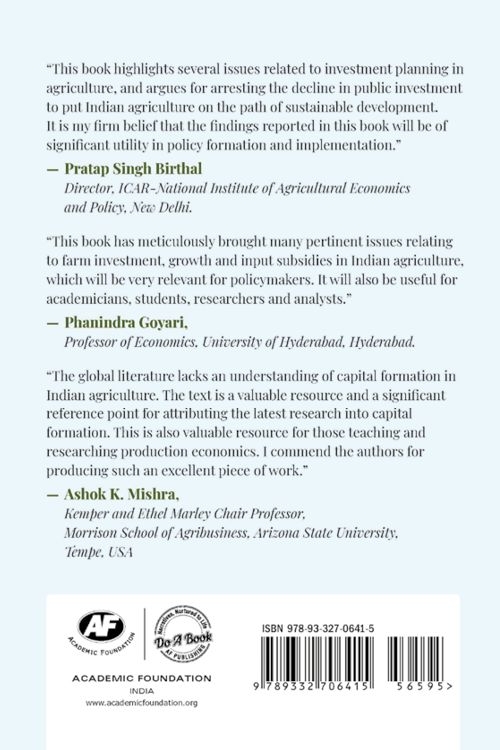
Praise for this book
About the Authors
Dr. Nusrat Akber is a Uma Lele Fellow of the Agricultural & Applied Economics Association (AAEA) Trust in Milwaukee and serves as a senior research consultant at the International Food Policy Research Institute (IFPRI), South Asia Office, in New Delhi. She earned her PhD in Economics from SMVD University in 2022. Her research interests and engagements encompass farm investment dynamics, supply response, climate risk assessment, and various agrarian policy issues.
Dr. Kirtti Ranjan Paltasingh is an Assistant Professor of Economics at Ravenshaw University, India. His research spans a broad spectrum of developmental and agricultural policy issues, including farm technology adoption, food security, tenancy structures, climate risk assessment and mitigation strategies, farm supply response, healthcare utilization, and the intersections of gender and education. In 2017, he was honored with the Prof. D.R. Gadgil Award for his contributions to research.
Contents in Detail
| Publisher | AF Press |
| Publication Date | 2024 |
| Number of Pages | 172 |
| ISBN |
9789332706415 |
Academic Foundation (AF), based in New Delhi, is India’s leading independent publisher of academic/scholarly books in Social Sciences, specialising in Economics—Development Economics and Indian Economy in particular, and allied subjects.
About the Book
This book delves into a broad spectrum of issues related to capital formation in Indian agriculture. Through empirical examination, it establishes that a decline in investment, particularly public investment, is the primary cause of prolonged stagnation in the growth of Indian agriculture. It further explores the crowding-in/out hypothesis between public and private investment, revealing that public investments in various forms—such as the expansion of surface irrigation, connectivity, rural electrification, and storage—tend to induce more private investment due to their complementary nature.
The book expresses concern over the secular decline in public investment, juxtaposed with the mounting input subsidies for fertilizers, power, credit, and irrigation. By analyzing the comparative returns from these two types of public expenditures on Indian farms, it finds that the marginal returns from public investment, in the form of Total Factor Productivity (TFP) increases, are significantly higher than those from any input subsidies, although irrigation subsidies do offer some benefits. Consequently, the book recommends a gradual rationalization of input subsidies coupled with a rapid increase in public investment. This work will be invaluable to agricultural policymakers and researchers interested in the multifaceted aspects of Indian agriculture.
Praise for this book
About the Authors
Dr. Nusrat Akber is a Uma Lele Fellow of the Agricultural & Applied Economics Association (AAEA) Trust in Milwaukee and serves as a senior research consultant at the International Food Policy Research Institute (IFPRI), South Asia Office, in New Delhi. She earned her PhD in Economics from SMVD University in 2022. Her research interests and engagements encompass farm investment dynamics, supply response, climate risk assessment, and various agrarian policy issues.
Dr. Kirtti Ranjan Paltasingh is an Assistant Professor of Economics at Ravenshaw University, India. His research spans a broad spectrum of developmental and agricultural policy issues, including farm technology adoption, food security, tenancy structures, climate risk assessment and mitigation strategies, farm supply response, healthcare utilization, and the intersections of gender and education. In 2017, he was honored with the Prof. D.R. Gadgil Award for his contributions to research.
Contents in Detail
| Publisher | AF Press |
| Publication Date | 2024 |
| Number of Pages | 172 |
| ISBN |
9789332706415 |

Couldn't load pickup availability
Share

-

Curated Collections By AF Press
-

Premium Print Quality
-

Author-Centric Publishing
-

Trusted by Readers Nationwide


Capital Formation in Indian Agriculture