

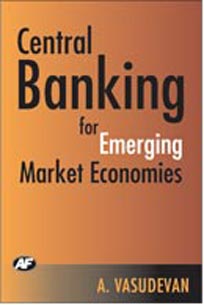
Central Banking for Emerging Market Economies
Vijay Shankar Vyas
About the Book
“This book is undoubtedly a work of encyclopædic proportions, which only a master of the subject will dare to undertake. We central bankers owe a deep debt of gratitude for Vasudevan's efforts. Virtually no important aspect of central banking is left out...
“...Vasudevan's tantalising voyage through the theory and practice of central banking is a path-breaking and salutary effort. It deserves to be a manual for the modern central banker and those outside who wish to unravel the traditional mystique of monetary or economic policies....
“...Vasudevan's treatise is a delightful read for all who are seriously interested in central banking. I enjoyed the intellectual prowess of the writer.”
— A.S. Jayawardena
GOVERNOR
Central Bank of Sri Lanka, Colombo
Praise for this book
“Virtually all aspects of central banking are covered... so systema-tically and fairly that it may well turn out to be an indispensable guide-book for both advisers and policy-makers in monetary authorities as well as finance ministries...”
— Economic and Political Weekly
About the Author(s) / Editor(s)
Dr A Vasudevan, currently Honorary Advisor in the Reserve Bank of India, was Executive Director of the Reserve Bank between May 1996 and end-August 2000. As the Executive Director, he was in charge of research, statistics, monetary policy, and information technology departments. He has had vast international experience — Advisor to Executive Director for India at the International Monetary Fund (IMF) between 1984 and 1989; Member of the Indian Delegations to IMF / World Bank and G-24 meetings between 1984-1989 and again between 1993 and 2000; represented India at the UNDP Conference on financing of sustainable development at Santiago, Chile; Central Bank Deputy at the G-20 Deputies' meetings in 1999 and 2000; and Member of the Task Force on Implementation of Standards and the Follow-up Group on the Implementation of Standards appointed by the Financial Stability Forum located at Basle.
Among the several Committees on which he served, the important ones were: Expert Group on Saving and Capital Formation in India, Government of India, 1996 (Member), the Working Group on Money Supply, Reserve Bank 1998 (Vice-Chairman), and the Committee on Technology Upgradation in Banking Sector, Reserve Bank of India, 1999 (Chairman).
He has written two books : Deficit Financing, Controls, and Movement of Prices in India Since 1947 (Allied Publishers, 1967), The Strategy of Planning in India (Meenakshi Prakashan, Meerut 1970); edited two books: External Debt Management (RBI, 1999), Fifty Years of Development Economics (with D M Nachane and Ajit Karnik, Himalaya Publishing House, 1999); and over fifty articles in professional journals, both Indian and foreign. He also taught M.A. students at the University of Bombay between 1966-69 on the theories of money, and economic development and central banking.
Contents in Detail
| Publisher | AF Press |
| Publication Date | 2003 |
| Number of Pages | 270 |
| ISBN |
8171882811 |
Academic Foundation (AF), based in New Delhi, is India’s leading independent publisher of academic/scholarly books in Social Sciences, specialising in Economics—Development Economics and Indian Economy in particular, and allied subjects.
About the Book
“This book is undoubtedly a work of encyclopædic proportions, which only a master of the subject will dare to undertake. We central bankers owe a deep debt of gratitude for Vasudevan's efforts. Virtually no important aspect of central banking is left out...
“...Vasudevan's tantalising voyage through the theory and practice of central banking is a path-breaking and salutary effort. It deserves to be a manual for the modern central banker and those outside who wish to unravel the traditional mystique of monetary or economic policies....
“...Vasudevan's treatise is a delightful read for all who are seriously interested in central banking. I enjoyed the intellectual prowess of the writer.”
— A.S. Jayawardena
GOVERNOR
Central Bank of Sri Lanka, Colombo
Praise for this book
“Virtually all aspects of central banking are covered... so systema-tically and fairly that it may well turn out to be an indispensable guide-book for both advisers and policy-makers in monetary authorities as well as finance ministries...”
— Economic and Political Weekly
About the Author(s) / Editor(s)
Dr A Vasudevan, currently Honorary Advisor in the Reserve Bank of India, was Executive Director of the Reserve Bank between May 1996 and end-August 2000. As the Executive Director, he was in charge of research, statistics, monetary policy, and information technology departments. He has had vast international experience — Advisor to Executive Director for India at the International Monetary Fund (IMF) between 1984 and 1989; Member of the Indian Delegations to IMF / World Bank and G-24 meetings between 1984-1989 and again between 1993 and 2000; represented India at the UNDP Conference on financing of sustainable development at Santiago, Chile; Central Bank Deputy at the G-20 Deputies' meetings in 1999 and 2000; and Member of the Task Force on Implementation of Standards and the Follow-up Group on the Implementation of Standards appointed by the Financial Stability Forum located at Basle.
Among the several Committees on which he served, the important ones were: Expert Group on Saving and Capital Formation in India, Government of India, 1996 (Member), the Working Group on Money Supply, Reserve Bank 1998 (Vice-Chairman), and the Committee on Technology Upgradation in Banking Sector, Reserve Bank of India, 1999 (Chairman).
He has written two books : Deficit Financing, Controls, and Movement of Prices in India Since 1947 (Allied Publishers, 1967), The Strategy of Planning in India (Meenakshi Prakashan, Meerut 1970); edited two books: External Debt Management (RBI, 1999), Fifty Years of Development Economics (with D M Nachane and Ajit Karnik, Himalaya Publishing House, 1999); and over fifty articles in professional journals, both Indian and foreign. He also taught M.A. students at the University of Bombay between 1966-69 on the theories of money, and economic development and central banking.
Contents in Detail
| Publisher | AF Press |
| Publication Date | 2003 |
| Number of Pages | 270 |
| ISBN |
8171882811 |

Couldn't load pickup availability
Share
-

Curated Collections By AF Press
-

Premium Print Quality
-

Author-Centric Publishing
-

Trusted by Readers Nationwide


Central Banking for Emerging Market E...