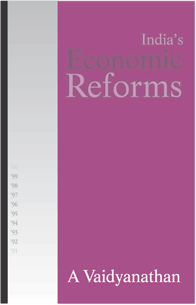
India's Economic Reforms and Development
A. Vaidyanathan
About the Book
Rapid economic growth and eradication of abject poverty have been the core concerns of India’s polity and government throughout the last five decades. Coordinated planning with the state playing the leading role in initiating and regulating the process of development in pursuit of these objectives has been a distinctive feature. Specific targets, perceptions of the problems involved and their solutions have been changing over time. The essays in this collection provide an overview of evolution of this process culminating in the far-reaching reorientation of strategy and policies during the nineties and a critical assessment of their rationale, implementation and impact from the political economy perspective.
The essays are divided into two sections : Those in the first part, mostly written in the nineties, focus on key elements of overall development strategy being pursued from the early nineties, the rationale and the thrust of the structural adjustment package soon after it was unveiled by Dr. Manmohan Singh, issues relating to subsidies and foreign direct investment and broader issues of the role of the state generally and of planning in particular in the changed context.
The lead piece in this section pulls together the assessment of different aspects and attempts an overall assessment of the antecedents of the reforms of the nineties, their halting and meandering course and the reasons for their less-than-expected achievements. It also reflects on the prospects for the future.
Selections in the second section spanning over a much longer period discuss issues relating to poverty — concepts, data and measurement and regional variations, evolution of poverty alleviation programmes, critical commentary on their design, implementation and measures to improve their efficacy.
The general thrust of the essays is critical of the design and implementation of the reform package and skeptical of its impact on growth and socio-economic inequality.
About the Author(s) / Editor(s)
A. Vaidyanathan is currently Emeritus Professor at the Madras Institute of Development Studies (Chennai, India) and is a member of the Prime Minister’s Econo-mic Advisory Council.
Born in 1931, he was educated in Madras, and did his post graduation in the USA. After obtaining a Ph.D from Cornell University, he worked for 6 years (1956-62) as economist in the National Council of Applied Economic Research, New Delhi. Thereafter he joined the Perspective Planning Division of the Planning Commission, Government of India.
After 10 years in the Planning Commission, and 4 years in the World Bank, he shifted to the Centre for Development Studies, Trivandrum, in 1976 and worked there as Professor for 8 years and has been in the Madras Institute of Development Studies since 1984.
He has been president of the Indian Society of Agricultural Economics since 1993. Currently he is also Chairperson of the Board of Trustees of the Institute of Social Studies Trust, New Delhi.
Prof. Vaidyanathan has served on a number of Government Committees : as Member of the Planning Commission in New Delhi and Tamilnadu State Planning Commission; and Chairperson of a Committee on Irrigation Pricing set up by the Planning Commission.
Contents in Detail
Section – I : Planning, State and Development
1.A Decade of Reforms
Antecedents
Expectations and Achievements
Factors Affecting Reforms and their Impact
Political Resistance to Reform
Prospects
Decentralisation
Improvement on the Fiscal Front
Agriculture
Role of Planning
2.Structural Adjustment in the Indian Economy
Approach to Planning
Policy Package and Growth Rate
Problem of Liberalisation
Devaluation and After
Major Changes
Price Increases
Safety Net
3.Attitude Towards Multinationals
The Magnitude
TNC’s and MNC’s
The Experience of South Asian Countries
Lessons for India
4.Subsidies in India
Magnitude
Implications
5.Planning, State and Development
Criticism of Planning
Planning Development at Sub-State Level
Management of Public Enterprises
State-Private Sector Relationship
6.Planning in India : Retrospect and Prospect
Introduction
Indian Planning: Distinctive Features;
Planning in a Federal Set-up;
The Political Environment;
Changes in Political Environment;
The Functioning of the Planning Commission
Reorientation of Planning
7.Development Planning Models : The Indian Experience
8.Growth of Indian Industry : Role of Demand Factors
Background
Overall Trends
Impact on Income Distribution Changes
Pattern of Consumer Demand for Manufactures: Textiles and Clothing;
Other Manufactures;
Durables
Conclusion
9.Cottage and Small Scale Industries in India : Policy and Performance
The Rationale and Strategy
The Impact
State Intervention
Section – II : Poverty, Inequality and Development Policy
10.Poverty and Development Policy
Background
Conceptual Issues
Measurement Issues
Correlates and Determinants
Policy : Targeting; Accountability
11.The New Economics of Poverty
Increasing Labour-Intensity of Production
Product-Mix
Limits to Technological Choice
Rural Development
Works Programmes
12.The Political Economy of the Evolution
of Anti-Poverty Programmes
Raising the Standard of Living of the
Poor: The First Four Plans
Political Pressures Impinging on Poverty
Alleviation Programmes
Organizational Problems Facing Poverty
Alleviation Programmes
Recent Shifts in the Debate on Decentralization
13.Restructuring Poverty Alleviation Programmes
Main Characteristics
Deficiencies
Integrated Local Area Planning
Targeting
Accountability
Role of Panchayat Raj Institutions
Conclusions and Suggestions
Design
Monitoring and Evaluation
14.Some Aspects of Inequalities in Living
Standards in Rural India
Introduction
Review of Recent Literature
The Scope of the Present Study
The Pattern of Inequality : All India
Distribution of Land Holdings and
Consumption Inequality
The Influence of Family Size
Occupation and Consumption Inequality
Consumption Inequalities: Inter-State
Variations
Behaviour of Inequalities Over Time
15.The Validity of NSS Consumption in
Rural India
Sources of Inaccuracy in NSS Data
Sampling Errors
Sampling Design
Bias in Sampling
Non-Sampling Errors
Comparison of NSS and CSO Estimates
Nature of Non-Sampling Errors in NSS
Changes in Non-Sampling Errors
Effects of Non-Sampling Errors
Conclusion
16.Asset Holdings and Consumption of
Rural Households in India :
A Study of Spatial and Temporal Variations
Level and Composition of Assets of
Rural Households
Relation between Assets and Consumption
Changes in Asset Holding and Inequality
Changes in Asset-Consumption Relation
Conclusion
17.Poverty and Economy : The Regional
Dimension
Level and Composition of Assets of
Rural Households
Reducing Regional Disparities: The
Approaches of Planners
Regional Strategy for Agriculture
The Problem of Wage Labour in
Poor Regions
Implications for Programmes and Policy
Institutional Requirements
18.Assessment of Nutritional and
Health Status
Nutrition and Health Status: Concepts
and Measurement
Conceptual Problems; Food Intake
Requirement Norms; Relevance of Morbidity
Measurement Problems
Determinants of Morbidity
Directions of Further Work
| Publisher | AF Press |
| Publication Date | 2003 |
| Number of Pages | 504 |
| ISBN |
8171882870 |
Academic Foundation (AF), based in New Delhi, is India’s leading independent publisher of academic/scholarly books in Social Sciences, specialising in Economics—Development Economics and Indian Economy in particular, and allied subjects.
About the Book
Rapid economic growth and eradication of abject poverty have been the core concerns of India’s polity and government throughout the last five decades. Coordinated planning with the state playing the leading role in initiating and regulating the process of development in pursuit of these objectives has been a distinctive feature. Specific targets, perceptions of the problems involved and their solutions have been changing over time. The essays in this collection provide an overview of evolution of this process culminating in the far-reaching reorientation of strategy and policies during the nineties and a critical assessment of their rationale, implementation and impact from the political economy perspective.
The essays are divided into two sections : Those in the first part, mostly written in the nineties, focus on key elements of overall development strategy being pursued from the early nineties, the rationale and the thrust of the structural adjustment package soon after it was unveiled by Dr. Manmohan Singh, issues relating to subsidies and foreign direct investment and broader issues of the role of the state generally and of planning in particular in the changed context.
The lead piece in this section pulls together the assessment of different aspects and attempts an overall assessment of the antecedents of the reforms of the nineties, their halting and meandering course and the reasons for their less-than-expected achievements. It also reflects on the prospects for the future.
Selections in the second section spanning over a much longer period discuss issues relating to poverty — concepts, data and measurement and regional variations, evolution of poverty alleviation programmes, critical commentary on their design, implementation and measures to improve their efficacy.
The general thrust of the essays is critical of the design and implementation of the reform package and skeptical of its impact on growth and socio-economic inequality.
About the Author(s) / Editor(s)
A. Vaidyanathan is currently Emeritus Professor at the Madras Institute of Development Studies (Chennai, India) and is a member of the Prime Minister’s Econo-mic Advisory Council.
Born in 1931, he was educated in Madras, and did his post graduation in the USA. After obtaining a Ph.D from Cornell University, he worked for 6 years (1956-62) as economist in the National Council of Applied Economic Research, New Delhi. Thereafter he joined the Perspective Planning Division of the Planning Commission, Government of India.
After 10 years in the Planning Commission, and 4 years in the World Bank, he shifted to the Centre for Development Studies, Trivandrum, in 1976 and worked there as Professor for 8 years and has been in the Madras Institute of Development Studies since 1984.
He has been president of the Indian Society of Agricultural Economics since 1993. Currently he is also Chairperson of the Board of Trustees of the Institute of Social Studies Trust, New Delhi.
Prof. Vaidyanathan has served on a number of Government Committees : as Member of the Planning Commission in New Delhi and Tamilnadu State Planning Commission; and Chairperson of a Committee on Irrigation Pricing set up by the Planning Commission.
Contents in Detail
Section – I : Planning, State and Development
1.A Decade of Reforms
Antecedents
Expectations and Achievements
Factors Affecting Reforms and their Impact
Political Resistance to Reform
Prospects
Decentralisation
Improvement on the Fiscal Front
Agriculture
Role of Planning
2.Structural Adjustment in the Indian Economy
Approach to Planning
Policy Package and Growth Rate
Problem of Liberalisation
Devaluation and After
Major Changes
Price Increases
Safety Net
3.Attitude Towards Multinationals
The Magnitude
TNC’s and MNC’s
The Experience of South Asian Countries
Lessons for India
4.Subsidies in India
Magnitude
Implications
5.Planning, State and Development
Criticism of Planning
Planning Development at Sub-State Level
Management of Public Enterprises
State-Private Sector Relationship
6.Planning in India : Retrospect and Prospect
Introduction
Indian Planning: Distinctive Features;
Planning in a Federal Set-up;
The Political Environment;
Changes in Political Environment;
The Functioning of the Planning Commission
Reorientation of Planning
7.Development Planning Models : The Indian Experience
8.Growth of Indian Industry : Role of Demand Factors
Background
Overall Trends
Impact on Income Distribution Changes
Pattern of Consumer Demand for Manufactures: Textiles and Clothing;
Other Manufactures;
Durables
Conclusion
9.Cottage and Small Scale Industries in India : Policy and Performance
The Rationale and Strategy
The Impact
State Intervention
Section – II : Poverty, Inequality and Development Policy
10.Poverty and Development Policy
Background
Conceptual Issues
Measurement Issues
Correlates and Determinants
Policy : Targeting; Accountability
11.The New Economics of Poverty
Increasing Labour-Intensity of Production
Product-Mix
Limits to Technological Choice
Rural Development
Works Programmes
12.The Political Economy of the Evolution
of Anti-Poverty Programmes
Raising the Standard of Living of the
Poor: The First Four Plans
Political Pressures Impinging on Poverty
Alleviation Programmes
Organizational Problems Facing Poverty
Alleviation Programmes
Recent Shifts in the Debate on Decentralization
13.Restructuring Poverty Alleviation Programmes
Main Characteristics
Deficiencies
Integrated Local Area Planning
Targeting
Accountability
Role of Panchayat Raj Institutions
Conclusions and Suggestions
Design
Monitoring and Evaluation
14.Some Aspects of Inequalities in Living
Standards in Rural India
Introduction
Review of Recent Literature
The Scope of the Present Study
The Pattern of Inequality : All India
Distribution of Land Holdings and
Consumption Inequality
The Influence of Family Size
Occupation and Consumption Inequality
Consumption Inequalities: Inter-State
Variations
Behaviour of Inequalities Over Time
15.The Validity of NSS Consumption in
Rural India
Sources of Inaccuracy in NSS Data
Sampling Errors
Sampling Design
Bias in Sampling
Non-Sampling Errors
Comparison of NSS and CSO Estimates
Nature of Non-Sampling Errors in NSS
Changes in Non-Sampling Errors
Effects of Non-Sampling Errors
Conclusion
16.Asset Holdings and Consumption of
Rural Households in India :
A Study of Spatial and Temporal Variations
Level and Composition of Assets of
Rural Households
Relation between Assets and Consumption
Changes in Asset Holding and Inequality
Changes in Asset-Consumption Relation
Conclusion
17.Poverty and Economy : The Regional
Dimension
Level and Composition of Assets of
Rural Households
Reducing Regional Disparities: The
Approaches of Planners
Regional Strategy for Agriculture
The Problem of Wage Labour in
Poor Regions
Implications for Programmes and Policy
Institutional Requirements
18.Assessment of Nutritional and
Health Status
Nutrition and Health Status: Concepts
and Measurement
Conceptual Problems; Food Intake
Requirement Norms; Relevance of Morbidity
Measurement Problems
Determinants of Morbidity
Directions of Further Work
| Publisher | AF Press |
| Publication Date | 2003 |
| Number of Pages | 504 |
| ISBN |
8171882870 |
Couldn't load pickup availability
Share
-
Curated Collections By AF Press
-
Premium Print Quality
-
Author-Centric Publishing
-
Trusted by Readers Nationwide
India's Economic Reforms and Development