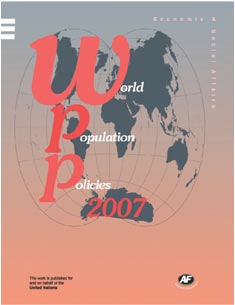
World Population Policies 2007
United Nations
About the Book
The publication provides a summary overview of population policies and dynamics for each of the United Nations Member and non-member States for which data are available at mid-decade for the 1970s, 1980s, 1990s and for 2007.
The core information included in the monitoring of population policies encompasses two basic components:
Government perceptions of population size and growth, population age structure and spatial distribution, and of the demographic components of fertility, mortality and migration which affect them. For each of these variables, is the level or trend viewed as a significant policy issue, and is the prevailing level or rate of change seen as too high, too low or acceptable/satisfactory in relation to other social and economic conditions?
Government policies with respect to each variable. Is the policy of the Government to raise, lower or maintain the current level of the variable? Has the Government actively intervened to influence the variable and, if so, by what means?
This publication shows, on a country-by-country basis, the evolution of Government views and policies from 1976 to 2007 with respect to population size and growth, population age structure, fertility and family planning, health and mortality, spatial distribution and international migration. Within the context of demographic, social and economic change. The material is presented in the form of two-page data sheets: the first page contains population policy data for each country for 1976, 1986, 1996 and 2007, and the second page provides population indicators for the corresponding years.
About the Author(s) / Editor(s)
UNITED NATIONS
Contents in Detail
Preface
Explanatory notes
Introduction
Part One. GOVERNMENT VIEWS AND POLICIES
I.POPULATION SIZE AND GROWTH
II.POPULATION AGE STRUCTURE
III.FERTILITY AND FAMILY PLANNING
IV.HEALTH AND MORTALITY
V.SPATIAL DISTRIBUTION AND INTERNAL
MIGRATION
VI.INTERNATIONAL MIGRATION
VII.SUMMARY AND CONCLUSIONS
PART TWO. COUNTRY PROFILES
VIII.DEFINITIONS AND SOURCES
A. GLOSSARY
1. GOVERNMENT PERCEPTIONS AND POLICIES
2. DEMOGRAPHIC INDICATORS
B. SOURCES
C. ORDERING THE DATA ON CD-ROM
IX.PROFILES OF NATIONAL POPULATION POLICIES
Afghanistan
Albania
Algeria
Andorra
Angola
Antigua and Barbuda
Argentina
Armenia
Australia
Austria
Azerbaijan
Bahamas
Bahrain
Bangladesh
Barbados
Belarus
Belgium
Belize
Benin
Bhutan
Bolivia
Bosnia and Herzegovina
Botswana
Brazil
Brunei Darussalam
Bulgaria
Burkina Faso
Burundi
Cambodia
Cameroon
Canada
Cape Verde
Central African Republic
Chad
Chile
China
Colombia
Comoros
Congo
Cook Islands
Costa Rica
Côte d’Ivoire
Croatia
Cuba
Cyprus
Czech Republic
Democratic People’s Republic of Korea
Democratic Republic of the Congo
Democratic Republic of Timor-Leste
Denmark
Djibouti
Dominica
Dominican Republic
Ecuador
Egypt
El Salvador
Equatorial Guinea
Eritrea
Estonia
Ethiopia
Fiji
Finland
France
Gabon
Gambia
Georgia
Germany
Ghana
Greece
Grenada
Guatemala
Guinea
Guinea-Bissau
Guyana
Haiti
Holy See
Honduras
Hungary
Iceland
India
Indonesia
Iran (Islamic Republic of)
Iraq
Ireland
Israel
Italy
Jamaica
Japan
Jordan
Kazakhstan
Kenya
Kiribati
Kuwait
Kyrgyzstan
Lao People’s Democratic Republic
Latvia
Lebanon
Lesotho
Liberia
Libyan Arab Jamahiriya
Liechtenstein
Lithuania
Luxembourg
Madagascar
Malawi
Malaysia
Maldives
Mali
Malta
Marshall Islands
Mauritania
Mauritius
Mexico
Micronesia (Federated States of)
Monaco
Mongolia
Morocco
Mozambique
Myanmar
Namibia
Nauru
Nepal
Netherlands
New Zealand
Nicaragua
Niger
Nigeria
Niue
Norway
Oman
Pakistan
Palau
Panama
Papua New Guinea
Paraguay
Peru
Philippines
Poland
Portugal
Qatar
Republic of Korea
Republic of Moldova
Romania
Russian Federation
Rwanda
Saint Kitts and Nevis
Saint Lucia
Saint Vincent and the Grenadines
Samoa
San Marino
Sao Tome and Principe
Saudi Arabia
Senegal
Serbia and Montenegro
Seychelles
Sierra Leone
Singapore
Slovakia
Slovenia
Solomon Islands
Somalia
South Africa
Spain
Sri Lanka
Sudan
Suriname
Swaziland
Sweden
Switzerland
Syrian Arab Republic
Tajikistan
Thailand
The former Yugoslav Republic of Macedonia
Togo
Tonga
Trinidad and Tobago
Tunisia
Turkey
Turkmenistan
Tuvalu
Uganda
Ukraine
United Arab Emirates
United Kingdom of Great Britain and Northern Ireland
United Republic of Tanzania
United States of America
Uruguay
Uzbekistan
Vanuatu
Venezuela
Viet Nam
Yemen
Zambia
Zimbabwe
| Publisher | AF Press |
| Publication Date | 2008 |
| Number of Pages | 496 |
| ISBN |
8171887064 |
Academic Foundation (AF), based in New Delhi, is India’s leading independent publisher of academic/scholarly books in Social Sciences, specialising in Economics—Development Economics and Indian Economy in particular, and allied subjects.
About the Book
The publication provides a summary overview of population policies and dynamics for each of the United Nations Member and non-member States for which data are available at mid-decade for the 1970s, 1980s, 1990s and for 2007.
The core information included in the monitoring of population policies encompasses two basic components:
Government perceptions of population size and growth, population age structure and spatial distribution, and of the demographic components of fertility, mortality and migration which affect them. For each of these variables, is the level or trend viewed as a significant policy issue, and is the prevailing level or rate of change seen as too high, too low or acceptable/satisfactory in relation to other social and economic conditions?
Government policies with respect to each variable. Is the policy of the Government to raise, lower or maintain the current level of the variable? Has the Government actively intervened to influence the variable and, if so, by what means?
This publication shows, on a country-by-country basis, the evolution of Government views and policies from 1976 to 2007 with respect to population size and growth, population age structure, fertility and family planning, health and mortality, spatial distribution and international migration. Within the context of demographic, social and economic change. The material is presented in the form of two-page data sheets: the first page contains population policy data for each country for 1976, 1986, 1996 and 2007, and the second page provides population indicators for the corresponding years.
About the Author(s) / Editor(s)
UNITED NATIONS
Contents in Detail
Preface
Explanatory notes
Introduction
Part One. GOVERNMENT VIEWS AND POLICIES
I.POPULATION SIZE AND GROWTH
II.POPULATION AGE STRUCTURE
III.FERTILITY AND FAMILY PLANNING
IV.HEALTH AND MORTALITY
V.SPATIAL DISTRIBUTION AND INTERNAL
MIGRATION
VI.INTERNATIONAL MIGRATION
VII.SUMMARY AND CONCLUSIONS
PART TWO. COUNTRY PROFILES
VIII.DEFINITIONS AND SOURCES
A. GLOSSARY
1. GOVERNMENT PERCEPTIONS AND POLICIES
2. DEMOGRAPHIC INDICATORS
B. SOURCES
C. ORDERING THE DATA ON CD-ROM
IX.PROFILES OF NATIONAL POPULATION POLICIES
Afghanistan
Albania
Algeria
Andorra
Angola
Antigua and Barbuda
Argentina
Armenia
Australia
Austria
Azerbaijan
Bahamas
Bahrain
Bangladesh
Barbados
Belarus
Belgium
Belize
Benin
Bhutan
Bolivia
Bosnia and Herzegovina
Botswana
Brazil
Brunei Darussalam
Bulgaria
Burkina Faso
Burundi
Cambodia
Cameroon
Canada
Cape Verde
Central African Republic
Chad
Chile
China
Colombia
Comoros
Congo
Cook Islands
Costa Rica
Côte d’Ivoire
Croatia
Cuba
Cyprus
Czech Republic
Democratic People’s Republic of Korea
Democratic Republic of the Congo
Democratic Republic of Timor-Leste
Denmark
Djibouti
Dominica
Dominican Republic
Ecuador
Egypt
El Salvador
Equatorial Guinea
Eritrea
Estonia
Ethiopia
Fiji
Finland
France
Gabon
Gambia
Georgia
Germany
Ghana
Greece
Grenada
Guatemala
Guinea
Guinea-Bissau
Guyana
Haiti
Holy See
Honduras
Hungary
Iceland
India
Indonesia
Iran (Islamic Republic of)
Iraq
Ireland
Israel
Italy
Jamaica
Japan
Jordan
Kazakhstan
Kenya
Kiribati
Kuwait
Kyrgyzstan
Lao People’s Democratic Republic
Latvia
Lebanon
Lesotho
Liberia
Libyan Arab Jamahiriya
Liechtenstein
Lithuania
Luxembourg
Madagascar
Malawi
Malaysia
Maldives
Mali
Malta
Marshall Islands
Mauritania
Mauritius
Mexico
Micronesia (Federated States of)
Monaco
Mongolia
Morocco
Mozambique
Myanmar
Namibia
Nauru
Nepal
Netherlands
New Zealand
Nicaragua
Niger
Nigeria
Niue
Norway
Oman
Pakistan
Palau
Panama
Papua New Guinea
Paraguay
Peru
Philippines
Poland
Portugal
Qatar
Republic of Korea
Republic of Moldova
Romania
Russian Federation
Rwanda
Saint Kitts and Nevis
Saint Lucia
Saint Vincent and the Grenadines
Samoa
San Marino
Sao Tome and Principe
Saudi Arabia
Senegal
Serbia and Montenegro
Seychelles
Sierra Leone
Singapore
Slovakia
Slovenia
Solomon Islands
Somalia
South Africa
Spain
Sri Lanka
Sudan
Suriname
Swaziland
Sweden
Switzerland
Syrian Arab Republic
Tajikistan
Thailand
The former Yugoslav Republic of Macedonia
Togo
Tonga
Trinidad and Tobago
Tunisia
Turkey
Turkmenistan
Tuvalu
Uganda
Ukraine
United Arab Emirates
United Kingdom of Great Britain and Northern Ireland
United Republic of Tanzania
United States of America
Uruguay
Uzbekistan
Vanuatu
Venezuela
Viet Nam
Yemen
Zambia
Zimbabwe
| Publisher | AF Press |
| Publication Date | 2008 |
| Number of Pages | 496 |
| ISBN |
8171887064 |
Couldn't load pickup availability
Share
-
Curated Collections By AF Press
-
Premium Print Quality
-
Author-Centric Publishing
-
Trusted by Readers Nationwide
World Population Policies 2007