

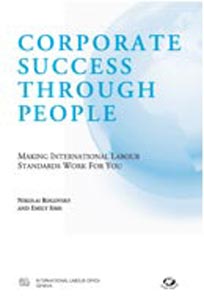
Corporate Success Through People
Emily Sims‚ Nikolai Rogovsky
About the Book
In today’s global economy, corporate managers are in the front line when it comes to transforming management principles from an abstract vision into reality. International labour standards (ILS) can be effective and powerful tools around which managers can build their corporate policies and practices. ILS embody the principle that workers are an asset in which to invest, rather than a cost to be borne, and this book presents convincing evidence that the practical implementation of these standards can help a company develop its competitive edge by putting people first.
The book presents numerous case studies from both large and small companies all over the world, where the adoption of ILS has transformed working practices. It provides concrete examples of how implementing ILS on issues such as recruiting and hiring, employee involvement and labour relations, and health and safety, has helped organizations to create a healthy and positive working environment while at the same time reducing labour costs and increasing productivity.
Dealing with such contemporary contexts as the global economy, online recruiting, an ageing workforce, and HIV/AIDS in the workplace, this is a timely and important resource for managers who want to know how to treat their employees with dignity without compromising the bottom line. It shows how implementing ILS in any company is not only a wise code of conduct, but makes sound business sense as well.
Is there a trade-off between treating employees well and succeeding in business ? Many employers assume that treating employees well means higher labour costs and lower profits. But a number of companies have found that they can do well by their employees and also succeed in business. The aim of this book is to explain how.
About the Author(s) / Editor(s)
Nikolai Rogovsky
Emily Sims
The International Labour Organization was founded in 1919 to promote social justice and, thereby, to contribute to universal and lasting peace. Its tripartite structure is unique among agencies affiliated to the United Nations; the ILO's Governing Body includes representatives of government, and of employers' and workers' organizations. These three constituencies are active participants in regional and other meetings sponsored by the ILO, as well as in the International Labour Conference — a world forum which meets annually to discuss social and labour questions.
Over the years the ILO has issued for adoption by member States a widely respected code of international labour Conventions and Recommendations on freedom of association, employment, social policy, conditions of work, social security, industrial relations and labour administration, among others.
The ILO provides expert advice and technical assistance to member States through a network of offices and multidisciplinary teams in over 40 countries. This assistance takes the form of labour rights and industrial relations counselling, employment promotion, training in small business development, project management, advice on social security, workplace safety and working conditions, the compiling and dissemination of labour statistics, and workers' education.
Contents in Detail
| Publisher | AF Press |
| Publication Date | 2006 |
| Number of Pages | 140 |
| ISBN |
8171884989 |
Academic Foundation (AF), based in New Delhi, is India’s leading independent publisher of academic/scholarly books in Social Sciences, specialising in Economics—Development Economics and Indian Economy in particular, and allied subjects.
About the Book
In today’s global economy, corporate managers are in the front line when it comes to transforming management principles from an abstract vision into reality. International labour standards (ILS) can be effective and powerful tools around which managers can build their corporate policies and practices. ILS embody the principle that workers are an asset in which to invest, rather than a cost to be borne, and this book presents convincing evidence that the practical implementation of these standards can help a company develop its competitive edge by putting people first.
The book presents numerous case studies from both large and small companies all over the world, where the adoption of ILS has transformed working practices. It provides concrete examples of how implementing ILS on issues such as recruiting and hiring, employee involvement and labour relations, and health and safety, has helped organizations to create a healthy and positive working environment while at the same time reducing labour costs and increasing productivity.
Dealing with such contemporary contexts as the global economy, online recruiting, an ageing workforce, and HIV/AIDS in the workplace, this is a timely and important resource for managers who want to know how to treat their employees with dignity without compromising the bottom line. It shows how implementing ILS in any company is not only a wise code of conduct, but makes sound business sense as well.
Is there a trade-off between treating employees well and succeeding in business ? Many employers assume that treating employees well means higher labour costs and lower profits. But a number of companies have found that they can do well by their employees and also succeed in business. The aim of this book is to explain how.
About the Author(s) / Editor(s)
Nikolai Rogovsky
Emily Sims
The International Labour Organization was founded in 1919 to promote social justice and, thereby, to contribute to universal and lasting peace. Its tripartite structure is unique among agencies affiliated to the United Nations; the ILO's Governing Body includes representatives of government, and of employers' and workers' organizations. These three constituencies are active participants in regional and other meetings sponsored by the ILO, as well as in the International Labour Conference — a world forum which meets annually to discuss social and labour questions.
Over the years the ILO has issued for adoption by member States a widely respected code of international labour Conventions and Recommendations on freedom of association, employment, social policy, conditions of work, social security, industrial relations and labour administration, among others.
The ILO provides expert advice and technical assistance to member States through a network of offices and multidisciplinary teams in over 40 countries. This assistance takes the form of labour rights and industrial relations counselling, employment promotion, training in small business development, project management, advice on social security, workplace safety and working conditions, the compiling and dissemination of labour statistics, and workers' education.
Contents in Detail
| Publisher | AF Press |
| Publication Date | 2006 |
| Number of Pages | 140 |
| ISBN |
8171884989 |

Couldn't load pickup availability
Share
-

Curated Collections By AF Press
-

Premium Print Quality
-

Author-Centric Publishing
-

Trusted by Readers Nationwide


Corporate Success Through People