

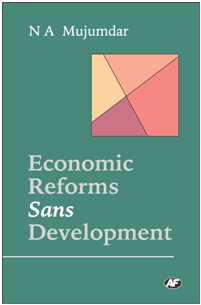
Economic Reforms Sans Development
N.A. Mujumdar
About the Book
The author argues, the emphasis of reforms seems to be on exhibiting the form of the textbook characteristics of a liberalised, and open economy, at the cost of the substance of development : reduce State intervention and involvement in economic activities, usher in market-driven economy abolish all subsidies including food and interest rate subsidies to the poor, and let the poor fend for themselves and so on. In the hierarchy of priorities of contemporary Indian policy makers, for instance, privatisation has gained ascendancy over poverty reduction. Economic reforms have thus become empty rhetorics so far as the attainment of end-objectives of development is concerned.
The bunch of 33 selected articles brought together in this book seeks to provide concrete evidence in support of this central theme. The discussion also sketches the broad contours of policy correctives that are needed if the substance of development is to be retained as an important ingredient in the macroeconomic policy mix.
The discussion in the book is organised around seven aspects :
Macro Prospective of Growth,
Monetary and Credit Policies,
Banking and Savings,
Utilisation of Forex Reserves,
Crisis of Capitalism,
Fiscal Policies, and
Hunger, Poverty and Rural Development
About the Author(s) / Editor(s)
Dr. N A Mujumdar is former Principal Adviser, Reserve Bank of India. At present he is the Editor of the Indian Journal of Agricultural Economics and also Honorary Professor at the Society for Development Studies.
Dr. Mujumdar began his career as Lecturer in what was then known as the School of Economics, University of Bombay. He was Nuffield Fellow of Oxford University, Oxford, in 1959, and after his return to India, joined the Reserve Bank of India.
Dr. Mujumdar has also worked, under the auspices of the International Monetary Fund, as Adviser to the Central Banks of five countries: Zambia, Mauritius, Tanzania, Belize and Cambodia. He was Consultant to FAO, ESCAP and the World Bank. He was member of various Working Groups appointed by the Reserve Bank of India and the Planning Commission.
He has published eight books and a number of research papers in various technical journals.
Contents in Detail
| Publisher | AF Press |
| Publication Date | 2004 |
| Number of Pages | 203 |
| ISBN |
8171883575 |
Academic Foundation (AF), based in New Delhi, is India’s leading independent publisher of academic/scholarly books in Social Sciences, specialising in Economics—Development Economics and Indian Economy in particular, and allied subjects.
About the Book
The author argues, the emphasis of reforms seems to be on exhibiting the form of the textbook characteristics of a liberalised, and open economy, at the cost of the substance of development : reduce State intervention and involvement in economic activities, usher in market-driven economy abolish all subsidies including food and interest rate subsidies to the poor, and let the poor fend for themselves and so on. In the hierarchy of priorities of contemporary Indian policy makers, for instance, privatisation has gained ascendancy over poverty reduction. Economic reforms have thus become empty rhetorics so far as the attainment of end-objectives of development is concerned.
The bunch of 33 selected articles brought together in this book seeks to provide concrete evidence in support of this central theme. The discussion also sketches the broad contours of policy correctives that are needed if the substance of development is to be retained as an important ingredient in the macroeconomic policy mix.
The discussion in the book is organised around seven aspects :
Macro Prospective of Growth,
Monetary and Credit Policies,
Banking and Savings,
Utilisation of Forex Reserves,
Crisis of Capitalism,
Fiscal Policies, and
Hunger, Poverty and Rural Development
About the Author(s) / Editor(s)
Dr. N A Mujumdar is former Principal Adviser, Reserve Bank of India. At present he is the Editor of the Indian Journal of Agricultural Economics and also Honorary Professor at the Society for Development Studies.
Dr. Mujumdar began his career as Lecturer in what was then known as the School of Economics, University of Bombay. He was Nuffield Fellow of Oxford University, Oxford, in 1959, and after his return to India, joined the Reserve Bank of India.
Dr. Mujumdar has also worked, under the auspices of the International Monetary Fund, as Adviser to the Central Banks of five countries: Zambia, Mauritius, Tanzania, Belize and Cambodia. He was Consultant to FAO, ESCAP and the World Bank. He was member of various Working Groups appointed by the Reserve Bank of India and the Planning Commission.
He has published eight books and a number of research papers in various technical journals.
Contents in Detail
| Publisher | AF Press |
| Publication Date | 2004 |
| Number of Pages | 203 |
| ISBN |
8171883575 |

Couldn't load pickup availability
Share
-

Curated Collections By AF Press
-

Premium Print Quality
-

Author-Centric Publishing
-

Trusted by Readers Nationwide


Economic Reforms Sans Development