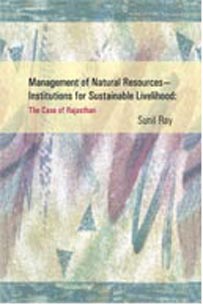
Management of Natural Resources
Institutions for Sustainable Livelihood: The case of Rajasthan
Sunil Ray
Institutions for Sustainable Livelihood: The case of Rajasthan
About the Book
In this book the author explores the relevance of communitarian institutional approach for sustainable management of renewable natural resources in Rajasthan. The book is interdisciplinary and closely verifies institutional development within the power theoretic framework. Moving from case to case, it searches for a conceivable strategy for equitable management of renewable natural resources in the public domain. While having followed proven methodologies, it has examined several aspects of institutional interventions and ecological changes that have serious implications for livelihood generation.
Despite the fact that the rural society is socially and economically heterogeneous, the book reveals that institutional sustainability against the backdrop of unequal power relations may succeed in restoring degraded eco-system by means of expanding bio-diversity. And, by doing so, it could ensure livelihood of the poor and the disadvantaged in a drought that prevailed for more than three years. All these bring missing links between poverty reduction and ecological restoration to the centre of the development discourse. Prof. Ray has systematically drawn some insightful lessons from the scenario analysis of the institutions and explores complementarity between market and community institutions. While conflicts on command over renewable resources in the state are inescapable, their resolution must be sought in the public domain, suggests Prof. Ray. It may call for vertical integration between the state, civil society organisations and community institutions.
About the Author(s) / Editor(s)
Sunil Ray is a professor at the Institute of Development Studies, Jaipur. He has earlier been on the faculty of the National Institute of Rural Development, Hyderabad. He has also served at the Institute for Social and Economic Change, Bangalore. He has been a Visiting Fellow at the Institute of Development Studies, Sussex (UK). Prof. Ray has conducted several research studies sponsored by both national and international organisations. He has been in a Review Mission Team of the European Commission. Besides having published extensively in national and International journals, Prof. Ray has authored several books including Protection and Indus-trial Growth in India and Natural Resources, Organization and Technology Linkages. He has also co-authored Agricultural Services and the Poor: Case of Livestock Health and Breeding Services in India.
Contents in Detail
List of Tables, Figures and Annexures
Foreword
Preface
Introduction
• Background
• Criticality of Nature Capital
• Understanding Community
• Social Capital, Power Relations
and Institutions
• Objectives
• Methodology
• Sampling Design
• The Plan of the Book
Pastureland Development
• Introduction
• The Social Context
• Institutional Renovation
• Organisational Networking
• Formalisation of VDS
• Framing of Rules
• Institutional Flexibility
• Head Load System
• Coping Strategy
• Distribution Mechanism
• Institutional Renovation or Failure?
• Gains from Institutional Renovation
• The Social Context
• Resource Base of the Village
• Making an Institution
• Gains from Institutional Renovation
• Institutional Stability
• Floral Diversity
• Physico-Chemical Characteristics of Soil
• Commentary
• Analysis of Probable Scenarios
• Conclusion
Rainwater Harvesting
• Introduction
• The Study Area: A Brief Outline
• Entry of TBS
• Development Contrasts: Upstream
Versus Downstream
• Changing Agricultural Scenario
• Cropping Pattern and Crop Yield
• Livestock Development
• Floral Diversity
• Conclusion
Development of Farm Forestry
• Introduction
• Society and Panchayat
• Society and IFFDC
• Village Profile
• Encroachment
• Indigenous Technique
• Management of Grass Distribution
• Access to Resources
• Ecological Impact
• Floral Diversity
• Employment Opportunities
• Livestock
• Other Probable Institutional Outcomes
• Conclusion
Revival of a Degraded Forest
• Introduction
• Genesis of Institutional Development
• Village Institution: Transition from
Informal to Formal
• Content of Social Capital
• Framing of Rules
• Plantation Programme
• Resource Base and its Changing Status
• Access to Improved Resource Base
• Ecological Impact
• Floral Diversity
• Surviving Species: Planted Versus Native
• Plot-wise Analysis of Survival of Plants
• Institutional Prospects: Was Reconciliation
Successful?
• Conclusion
Micro Watershed Development
• Introduction
• Past Initiatives
• Entry of PSBUSS
• Institution Building
• River Training Works
• Management of Drinking Water Supply
• Plantation and Sand Dune Stabilisation
• Floral Diversity
• Importance Value Index (IVI)
• Soil Characteristics
• Changing Land Use Pattern
• Changing Educational Background
• Changing Status of Livestock Resources
• Conclusion
Women’s Gain
• Introduction
• Approaches
• Women’s Participation
• Gains from Intervention
• Conclusion
Summing Up
• Power Relations, Social Processes
and Institutional Sustainability
• Entitlement to Improved Resource Base
• Ecological and Institutional Resilience
• Gains for the Village Economy
• Women’s Gain
• Institutional Performance and Capacity Building
• Market and Community Institution
In Search of an Alternative Perspective
• Ecology, Poverty and Local Institutions
References
Annexures
Index
| Publisher | AF Press |
| Publication Date | 2008 |
| Number of Pages | 420 |
| ISBN |
9788171886272 |
Academic Foundation (AF), based in New Delhi, is India’s leading independent publisher of academic/scholarly books in Social Sciences, specialising in Economics—Development Economics and Indian Economy in particular, and allied subjects.
About the Book
In this book the author explores the relevance of communitarian institutional approach for sustainable management of renewable natural resources in Rajasthan. The book is interdisciplinary and closely verifies institutional development within the power theoretic framework. Moving from case to case, it searches for a conceivable strategy for equitable management of renewable natural resources in the public domain. While having followed proven methodologies, it has examined several aspects of institutional interventions and ecological changes that have serious implications for livelihood generation.
Despite the fact that the rural society is socially and economically heterogeneous, the book reveals that institutional sustainability against the backdrop of unequal power relations may succeed in restoring degraded eco-system by means of expanding bio-diversity. And, by doing so, it could ensure livelihood of the poor and the disadvantaged in a drought that prevailed for more than three years. All these bring missing links between poverty reduction and ecological restoration to the centre of the development discourse. Prof. Ray has systematically drawn some insightful lessons from the scenario analysis of the institutions and explores complementarity between market and community institutions. While conflicts on command over renewable resources in the state are inescapable, their resolution must be sought in the public domain, suggests Prof. Ray. It may call for vertical integration between the state, civil society organisations and community institutions.
About the Author(s) / Editor(s)
Sunil Ray is a professor at the Institute of Development Studies, Jaipur. He has earlier been on the faculty of the National Institute of Rural Development, Hyderabad. He has also served at the Institute for Social and Economic Change, Bangalore. He has been a Visiting Fellow at the Institute of Development Studies, Sussex (UK). Prof. Ray has conducted several research studies sponsored by both national and international organisations. He has been in a Review Mission Team of the European Commission. Besides having published extensively in national and International journals, Prof. Ray has authored several books including Protection and Indus-trial Growth in India and Natural Resources, Organization and Technology Linkages. He has also co-authored Agricultural Services and the Poor: Case of Livestock Health and Breeding Services in India.
Contents in Detail
List of Tables, Figures and Annexures
Foreword
Preface
Introduction
• Background
• Criticality of Nature Capital
• Understanding Community
• Social Capital, Power Relations
and Institutions
• Objectives
• Methodology
• Sampling Design
• The Plan of the Book
Pastureland Development
• Introduction
• The Social Context
• Institutional Renovation
• Organisational Networking
• Formalisation of VDS
• Framing of Rules
• Institutional Flexibility
• Head Load System
• Coping Strategy
• Distribution Mechanism
• Institutional Renovation or Failure?
• Gains from Institutional Renovation
• The Social Context
• Resource Base of the Village
• Making an Institution
• Gains from Institutional Renovation
• Institutional Stability
• Floral Diversity
• Physico-Chemical Characteristics of Soil
• Commentary
• Analysis of Probable Scenarios
• Conclusion
Rainwater Harvesting
• Introduction
• The Study Area: A Brief Outline
• Entry of TBS
• Development Contrasts: Upstream
Versus Downstream
• Changing Agricultural Scenario
• Cropping Pattern and Crop Yield
• Livestock Development
• Floral Diversity
• Conclusion
Development of Farm Forestry
• Introduction
• Society and Panchayat
• Society and IFFDC
• Village Profile
• Encroachment
• Indigenous Technique
• Management of Grass Distribution
• Access to Resources
• Ecological Impact
• Floral Diversity
• Employment Opportunities
• Livestock
• Other Probable Institutional Outcomes
• Conclusion
Revival of a Degraded Forest
• Introduction
• Genesis of Institutional Development
• Village Institution: Transition from
Informal to Formal
• Content of Social Capital
• Framing of Rules
• Plantation Programme
• Resource Base and its Changing Status
• Access to Improved Resource Base
• Ecological Impact
• Floral Diversity
• Surviving Species: Planted Versus Native
• Plot-wise Analysis of Survival of Plants
• Institutional Prospects: Was Reconciliation
Successful?
• Conclusion
Micro Watershed Development
• Introduction
• Past Initiatives
• Entry of PSBUSS
• Institution Building
• River Training Works
• Management of Drinking Water Supply
• Plantation and Sand Dune Stabilisation
• Floral Diversity
• Importance Value Index (IVI)
• Soil Characteristics
• Changing Land Use Pattern
• Changing Educational Background
• Changing Status of Livestock Resources
• Conclusion
Women’s Gain
• Introduction
• Approaches
• Women’s Participation
• Gains from Intervention
• Conclusion
Summing Up
• Power Relations, Social Processes
and Institutional Sustainability
• Entitlement to Improved Resource Base
• Ecological and Institutional Resilience
• Gains for the Village Economy
• Women’s Gain
• Institutional Performance and Capacity Building
• Market and Community Institution
In Search of an Alternative Perspective
• Ecology, Poverty and Local Institutions
References
Annexures
Index
| Publisher | AF Press |
| Publication Date | 2008 |
| Number of Pages | 420 |
| ISBN |
9788171886272 |
Couldn't load pickup availability
Share
-
Curated Collections By AF Press
-
Premium Print Quality
-
Author-Centric Publishing
-
Trusted by Readers Nationwide
Management of Natural Resources