


The State of Ecology of the Tibetan Plateau
L.M.S. Palni (Ed.)‚ Rebon Banerjee Dhar (Ed.)‚ O.P. Tandon (Ed.)
Foreword: L.M.S. Palni (Ed.)Rebon Banerjee Dhar (Ed.)O.P. Tandon (Ed.)
About the Book
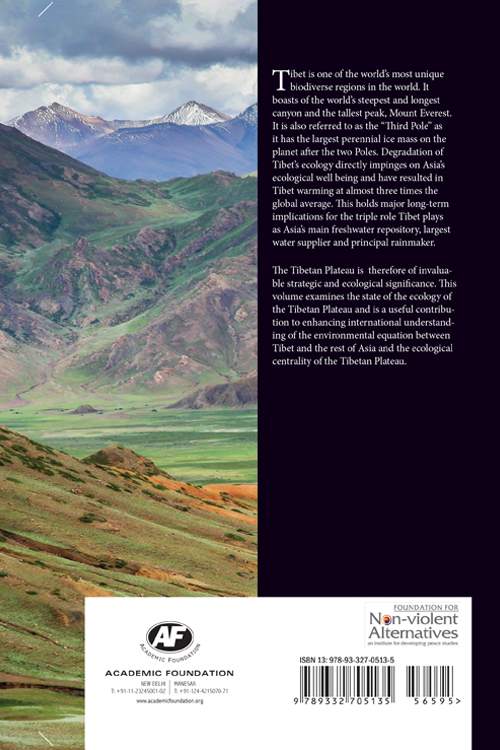
Tibet is one of the world’s most unique biodiverse regions in the world. It boasts of the world’s steepest and longest canyon and the tallest peak, Mount Everest. It is also referred to as the “Third Pole” as it has the largest perennial ice mass on the planet after the two Poles. Degradation of Tibet’s ecology directly impinges on Asia’s ecological well being and have resulted in Tibet warming at almost three times the global average. This holds major long-term implications for the triple role Tibet plays as Asia’s main freshwater repository, largest water supplier and principal rainmaker.
The Tibetan Plateau is therefore of invaluable strategic and ecological significance. This volume examines the state of the ecology of the Tibetan Plateau and is a useful contribution to enhancing international understanding of the environmental equation between Tibet and the rest of Asia and the ecological centrality of the Tibetan Plateau.
About the Author(s) / Editor(s)
L.M.S. Palni, Former Director, G.B. Pant Institute of Himalayan Environment and Development, Almora.
Rebon Banerjee Dhar, Founding Trustee, Foundation for non violent Alternatives.
O.P. Tandon, Founding Trustee, Foundation for non violent Alternatives.
Contributors
Tempa Gyaltsen
Andreas Gruschke
Gabriel Lafitte
Zhou Lei
Chandan Mahanta
Nimmi Kurian
Pankaj Chandan
Kiran Rajashekariah
Aadya Singh
Shaofeng Jia
Zhu Wenbin
Yan Han
Grace Mang
Yang Yong
Minghong Yang
Åshild Kolås
Tashi Nyima
Claude Arpi
Zhanggui Zhou
Ranbeer S. Rawal
Mahendra R. Bhutiyani
Archana Sarkar
Shresth Tayal
Nathaniel B Dkhar
Contents in Detail
| Publisher | AF Press |
| Publication Date | 2019 |
| Number of Pages | 296 |
| ISBN |
9789332705135 |
Academic Foundation (AF), based in New Delhi, is India’s leading independent publisher of academic/scholarly books in Social Sciences, specialising in Economics—Development Economics and Indian Economy in particular, and allied subjects.
About the Book
Tibet is one of the world’s most unique biodiverse regions in the world. It boasts of the world’s steepest and longest canyon and the tallest peak, Mount Everest. It is also referred to as the “Third Pole” as it has the largest perennial ice mass on the planet after the two Poles. Degradation of Tibet’s ecology directly impinges on Asia’s ecological well being and have resulted in Tibet warming at almost three times the global average. This holds major long-term implications for the triple role Tibet plays as Asia’s main freshwater repository, largest water supplier and principal rainmaker.
The Tibetan Plateau is therefore of invaluable strategic and ecological significance. This volume examines the state of the ecology of the Tibetan Plateau and is a useful contribution to enhancing international understanding of the environmental equation between Tibet and the rest of Asia and the ecological centrality of the Tibetan Plateau.
About the Author(s) / Editor(s)
L.M.S. Palni, Former Director, G.B. Pant Institute of Himalayan Environment and Development, Almora.
Rebon Banerjee Dhar, Founding Trustee, Foundation for non violent Alternatives.
O.P. Tandon, Founding Trustee, Foundation for non violent Alternatives.
Contributors
Tempa Gyaltsen
Andreas Gruschke
Gabriel Lafitte
Zhou Lei
Chandan Mahanta
Nimmi Kurian
Pankaj Chandan
Kiran Rajashekariah
Aadya Singh
Shaofeng Jia
Zhu Wenbin
Yan Han
Grace Mang
Yang Yong
Minghong Yang
Åshild Kolås
Tashi Nyima
Claude Arpi
Zhanggui Zhou
Ranbeer S. Rawal
Mahendra R. Bhutiyani
Archana Sarkar
Shresth Tayal
Nathaniel B Dkhar
Contents in Detail
| Publisher | AF Press |
| Publication Date | 2019 |
| Number of Pages | 296 |
| ISBN |
9789332705135 |

Couldn't load pickup availability
Share

-

Curated Collections By AF Press
-

Premium Print Quality
-

Author-Centric Publishing
-

Trusted by Readers Nationwide


The State of Ecology of the Tibetan P...