Indian Economy
Economic Development and Policy (2016-17)
Uma Kapila (Ed.)
Economic Development and Policy (2016-17)
Foreword: Uma Kapila (Ed.)
About the Book
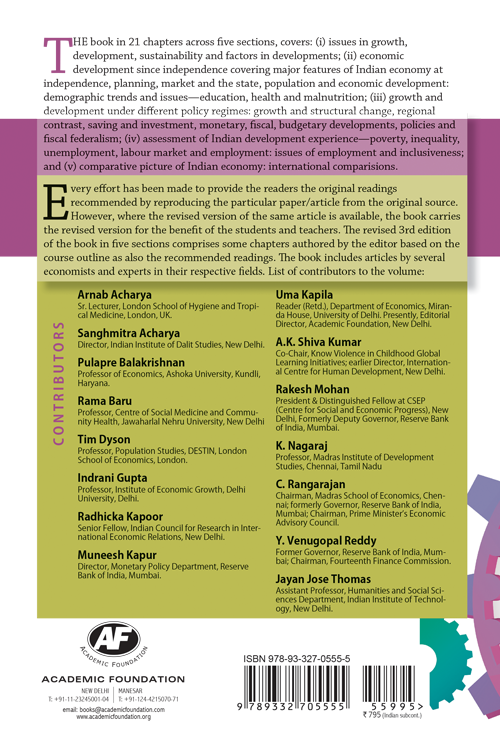
This book has been designed to cover the course content of Indian Economy paper for the students of B.A. Programme and B.A. (Hons.) other than Economics, including B. Com (Hons.). The book, in five sections, aims to provide comprehensive coverage of the Indian economy as per the course outline with original readings as recommended.
Section I discusses the issues in growth, development and sustainability and factors in development followed by economic development in India since Independence (Section II). Section III is devoted to growth and structural change in Indian economy. Section IV provides an assessment of Indian development experience covering critical evaluation of growth, inequality, poverty, employment and unemployment. Section V looks into a comparative picture of Indian economy.
The analysis and discussion covering these 5 sections in 20 chapters include contributors by economics and experts in their respective fields.
About the Author(s) / Editor(s)
UMA KAPILA, author/editor of several other books, has taught Indian Economy to undergraduate students for over forty-two years. She retired as Reader from the Department of Economics, Miranda House, University of Delhi. Presently, she is Senior Editor, Academic Foundation.
An Honours Graduate from Miranda House, University of Delhi and M.A. and Ph.D. from Delhi School of Economics, Dr. Uma Kapila has also served on the Planning Commission Study Group on “Agricultural Strategies in the Eastern Region of India for the Seventh Five Year Plan” (Perspective Planning Division).
Dr. Uma Kapila is the author of the book Oilseeds Economy of India (1982) published by the Institute of Economic Growth, Delhi. She is also the author/editor of two other textbooks on Indian economy, one meant for B.A. (Hons.) Economics, and the other for B.A.(Programme) and B.Com (Hons.) and Honours other than Economics. She has edited, and co-edited with Raj Kapila, a number of books on India’s economy, banking and finance.
Contributors
Arnab Acharya, Sr. Lecturer, London School of Hygiene
and Tropical Medicine, London, UK.
Sanghmitra Acharya, Director, Indian Institute of Dalit Studies,
New Delhi.
Pulapre Balakrishnan, Professor of Economics,
Ashoka University, Kundli, Haryana.
Rama Baru, Professor, Centre of Social Medicine and
Community Health, Jawaharlal Nehru University, New Delhi
Kaushik Basu, Economist, Senior Vice-President and
Chief Economist, World Bank, Washington, USA.
S. Mahendra Dev, Director (Vice Chancellor),
Indira Gandhi Institute of Development Research, Mumbai.
Tim Dyson, Professor, Population Studies, DESTIN,
London School of Economics, London.
Uma Kapila, Reader (Retd.), Department of Economics,
Miranda House, University of Delhi.
Presently, Senior Editor,
A.K. Shiva Kumar, Co-Chair, Know Violence in Childhood
Global Learning Initiatives; earlier Director, International Centre
for Human Development, New Delhi.
Rakesh Mohan, Executive Director, International Monetary
Fund (IMF) Washington, DC representing India,
Sri Lanka and Bhutan.
K. Nagaraj, Professor, Madras Institute of
Development Studies, Chennai, Tamil Nadu
T.S. Papola, ICSSR National Fellow, Institute for Studies
in Industrial Development (ISID), New Delhi.
C. Rangarajan, Chairman, Madras School of Economics,
Chennai; formerly Chairman, Prime Minister’s Economic Advisory
Council; Chairman, Twelfth Finance Commission.
Alakh N. Sharma, Director, Institute for Human Development (IHD),
New Delhi.
Jayan Jose Thomas, Assistant Professor, Humanities and
Social Sciences Department, Indian Institute of Technology, New Delhi.
Contents in Detail
Preface
Contributors
SECTION I
ISSUES IN GROWTH, DEVELOPMENT, SUSTAINABILITY
AND FACTORS IN DEVELOPMENT
1. Growth, Development and Sustainability
Uma Kapila
• Introduction
• What Does Development Mean
• Economic Growth and Economic Development
• The New View of Economic Development
• Development, Freedom and Opportunities
• The Three Objectives of Development
• Human Development
• Are there Limits to Human Development?
• What Makes Development Unsustainable?
• The Current State of Human Development
• The Millennium Development Goals
• Developed and Underdeveloped Countries
• Defining the Developing World
• Characteristics of the Developing World:
Diversity within Commonality
2. Factors in Development
Uma Kapila
• Introduction
• Economic Factors
• Non-Economic Factors
• Conclusion
3. Capital Formation
Uma Kapila
• What is Capital Formation?
• Process of Capital Formation
• Role of Capital Formation
• Problem of Capital Formation
• Theory of Balanced Growth
• Supply-Side of Capital Formation
• Foreign Capital and Economic Development
SECTION II
ECONOMIC DEVELOPMENT IN INDIA SINCE INDEPENDENCE
4. Indian Economy at Independence
Uma Kapila
• The Colonial Regime
• The India of 1947
• The Agrarian Scene
• The State of Indian Industry and its Structure
• The Planning Era
5. Planning, Market and the State
Uma Kapila
• Structural Constraints and the
Development Strategy
• Role of the State as Visualised in the Fifties
• Evolution of Strategy and Priorities
• Changing Perceptions
• Role of Planning in a Market Economy
• Redefining the Role of State
• The Government, the State and the Market
• Relevance of Planning Commission
• NITI Aayog: Role and Functions
6. Monetary, Fiscal and Budgetary Developments
Policies and their Impact
Uma Kapila
• Monetary Policy
• Fiscal Policy
• Recent Fiscal Performance
• Medium-Term Fiscal Framework
• Conclusions
7. Fiscal Federalism: Centre-State Fiscal Relations
Uma Kapila
• Fiscal Federalism
• Fiscal Transfers
• Guiding Factors and Work Processes
• The Context
• Major Recommendations of FFC
• Implications of FFC Recommendations for
Fiscal Federalism: A Way Ahead
8. Demographic Constraint: Population Change
and Economic Development
Uma Kapila
• Introduction
• Economic Development and Population Growth
• The Microeconomic Theory of Fertility
• Population Trends
• Gender Equity and the Demographic Transition
• Population Policy since 1947
• National Population Policy, 2000
• Human Resource Development
• Public Expenditure and Education Policy
• Health Care as a Social Responsibility
• Human Development: International Comparison
• Disparities and Divides
• Tamil Nadu: The Success Story
• The Future
• Demographic Dividend and Related
Policy Interventions
9. India’s Demographic Transition and its
Consequences for Development
Tim Dyson
• India’s Demographic Transition
• Urbanisation
• The Future
• Discussion
10. India’s Labour Market During the 2000s:
Surveying the Changes
Jayan Jose Thomas
• Broad Trends in Labour Absorption
• Explaining Jobless Growth (Second-Half of 2000s)
• Continuing Challenges to a Modern Labour Market
• Missing Women in the Indian Economy
• Conclusions
SECTION III
GROWTH AND STRUCTURAL CHANGE
11. Growth and Structural Change Since 1951
Uma Kapila
• Periodisation of Indian Growth Experience
• India’s Growth Turnaround
• Aggregate Demand
• Priorities for Reviving Growth
• Reform Agenda
• Performance on Inclusiveness
• The Need for Faster Growth
• International Comparisons
• Growth and Structural Change
• Sectoral Growth Trends
• Growth and Sectoral Shares, Cross-Country
Evidence and Indian Experience
• Inter-Regional Disparities in
Growth and Development
• The Way Ahead
• Growth Prospect: An Assessment
• Sustainable Development and Climate Change
12. The Recovery of India: Economic Growth
in the Nehru Era
Pulapre Balakrishnan
• Introduction
• Nehru-Mahalanobis Strategy
• A Record of Growth in the Nehru Era
• Caricature of a Vision: Through a Glass, Darkly
• Conclusions
13. Growth Record of the Indian Economy,
1950-2008: A Story of Sustained Savings
and Investment
Rakesh Mohan
• A Review of the Indian Growth Process
• Prospects for the Next Five Years
• Issues and Challenges
14. Growth and Investment: The Interlinks
C. Rangarajan
• Behaviour of Saving
• Behaviour of Investment
• The Way Forward
SECTION IV
ASSESSMENT OF INDIAN DEVELOPMENT EXPERIENCE
15. Assessment of the Growth Experience
Poverty, Inequality and Unemployment
Uma Kapila
• Poverty and Unemployment
• Poverty Estimates
• Poverty and Inclusive Growth
• Inequality
• Urban Inequality After Economic Reforms
• Employment
• Employment, Unemployment and
Labour Force Dynamics
• Underemployment: A Continuing
Characteristic of Employment
• Characteristics and Structure of the
Indian Labour Market
• Trends and Patterns of Employment Growth
• Summing Up: Key Features of the
Employment Situation
• Labour Market Reforms Would Help Boost
Employment Creation
• Public Employment Programme for the
Unorganised Workers: The Case of NREGA
• The Performance
• Success Stories
• Policy Agenda
• Employment Perspective
• Skill Development: The Challenge
16. Labour and Employment in Fast Growing
India: Issues of Employment and Inclusiveness
T.S. Papola and Alakh N. Sharma
• Introduction
• Some Characteristics of the Indian Labour Market
• Trend and Pattern of Employment Growth
• Impact of Global Financial 2008 Crisis on
Indian Labour Market and Employment
• Quality of Employment and Disparities
• Increasing Labour Flexibility and Erosion
of Labour Rights
• Conclusion and Policy Agenda
17. Counting the Poor: Measurement and Other Issues
C. Rangarajan and S. Mahendra Dev
• Clarifications on Issues
• What is New?
• Use of Calories
• Multidimensional Poverty
• Higher Urban Poverty
• NAS-NSS Consumption Differences
• Poverty Measures in Other Countries
• Public Expenditure and Poverty
• Poverty Ratio for Eligibility under Programmes
18. Inequities in Access to Health Services
in India Caste, Class and Region
Rama Baru, Arnab Acharya, Sanghmitra Acharya,
A.K. Shiva Kumar and K. Nagaraj
• Determinants of Health Inequities
• Features of Health Service Provisioning
• Inequities in Access to Health Services
• Factors Affecting Equity in Access to
Health Services
• Equity Enhancing Initiatives
• The Way Forward
SECTION V
COMPARATIVE PICTURE OF INDIAN ECONOMY
19. China and India: Idiosyncratic Paths to High Growth
Kaushik Basu
• Introduction
• Economic Growth: Core Factors
• The Asian Theatre
• China and India: What Were the Triggers?
• Notes on Markets and Interventions
20. Indian Economy Today:
Overview and Comparative Perspective
Uma Kapila
• Macroeconomic Management and Policy Reform
• Outlook for Growth
• Comparisons with the Non-African Poor
• India’s Decline in South Asia
• India Among the BRIC
• Conclusion
| Publisher | AF Press |
| Publication Date | 2016 |
| Number of Pages | 578 |
| ISBN |
9789332703742 |
Academic Foundation (AF), based in New Delhi, is India’s leading independent publisher of academic/scholarly books in Social Sciences, specialising in Economics—Development Economics and Indian Economy in particular, and allied subjects.
About the Book
This book has been designed to cover the course content of Indian Economy paper for the students of B.A. Programme and B.A. (Hons.) other than Economics, including B. Com (Hons.). The book, in five sections, aims to provide comprehensive coverage of the Indian economy as per the course outline with original readings as recommended.
Section I discusses the issues in growth, development and sustainability and factors in development followed by economic development in India since Independence (Section II). Section III is devoted to growth and structural change in Indian economy. Section IV provides an assessment of Indian development experience covering critical evaluation of growth, inequality, poverty, employment and unemployment. Section V looks into a comparative picture of Indian economy.
The analysis and discussion covering these 5 sections in 20 chapters include contributors by economics and experts in their respective fields.
About the Author(s) / Editor(s)
UMA KAPILA, author/editor of several other books, has taught Indian Economy to undergraduate students for over forty-two years. She retired as Reader from the Department of Economics, Miranda House, University of Delhi. Presently, she is Senior Editor, Academic Foundation.
An Honours Graduate from Miranda House, University of Delhi and M.A. and Ph.D. from Delhi School of Economics, Dr. Uma Kapila has also served on the Planning Commission Study Group on “Agricultural Strategies in the Eastern Region of India for the Seventh Five Year Plan” (Perspective Planning Division).
Dr. Uma Kapila is the author of the book Oilseeds Economy of India (1982) published by the Institute of Economic Growth, Delhi. She is also the author/editor of two other textbooks on Indian economy, one meant for B.A. (Hons.) Economics, and the other for B.A.(Programme) and B.Com (Hons.) and Honours other than Economics. She has edited, and co-edited with Raj Kapila, a number of books on India’s economy, banking and finance.
Contributors
Arnab Acharya, Sr. Lecturer, London School of Hygiene
and Tropical Medicine, London, UK.
Sanghmitra Acharya, Director, Indian Institute of Dalit Studies,
New Delhi.
Pulapre Balakrishnan, Professor of Economics,
Ashoka University, Kundli, Haryana.
Rama Baru, Professor, Centre of Social Medicine and
Community Health, Jawaharlal Nehru University, New Delhi
Kaushik Basu, Economist, Senior Vice-President and
Chief Economist, World Bank, Washington, USA.
S. Mahendra Dev, Director (Vice Chancellor),
Indira Gandhi Institute of Development Research, Mumbai.
Tim Dyson, Professor, Population Studies, DESTIN,
London School of Economics, London.
Uma Kapila, Reader (Retd.), Department of Economics,
Miranda House, University of Delhi.
Presently, Senior Editor,
A.K. Shiva Kumar, Co-Chair, Know Violence in Childhood
Global Learning Initiatives; earlier Director, International Centre
for Human Development, New Delhi.
Rakesh Mohan, Executive Director, International Monetary
Fund (IMF) Washington, DC representing India,
Sri Lanka and Bhutan.
K. Nagaraj, Professor, Madras Institute of
Development Studies, Chennai, Tamil Nadu
T.S. Papola, ICSSR National Fellow, Institute for Studies
in Industrial Development (ISID), New Delhi.
C. Rangarajan, Chairman, Madras School of Economics,
Chennai; formerly Chairman, Prime Minister’s Economic Advisory
Council; Chairman, Twelfth Finance Commission.
Alakh N. Sharma, Director, Institute for Human Development (IHD),
New Delhi.
Jayan Jose Thomas, Assistant Professor, Humanities and
Social Sciences Department, Indian Institute of Technology, New Delhi.
Contents in Detail
Preface
Contributors
SECTION I
ISSUES IN GROWTH, DEVELOPMENT, SUSTAINABILITY
AND FACTORS IN DEVELOPMENT
1. Growth, Development and Sustainability
Uma Kapila
• Introduction
• What Does Development Mean
• Economic Growth and Economic Development
• The New View of Economic Development
• Development, Freedom and Opportunities
• The Three Objectives of Development
• Human Development
• Are there Limits to Human Development?
• What Makes Development Unsustainable?
• The Current State of Human Development
• The Millennium Development Goals
• Developed and Underdeveloped Countries
• Defining the Developing World
• Characteristics of the Developing World:
Diversity within Commonality
2. Factors in Development
Uma Kapila
• Introduction
• Economic Factors
• Non-Economic Factors
• Conclusion
3. Capital Formation
Uma Kapila
• What is Capital Formation?
• Process of Capital Formation
• Role of Capital Formation
• Problem of Capital Formation
• Theory of Balanced Growth
• Supply-Side of Capital Formation
• Foreign Capital and Economic Development
SECTION II
ECONOMIC DEVELOPMENT IN INDIA SINCE INDEPENDENCE
4. Indian Economy at Independence
Uma Kapila
• The Colonial Regime
• The India of 1947
• The Agrarian Scene
• The State of Indian Industry and its Structure
• The Planning Era
5. Planning, Market and the State
Uma Kapila
• Structural Constraints and the
Development Strategy
• Role of the State as Visualised in the Fifties
• Evolution of Strategy and Priorities
• Changing Perceptions
• Role of Planning in a Market Economy
• Redefining the Role of State
• The Government, the State and the Market
• Relevance of Planning Commission
• NITI Aayog: Role and Functions
6. Monetary, Fiscal and Budgetary Developments
Policies and their Impact
Uma Kapila
• Monetary Policy
• Fiscal Policy
• Recent Fiscal Performance
• Medium-Term Fiscal Framework
• Conclusions
7. Fiscal Federalism: Centre-State Fiscal Relations
Uma Kapila
• Fiscal Federalism
• Fiscal Transfers
• Guiding Factors and Work Processes
• The Context
• Major Recommendations of FFC
• Implications of FFC Recommendations for
Fiscal Federalism: A Way Ahead
8. Demographic Constraint: Population Change
and Economic Development
Uma Kapila
• Introduction
• Economic Development and Population Growth
• The Microeconomic Theory of Fertility
• Population Trends
• Gender Equity and the Demographic Transition
• Population Policy since 1947
• National Population Policy, 2000
• Human Resource Development
• Public Expenditure and Education Policy
• Health Care as a Social Responsibility
• Human Development: International Comparison
• Disparities and Divides
• Tamil Nadu: The Success Story
• The Future
• Demographic Dividend and Related
Policy Interventions
9. India’s Demographic Transition and its
Consequences for Development
Tim Dyson
• India’s Demographic Transition
• Urbanisation
• The Future
• Discussion
10. India’s Labour Market During the 2000s:
Surveying the Changes
Jayan Jose Thomas
• Broad Trends in Labour Absorption
• Explaining Jobless Growth (Second-Half of 2000s)
• Continuing Challenges to a Modern Labour Market
• Missing Women in the Indian Economy
• Conclusions
SECTION III
GROWTH AND STRUCTURAL CHANGE
11. Growth and Structural Change Since 1951
Uma Kapila
• Periodisation of Indian Growth Experience
• India’s Growth Turnaround
• Aggregate Demand
• Priorities for Reviving Growth
• Reform Agenda
• Performance on Inclusiveness
• The Need for Faster Growth
• International Comparisons
• Growth and Structural Change
• Sectoral Growth Trends
• Growth and Sectoral Shares, Cross-Country
Evidence and Indian Experience
• Inter-Regional Disparities in
Growth and Development
• The Way Ahead
• Growth Prospect: An Assessment
• Sustainable Development and Climate Change
12. The Recovery of India: Economic Growth
in the Nehru Era
Pulapre Balakrishnan
• Introduction
• Nehru-Mahalanobis Strategy
• A Record of Growth in the Nehru Era
• Caricature of a Vision: Through a Glass, Darkly
• Conclusions
13. Growth Record of the Indian Economy,
1950-2008: A Story of Sustained Savings
and Investment
Rakesh Mohan
• A Review of the Indian Growth Process
• Prospects for the Next Five Years
• Issues and Challenges
14. Growth and Investment: The Interlinks
C. Rangarajan
• Behaviour of Saving
• Behaviour of Investment
• The Way Forward
SECTION IV
ASSESSMENT OF INDIAN DEVELOPMENT EXPERIENCE
15. Assessment of the Growth Experience
Poverty, Inequality and Unemployment
Uma Kapila
• Poverty and Unemployment
• Poverty Estimates
• Poverty and Inclusive Growth
• Inequality
• Urban Inequality After Economic Reforms
• Employment
• Employment, Unemployment and
Labour Force Dynamics
• Underemployment: A Continuing
Characteristic of Employment
• Characteristics and Structure of the
Indian Labour Market
• Trends and Patterns of Employment Growth
• Summing Up: Key Features of the
Employment Situation
• Labour Market Reforms Would Help Boost
Employment Creation
• Public Employment Programme for the
Unorganised Workers: The Case of NREGA
• The Performance
• Success Stories
• Policy Agenda
• Employment Perspective
• Skill Development: The Challenge
16. Labour and Employment in Fast Growing
India: Issues of Employment and Inclusiveness
T.S. Papola and Alakh N. Sharma
• Introduction
• Some Characteristics of the Indian Labour Market
• Trend and Pattern of Employment Growth
• Impact of Global Financial 2008 Crisis on
Indian Labour Market and Employment
• Quality of Employment and Disparities
• Increasing Labour Flexibility and Erosion
of Labour Rights
• Conclusion and Policy Agenda
17. Counting the Poor: Measurement and Other Issues
C. Rangarajan and S. Mahendra Dev
• Clarifications on Issues
• What is New?
• Use of Calories
• Multidimensional Poverty
• Higher Urban Poverty
• NAS-NSS Consumption Differences
• Poverty Measures in Other Countries
• Public Expenditure and Poverty
• Poverty Ratio for Eligibility under Programmes
18. Inequities in Access to Health Services
in India Caste, Class and Region
Rama Baru, Arnab Acharya, Sanghmitra Acharya,
A.K. Shiva Kumar and K. Nagaraj
• Determinants of Health Inequities
• Features of Health Service Provisioning
• Inequities in Access to Health Services
• Factors Affecting Equity in Access to
Health Services
• Equity Enhancing Initiatives
• The Way Forward
SECTION V
COMPARATIVE PICTURE OF INDIAN ECONOMY
19. China and India: Idiosyncratic Paths to High Growth
Kaushik Basu
• Introduction
• Economic Growth: Core Factors
• The Asian Theatre
• China and India: What Were the Triggers?
• Notes on Markets and Interventions
20. Indian Economy Today:
Overview and Comparative Perspective
Uma Kapila
• Macroeconomic Management and Policy Reform
• Outlook for Growth
• Comparisons with the Non-African Poor
• India’s Decline in South Asia
• India Among the BRIC
• Conclusion
| Publisher | AF Press |
| Publication Date | 2016 |
| Number of Pages | 578 |
| ISBN |
9789332703742 |
Couldn't load pickup availability
Share

-
Curated Collections By AF Press
-
Premium Print Quality
-
Author-Centric Publishing
-
Trusted by Readers Nationwide
Indian Economy