


Sub-Regional Cooperation between India, Myanmar and Bangladesh
Nisha Taneja‚ Deb Kusum Das‚ Samridhi Bimal (Eds.)
Foreword: Nisha Taneja (Ed.) Deb Kusum Das (Ed.)Samridhi Bimal (Ed.)
About the Book
The economic and political changes in Myanmar over the last two years along with the Modi government’s ‘Look East’ economic policy recognise the tremendous need for integrating one of the least developed region of South Asia namely —India’s north eastern states, Bangladesh, and Myanmar who share borders with each other. The book explores how greater trade in the sub-region can be a vehicle for economic integration and raise living standards for its people. It also analyses the challenges of non-trade issues such as connectivity, investments, infrastructure, deficiencies in logistics, lack of technical capacity, etc., which act as hindrances to economic cooperation as well as integration.
The book is the research collaboration of scholars from leading institutions of India, Myanmar, and Bangladesh to analyse important aspects of economic integration and cooperation from the perspective of each of these countries so as to overcome the challenges that act as a deterrent to poverty eradication in the sub region. The initiative was funded by the Department for International Development (DFID) and implemented by the Indian Council for Research on International Economics Relations (ICRIER).
Praise for the book
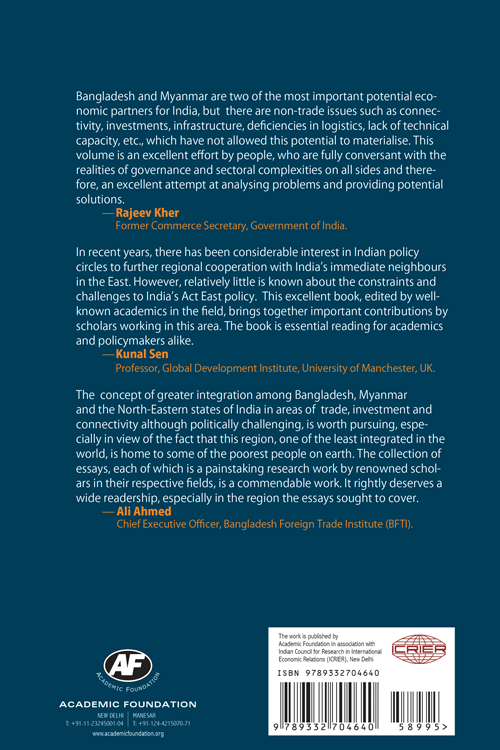
In recent years, there has been considerable interest in Indian policy circles to further regional cooperation with India’s immediate neighbours in the East. However, relatively little is known about the constraints and challenges to India’s Act East policy. This excellent book, edited by well-known academics in the field, brings together important contributions by scholars working in this area. The book is essential reading for academics and policymakers alike.
About the Author(s) / Editor(s)
Nisha Taneja, Professor Indian Council for Research on International Economic Relations (ICRIER), New Delhi, has been engaged in policy-oriented research for more than 30 years at ICRIER. She has extensive research experience on regional trade in South Asia and East Asia on issues related to tariffs, sensitive lists, services, investment, non-tariff measures, and trade and transport facilitation. She has led numerous research teams comprising national and international consultants in South and South-East Asia. She has worked closely with governments in the South Asian region and was recently appointed advisor to the Government of Nepal on trans-shipment. She has also worked as an International Consultant with the World Bank, Food and Agriculture Organization and the Asian Development Bank.
Deb Kusum Das teaches at the Department of Economics, Ramjas College. He has a PhD from the Delhi School of Economics and received the EXIM Bank IEDRA Award 2004 for his doctoral dissertation, “Some Aspects of Productivity and Trade in Indian Industry”. He is also associated with ICRIER as an external researcher and researched on important issues related to Indian economy: jobs, labour intensive manufacturing, India’s global competitiveness. His research interests are empirical international trade, labour markets and productivity growth of the Indian economy. He is the co founder of a network for South Asian undergraduate students of Economics (SAESM).
Samridhi Bimal is Consultant at ICRIER, New Delhi. She has over seven years of research expertise on international trade and trade policy issues related to the WTO, regional trading agreements and domestic trade policies. She has worked extensively on South Asia on a wide array of issues including trade, investment, transport facilitation, non-tariff barriers and informal trade. She has also been associated with the World Bank as a Short-term Consultant for their programme on Regional Integration in South Asia. Her research areas of interest include international trade, development policy and regional economics. She is currently a PhD scholar at the Centre for International Trade and Development, Jawaharlal Nehru University (JNU), New Delhi.
Contributors
Deb Kusum Das
Deepika Wadhwa
Farazi Binti Ferdous
Khin Thida Nyei
Myo Myo Myint
Nisha Taneja
Nyunt Maung Shein
Sonu Trivedi
Selim Raihan
Sreerupa Sengupta
Samridhi Bimal
Shubhdeep Deb
Tin Htoo Naing
Tun Min Sandar
Zin Zin Naing
Contents in Detail
| Publisher | AF Press |
| Publication Date | 2018 |
| Number of Pages | 398 |
| ISBN |
9789332704640 |
Academic Foundation (AF), based in New Delhi, is India’s leading independent publisher of academic/scholarly books in Social Sciences, specialising in Economics—Development Economics and Indian Economy in particular, and allied subjects.
About the Book
The economic and political changes in Myanmar over the last two years along with the Modi government’s ‘Look East’ economic policy recognise the tremendous need for integrating one of the least developed region of South Asia namely —India’s north eastern states, Bangladesh, and Myanmar who share borders with each other. The book explores how greater trade in the sub-region can be a vehicle for economic integration and raise living standards for its people. It also analyses the challenges of non-trade issues such as connectivity, investments, infrastructure, deficiencies in logistics, lack of technical capacity, etc., which act as hindrances to economic cooperation as well as integration.
The book is the research collaboration of scholars from leading institutions of India, Myanmar, and Bangladesh to analyse important aspects of economic integration and cooperation from the perspective of each of these countries so as to overcome the challenges that act as a deterrent to poverty eradication in the sub region. The initiative was funded by the Department for International Development (DFID) and implemented by the Indian Council for Research on International Economics Relations (ICRIER).
Praise for the book
In recent years, there has been considerable interest in Indian policy circles to further regional cooperation with India’s immediate neighbours in the East. However, relatively little is known about the constraints and challenges to India’s Act East policy. This excellent book, edited by well-known academics in the field, brings together important contributions by scholars working in this area. The book is essential reading for academics and policymakers alike.
About the Author(s) / Editor(s)
Nisha Taneja, Professor Indian Council for Research on International Economic Relations (ICRIER), New Delhi, has been engaged in policy-oriented research for more than 30 years at ICRIER. She has extensive research experience on regional trade in South Asia and East Asia on issues related to tariffs, sensitive lists, services, investment, non-tariff measures, and trade and transport facilitation. She has led numerous research teams comprising national and international consultants in South and South-East Asia. She has worked closely with governments in the South Asian region and was recently appointed advisor to the Government of Nepal on trans-shipment. She has also worked as an International Consultant with the World Bank, Food and Agriculture Organization and the Asian Development Bank.
Deb Kusum Das teaches at the Department of Economics, Ramjas College. He has a PhD from the Delhi School of Economics and received the EXIM Bank IEDRA Award 2004 for his doctoral dissertation, “Some Aspects of Productivity and Trade in Indian Industry”. He is also associated with ICRIER as an external researcher and researched on important issues related to Indian economy: jobs, labour intensive manufacturing, India’s global competitiveness. His research interests are empirical international trade, labour markets and productivity growth of the Indian economy. He is the co founder of a network for South Asian undergraduate students of Economics (SAESM).
Samridhi Bimal is Consultant at ICRIER, New Delhi. She has over seven years of research expertise on international trade and trade policy issues related to the WTO, regional trading agreements and domestic trade policies. She has worked extensively on South Asia on a wide array of issues including trade, investment, transport facilitation, non-tariff barriers and informal trade. She has also been associated with the World Bank as a Short-term Consultant for their programme on Regional Integration in South Asia. Her research areas of interest include international trade, development policy and regional economics. She is currently a PhD scholar at the Centre for International Trade and Development, Jawaharlal Nehru University (JNU), New Delhi.
Contributors
Deb Kusum Das
Deepika Wadhwa
Farazi Binti Ferdous
Khin Thida Nyei
Myo Myo Myint
Nisha Taneja
Nyunt Maung Shein
Sonu Trivedi
Selim Raihan
Sreerupa Sengupta
Samridhi Bimal
Shubhdeep Deb
Tin Htoo Naing
Tun Min Sandar
Zin Zin Naing
Contents in Detail
| Publisher | AF Press |
| Publication Date | 2018 |
| Number of Pages | 398 |
| ISBN |
9789332704640 |

Couldn't load pickup availability
Share

-

Curated Collections By AF Press
-

Premium Print Quality
-

Author-Centric Publishing
-

Trusted by Readers Nationwide


Sub-Regional Cooperation between Indi...