The World Economy
Angus Maddison
About the Book
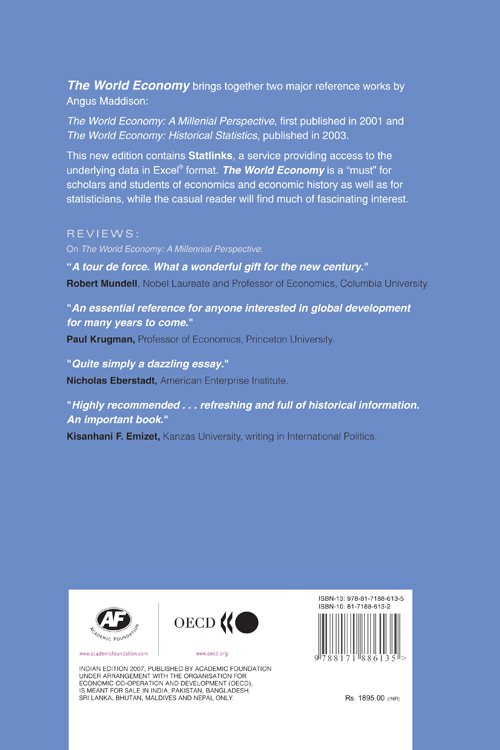
The World Economy brings together two major reference works by Angus Maddison: The World Economy: A Millenial Perspective, first published in 2001 and The World Economy: Historical Statistics, published in 2003.
This new edition contains Statlinks, a service providing access to the underlying data in Excel® format. The World Economy is a “must” for scholars and students of economics and economic history as well as for statisticians, while the casual reader will find much of fascinating interest.
Written by the distinguished economic historian, Angus Maddison, together, the two volumes (bound-in-one) comprising The World Economy, hold authoritative analysis along with extensive supporting data on a global level for the growth and performance of various economies across the world, over a very large span of time. They undoubtedly provide answers to many a big question and promise to offer clues to still unanswered paradoxes. This ‘only one of its kind’ publication is made more attractive in the present format (‘two-in-one edition’, hard cover) that is sure to be a valuable addition to any library, personal or otherwise.
The first volume provides a comprehensive view of the growth and levels of world population since the year 1000, when rich countries of today were poorer than Asia and Africa. It is a pioneering effort to quantify the economic performance of nations over the very long term, identifying forces which explain the success of the rich countries, and exploring the obstacles that hindered advance in less developed regions.
In the second volume, Angus Maddison offers a rare insight into the history and political influence of national accounts and national accounting. Based on revised and updated population estimates for 1950-2003 and GDP and per capita GDP estimates for 1820 to 2001, he demonstrates that such statistical data can shed light on the analysis of economic phenomena like growth, market formation and income distribution. This approach is particularly interesting for developing countries often lacking the expertise or data to produce good national accounts. It also serves as a reminder for OECD countries that effective policy making depends on verifiable economic data.
The World Economy is a monumental work of reference and a “must” for all scholars and students of economics and economic history, as well as a mine of fascinating facts for everyone else. An attractive feature of this new edition is the inclusion of Statlinks, which provide access to the underlying data in Excel® format.
About the Author(s) / Editor(s)
Angus Maddison (b. 1926) enjoys a world-wide reputation as a pioneer in the field of the quantification of economic growth in an international comparative and historical perspective. Maddison is Emeritus Professor of Economic Sociology at the Faculty of Economics at the University of Groningen in the Netherlands and Honorary Fellow of Selwyn College, Cambridge. Just recently (October 2006), Professor Maddison was awarded the title of Commander in the Order of Orange-Nassau. He was educated at Cambridge, McGill, and Johns Hopkins universities, before teaching at the University of St. Andrews in Scotland. His professional relationship with the OECD began even before the Organisation’s birth. He was Head of the OEEC Economics Division from 1953 to 1962 when the organisation became the OECD. From 1963 to 1966, he was a Fellow of the newly created OECD Development Centre. He left the Organisation in order to undertake research for the Twentieth Century Fund and Harvard University’s Development Advisory Service but, by 1971, Professor Maddison was back at the OECD as Head of the Central Analysis Division, a post he retained for seven years. Angus Maddison has been an advisor to the governments of Brazil, Ghana, Greece and Pakistan and has travelled widely in developing countries as part of his research interests. His major research interest today is the assessment of the forces affecting the economic growth performance of nations, with particular emphasis on quantitative analysis in historical and comparative perspectives. Professor Maddison is the author or co-author of 25 books and a great many articles in academic and financial journals.
The author currently lives in Thourotte (France).
Contents in Detail
Acknowledgements
Preface
Introduction and Summary
1.The Contours of World Development
2.The Impact of Western Development on
the Rest of the World, 1000–1950
3.The World Economy in the Second Half
of the Twentieth Century
Appendix A : World Population, GDP and GDP
Per Capita, Benchmark Years, 1820–1998
Appendix B : World Population, GDP and GDP Per
Capita Before 1820
Appendix C : Annual Estimates of Population, GDP and
GDP Per Capita for 124 Countries, Seven
Regions and the World 1950–98
Appendix D : Growth and Levels of Performance in 27
Formerly Communist Countries, 1990–98
Appendix E : Employment, Working Hours, and
Labour Productivity
Appendix F : Value and Volume of Exports, 1870–1998
Bibliography
Text Tables
Table 1–1 Level and Rate of Growth of Population:
World and Major Regions, 0–1998 A.D.
Table 1–2 Level and Rate of Growth of GDP Per Capita,
World and Major Regions, 0–1998 A.D.
Table 1–3 Level and Rate of Growth of GDP:
World and Major Regions, 0–1998 A.D.
Table 1–4 Life Expectation and Infant Mortality,
Both Sexes Combined, 33–1875 A.D.
Table 1–5a Birth Rates and Life Expectation,
1820–1998/99
Table 1–5b Average Life Expectation for
Groups A and B, 1000–1999
Table 1–5c Rate of Growth of Life Expectation
in Groups A and B, 1000–1999
Table 1–6a West European Population Levels,
0–1998 A.D.
Table 1–6b West European Population Growth
Rates, 0–1998 A.D.
Table 1–7a Population Growth: Western and Iberian
Offshoots in Comparative Perspective, 1500–1998
Table 1–7b Comparative Population Growth in the
Americas and Former European Metropoles,
1500–1998
Table 1–7c Shipment of African Slaves to the
Americas, 1500–1870
Table 1–7d Net Migration to Brazil, Australia and
the United States, and from the United
Kingdom, 1500–1998
Table 1–8a Comparative Population Growth: Japan,
China and Western Europe, 0–1998 A.D.
Table 1–8b Population Growth Rates: Japan,
China and Western Europe, 0–1998 A.D.
Table 1–8c Urbanisation Ratios: Japan, China
and Western Europe, 1000–1890
Table 1–9a Growth of Per Capita GDP by Major
Region, 1000–1998
Table 1–9b Level of Per Capita GDP:
Groups A and B, 1000–1998
Table 1–9c Population of Groups A and B, 1000–1998
Table 1–9d GDP of Groups A and B, 1000–1998
Table 2–1 Population of the Venetian
Empire in 1557
Table 2–2 Size and Carrying Capacity of Venetian
Merchant Galleys, 1318–1559
Table 2–3 Population of 31 Biggest West European
Cities, 1500–1800
Table 2–4 Sugar Production by Area of Origin,
1456–1894
Table 2–5 Atlantic Slave Shipments by Portugal
and Its Competitors, 1701–1800
Table 2–6 Number of Ships Sailing to Asia from
Seven European Countries, 1500–1800
Table 2–7 Movement of Portuguese Ships to
and from Asia, 1500–1800
Table 2–8 Gold and Silver Shipments from
the Americas to Europe
Table 2–9 Chinese Imports of Silver by Country
of Origin, 1550–1700
Table 2–10 Exports of Silver and Gold from
Western Europe, 1601–1780
Table 2–11 Chinese Naval Diplomacy: Voyages to
the “Western Oceans”, 1405–33
Table 2–12 Exchange Rates between Ming Paper
Currency and Silver, 1376–1426
Table 2–13 Commodity Composition of Brazilian
Exports, 1821–1951
Table 2–14 Confrontation of Brazilian and US
Economic Performance in the Five Major
Phases of Brazilian Development, 1500–1998
Table 2–15 Carrying Capacity of Dutch and Other
Merchant Fleets, 1470–1824
Table 2–16 Dutch Merchant Ships by Area of
Operation Around 1670
Table 2–17 Employment in Dutch Shipping
by Area of Operation, 1610–1770
Table 2–18a Dutch Involvement in European
Military Conflicts, 1560s–1815
Table 2–18b Size of European Armies, 1470–1814
Table 2–19 Dutch Commodity Trade, 1650 to 1770s
Table 2–20 Commodity Composition of European
Exports from Asia to Europe, 1513–1780
Table 2–21a The Dutch “Drain” on Indonesia, 1698–1930
Table 2–21b The British “Drain” on India, 1868–1930
Table 2–21c Growth of Indonesian Population and
Real Income by Ethnic Group, 1700–1929
Table 2–22a Levels of GDP Per Capita in European
Colonial Powers and Former Colonies,
1500–1998
Table 2–22b Growth of Per Capita GDP in European
Colonial Powers and Former Colonies,
1500–1998
Table 2–23 Structure of British Commodity Trade
by Origin and Destination, 1710–1996
Table 2–24 Structure of Employment in the Netherlands,
the United Kingdom and the United States,
1700–1998
Table 2–25a Carrying Capacity of British and
World Shipping, 1470–1913
Table 2–25b Comparative Rates of Growth of
British and World Shipping Capacity
and GDP, 1570-1913
Table 2–26a Gross Nominal Value of Capital
Invested Abroad in 1914
Table 2–26b Gross Nominal Value of Capital
Invested Abroad in 1938
Table 2–27 Gross Nominal Value of Foreign
Capital Invested in Nine Major
Recipient Countries, 1913
Table 2–28 Population of British Colonies and
Former Colonies in the Americas,
1750 and 1830
Box 2–1 Social Structure of India in the
Moghul Empire
Box 2–2 Indian Social Structure at the
End of British Rule
Table 2–29 Population of British Territories
in Asia, Africa, Australia and
Europe in 1830
Table 2–30 Comparative Macroeconomic Performance
of India and Britain, 1600–1947
Table 3–1a Growth of Per Capita GDP, Population
and GDP: World and Major Regions,
1000–1998
Table 3–1b Levels of Per Capita GDP and Interregional
Spreads, 1000–1998
Table 3–1c Shares of World GDP, 1000–1998
Table 3–2a Growth in Volume of Merchandise Exports,
World and Major Regions, 1870–1998
Table 3–2b Merchandise Exports as Per Cent of GDP
in 1990 Prices, World and Major Regions,
1870–1998
Table 3–2c Regional Percentage Shares of World
Exports, 1870–1998
Table 3–3 Gross Value of Foreign Capital Stock in
Developing Countries, 1870–1998
Table 3–4 Net Migration: Western Europe, Japan and
Western Offshoots, 1870–1998
Table 3–5 Per Capita GDP Performance in the
Three Most Successful Phases of the
Capitalist Epoch
Table 3–6 Economic Characteristics of the 20
Biggest Countries, 1998
Table 3–7 Western Europe and USA: Degree of
Productivity and Per Capita GDP
Convergence, 1950–98
Table 3–8 Experience of Unemployment and Inflation
in Advanced Capitalist Countries, 1950–98
Table 3–9 Total Government Expenditure as Per Cent
of GDP at Current Prices, Western Europe,
the United States and Japan, 1913–1999
Table 3–10 Stock of Foreign Assets and Liabilities,
the United States, Japan, Germany and
the United Kingdom, 1989–98
Table 3–11 Growth in Volume of Merchandise Imports
and Ratio of Imports to GDP, Western Europe,
Japan and the United States, 1950–98
Box 3–1 Impact of Recent Revisions on Measurement
of Level and Growth of US GDP, 1929–98
Table 3–12 Indices of Share Prices in National
Currencies, Japan, USA and Western
Europe, 1950–99
Table 3–13 Exchange Rates: Units of National
Currency per US Dollar, Japan and
Western Europe, 1950–99
Table 3–14 Variations in Per Capita Growth Momentum:
Resurgent Asia in Comparative Perspective,
1913–99
Table 3–15 Characteristics of Growth Performance
in Resurgent Asia, 1950–99
Table 3–16 Stock of Foreign Direct Investment, Total
and Per Capita, Major Countries, Regions
and World, 1998
Table 3–17 Annual Percentage Change in Real GDP Per
Capita, Japan and Resurgent Asia, 1997–99
Table 3–18 Exchange Rates: Units of National
Currency per US Dollar in Asian
Countries, 1973–99
Table 3–19 Pre and Post Crisis Savings as PerCent
of GDP in Five East Asian Countries, 1990–98
Table 3–20 Per Capita GDP Performance in Six
Problem Economies of East Asia,
1950–98
Table 3–21 World Production of Crude Oil
and Natural Gas, 1950–99
Table 3–22 Latin American Economic
Performance, 1870–1999
Table 3–23 Per Capita Growth Performance
in Former USSR and Eastern Europe,
1950–98
Table 3–24 Changes in Production and Consumption
in Belarus, Russia and Ukraine, 1990–98
Table 3–25 Per Cent of Population in Poverty in
Former USSR and Eastern Europe,
1987–88 and 1993–95
Table 3–26 Annual Average Rate of Change in
Consumer Prices: Former USSR and
Eastern Europe, 1990–98
Table 3–27 Illiteracy Rates in Africa in 1997
Table 3–28 Variations of Income Level
Within Africa, 1998
Table 3–29 Degree and Duration of Per Capita
Income Collapse in 13 Biggest African
Countries South of the Sahara
Table 3–30 Total External Debt of Africa, Asia,
Latin America, Eastern Europe and
former USSR, 1980, 1990 and 1998
Table 3–31 Arrears on External Debt in Africa
and Other Continents, 1980–98
Figure 1–1 Population of Western Europe:
Confrontation of Two Millennia
Figure 1–2 Annual Movement in Swedish Birth
and Death Rates, 1736–1987
Figure 1–3 Comparative Population Levels in
the Three Biggest Countries of the
Americas and their Former European
Metropoles, 1500–1998
Figure 1–4 Comparative Levels of GDP Per
Capita: China and West Europe,
400–1998 A.D.
Figure 1–5 Comparative Levels of GDP Per
Capita: China and the United Kingdom,
1700–1998
Figure 1–6 Comparative Levels of GDP Per Capita:
China and the United States, 1700–1998
Figure 3–1 Binary Confrontation of US/Japan,
US/European Per Capita GDP Levels,
1950–98
Figure 3–2a Binary Confrontation of Japan/East
Asian Per Capita GDP Levels, 1950–99
Figure 3–2b Binary Confrontation of Japan/East
Asian Per Capita GDP Levels, 1950–99
Figure 3–3 Binary Confrontation of US/Latin
American Per Capita GDP Levels,
1950–98
Figure 3–4 Binary Confrontation of US/African
Per Capita GDP Levels, 1950–98
Appendix Tables
Table A–a Coverage of the GDP Sample and the
Proportionate Role of Proxy Measures,
1820–1998
Table A–b Nature of the PPP Converters Used to
Estimate Levels of GDP in “International”
Dollars for the Benchmark Year 1990
Table A–b Nature of the PPP Converters Used
in Maddison (1995a)
Table A–c Confrontation of Maddison (1995a)
and Present Estimates of Regional and
World Population and GDP, 1820–1990
Table A–d The Impact of Border Changes
in Germany, 1820–1998
Table A–e Population and GDP: 13 Small
West European Countries, 1950–98
Table A–f GDP and Population in the Successor
Republics of Former Yugoslavia, 1990–98
Table A1–a Population of European Countries, the
Former USSR and Western Offshoots,
Benchmark Years 1820–1998
Table A1–b GDP Levels: European Countries, the
Former USSR and Western Offshoots,
Benchmark Years 1820–1998
Table A1–c Levels of GDP Per Capita in European
Countries, the Former USSR and Western
Offshoots, Benchmark Years 1820–1998
Table A1–d GDP Per Capita Growth Rates in European
Countries, the Former USSR and Western
Offshoots in Five Phases of Development,
1820–1998
Table A1–e GDP Growth Rates in European Countries,
the Former USSR and Western Offshoots in
Five Phases of Development, 1820–1998
Table A1–f Population Growth Rates in European
Countries, Former USSR and Western
Offshoots in Five Phases of Development,
1820–1998
Table A1–g Derivation of 1990 Benchmark Levels of
GDP in “International” Dollars: 22
OECD Countries
Table A1–h Derivation of 1990 Benchmark Levels
of GDP in “International” Dollars: Five
East European Countries and the USSR
Table A–g GDP and Population in 21 Small
Caribbean Countries, 1950–98
Table A2–a Population of 44 Latin American
Countries, Benchmark Years,
1820–1998
Table A2–b GDP Levels in 44 Latin American
Countries, Benchmark Years, 1820–1998
Table A2–c Levels of GDP Per Capita in 44 Latin
American Countries, Benchmark Years,
1820–1998
Table A2–d GDP Per Capita Growth Rates in 44 Latin
American Countries, in Five Phases of
Development 1820–1998
Table A2–e GDP Growth Rates in 44 Latin American
Countries, in Five Phases of Development,
1820–1998
Table A2–f Population Growth Rates in 44 Latin
American Countries, in Five Phases of
Development, 1820–1998
Table A2–g Derivation of 1990 Benchmark Levels of
GDP in “International” Dollars: 18 Latin
American Countries
Table A–h India: GDP, Population and Per Capita GDP,
Annual Estimates, 1820–1998
Table A–i Reconstitution of Japanese GDP by
Industry of Origin, 1874–90
Table A–j Japan: GDP, Population and Per
Capita GDP, Annual Estimates, 1820–1998
Table A–k Population and GDP in 19 Small
East Asian Countries, 1950–98
Table A–l Arab and Jewish Population and
GDP in Palestine and Israel, 1922–50
Table A–m Proxy Entries to Fill Holes in GDP
and GDP Per Capita Dataset for
1870 and 1913
Table A3–a Population of 56 Asian Countries,
Benchmark Years, 1820–1998
Table A3–b GDP Levels in 56 Asian Countries,
Benchmark Years 1820–1998
Table A3–c GDP Per Capita in 56 Asian Countries,
Benchmark Years, 1820–1998
Table A3–d GDP Per Capita Growth Rates in 56
Asian Countries, in Five Phases of
Development, 1820–1998
Table A3–e GDP Growth Rates in 56 Asian Countries,
in Five Phases of Development, 1820–1998
Table A3–f Population Growth Rates in 56 Asian
Countries, in Five Phases of Development,
1820–1998
Table A3–g Derivation of 1990 Benchmark Levels of
GDP in International Dollars for 15
East Asian Countries
Table A3–h Derivation of 1990 Benchmark Levels
of GDP in International Dollars for
Five East Asian Countries
Table A3–i Derivation of 1990 Benchmark Levels of
GDP in International Dollars for Three
West Asian Countries
Table A4–a Population of 57 African Countries,
Benchmark Years, 1820–1998
Table A4–b GDP Levels in 57 African Countries,
Benchmark Years, 1820–1998
Table A4–c GDP Per Capita in 57 African
Countries, Benchmark Years,
1820–1998
Table A4–d GDP Per Capita Growth Rates in 57
African Countries, in Five Phases of
Development, 1820–1998
Table A4–e GDP Growth Rates in 57 African
Countries, in Five Phases of Development,
1820–1998
Table A4–f Population Growth Rates in 57 African
Countries, in Five Phases of Development,
1820–1998
Table A4–g Alternative Estimates of 1990 GDP Level
by ICP and PWT in 24 African Countries
Table B–1 Alternative Estimates of the Regional
Components of World Population, 0–1700 A.D.
Table B–2 Population of Western and Eastern Europe
and Western Offshoots, 0–1820 A.D.
Table B–3 European and Asian Population of
Russia, 0–1870 A.D.
Table B–4 Ethnic Composition of Brazilian
Population, 1500–1870
Table B–5 Alternative Estimates of Latin
American Population, 0–1820 A.D.
Table B–6 Alternative Estimates of Indian
Population, 0–1820 A.D.
Table B–7 Alternative Estimates of Japanese
Population, 0–1820 A.D.
Table B–8 Population of Asia, 0–1820 A.D.
Table B–9a Alternative Estimates of African
Population, 0–1950 A.D.
Table B–9b Regional Distribution of African
Population, 0–1820 A.D.
Table B–10 World Population, 20 Countries
and Regional Totals, 0–1998 A.D.
Table B–11 Rates of Growth of World Population,
20 Countries and Regional Totals, 0–1998 A.D.
Table B–12 Shares of World Population, 20 Countries
and Regional Totals, 0–1998 A.D.
Table B–13 Regional Components of British GDP,
Population and GDP Per Capita, 1500–1920
Table B–14 Urbanisation Ratios in Europe and Asia,
1500–1890
Table B–15 Ethnic Composition of US Population,
1700–1820
Table B–16 Ethnic Composition of Latin American
Population in 1820
Table B–17 Japanese Cereal Production and Per
Capita Availability, 1600–1874
Table B–18 World GDP, 20 Countries and
Regional Totals, 0–1998 A.D.
Table B–19 Rates of Growth of World GDP,
20 Countries and Regional Totals,
0–1998 A.D.
Table B–20 Shares of World GDP, 20 Countries
and Regional Totals, 0–1998 A.D.
Table B–21 World GDP Per Capita, 20 Countries
and Regional Totals, 0–1998 A.D.
Table B–22 Rates of Growth of World GDP Per Capita,
20 Countries and Regional Totals, 0–1998 A.D.
Table C1–a Population of European Countries, Former
USSR and Western Offshoots, Annual
Estimates, 1950–98
Table C1–b Levels of GDP in European Countries, Former
USSR and Western Offshoots, Annual Estimates,
1950–98
Table C1–c Levels of Per Capita GDP in European Countries,
Former USSR and Western Offshoots, Annual
Estimates, 1950–98
Table C2–a Population of Latin American Countries,
Annual Estimates, 1950–98
Table C2–b Levels of GDP in Latin American Countries,
Annual Estimates, 1950–98
Table C2–c Levels of Per Capita GDP in Latin American
Countries, Annual Estimates, 1950–98
Table C3–a Population of Asian Countries, Annual
Estimates, 1950–98
Table C3–b Levels of GDP in Asian Countries,
Annual Estimates, 1950–98
Table C3–c Levels of Per Capita GDP in Asian
Countries, Annual Estimates, 1950–98
Table C4–a Population in 57 African Countries,
Annual Estimates, 1950–98
Table C4–b Levels of GDP in 57 African Countries,
Annual Estimates, 1950–98
Table C4–c Levels of Per Capita GDP in 57 African
Countries, Annual Estimates, 1950–98
Table C5–a World Population by Regions,
Annual Estimates, 1950–98
Table C5–b World GDP by Regions, Annual
Estimates, 1950–98
Table C5–c World Per Capita GDP by Regions,
Annual Estimates, 1950–98
Table C6–a Year to Year Percentage Change in
World Population, by Regions 1950–98
Table C6–b Year to Year Percentage Change in World
GDP Volume, by Regions 1950–98
Table C6–c Year to Year Percentage Change in World
Per Capita GDP, by Regions 1950–98
Table D–1a GDP in East European Countries,
1990–99
Table D–1b Population in East European
Countries, 1990–99
Table D–1c GDP Per Capita in East European
Countries, 1990–99
Table D–2a GDP in Successor Republics of
Former Yugoslavia 1990–98
Table D–2b Population in Successor Republics
of Former Yugoslavia, 1990–99
Table D–2c GDP Per Capita in Successor Republics
of Former Yugoslavia, 1990–98
Table D–3a GDP In Successor States of Former
USSR, 1990–98
Table D–3b Population in Successor States of
Former USSR, 1990–98
Table D–3c GDP Per Capita in Successor States
of Former USSR, 1990–98
Table D–4 Confrontation of OECD and Maddison
Estimates of 1990 Real GDP Levels in 15
Successor States of the Former Soviet Union
Table E–1 Total Employment in Europe, Japan and
Western Offshoots, 1870–1998
Table E–2 Total Employment in Latin America
and Asia, 1950–98
Table E–3 Annual Hours Worked Per Person
Employed, 1870–1998
Table E–4 Total Hours Worked, 1870–1998
Table E–5 GDP Per Person Employed in Europe,
Japan and Western Offshoots, 1870–1998
Table E–6 GDP Per Person Employed in Latin
America and Asia, 1950–98
Table E–7 Labour Productivity (GDP Per Hour Worked),
1870–1998
Table E–8 Rate of Growth of GDP Per Hour Worked,
1870–1998
Table E–9 Levels of GDP Per Hour Worked, 1870–1998
Table E–10 Annual Hours of Work Per Head of
Population, 1870–1998
Table E–11 Employment in Europe, Japan and Western
Offshoots, as Per Cent of Population,
1870–1998
Table E–12 Employment in Latin America and Asia,
as Per Cent of Population, 1950–98
Table F–1 Value of Merchandise Exports at Current
Prices (56 Countries), 1870–1998
Table F–2 Value of Merchandise Exports at Constant
Prices (35 Countries), 1820–1998
Table F–3 Value of World Exports by Region at
Constant Prices, 1870–1998
Table F–4 Rate of Growth in Volume of Merchandise
Exports, 11 Countries and World, 1870–1998
Table F–5 Merchandise Exports as Per Cent of
GDP in 1990 Prices, 11 Countries and
World, 1870–1998
| Publisher | AF Press |
| Publication Date | 2007 |
| Number of Pages | 654 |
| ISBN |
8171886132 |
Academic Foundation (AF), based in New Delhi, is India’s leading independent publisher of academic/scholarly books in Social Sciences, specialising in Economics—Development Economics and Indian Economy in particular, and allied subjects.
About the Book
The World Economy brings together two major reference works by Angus Maddison: The World Economy: A Millenial Perspective, first published in 2001 and The World Economy: Historical Statistics, published in 2003.
This new edition contains Statlinks, a service providing access to the underlying data in Excel® format. The World Economy is a “must” for scholars and students of economics and economic history as well as for statisticians, while the casual reader will find much of fascinating interest.
Written by the distinguished economic historian, Angus Maddison, together, the two volumes (bound-in-one) comprising The World Economy, hold authoritative analysis along with extensive supporting data on a global level for the growth and performance of various economies across the world, over a very large span of time. They undoubtedly provide answers to many a big question and promise to offer clues to still unanswered paradoxes. This ‘only one of its kind’ publication is made more attractive in the present format (‘two-in-one edition’, hard cover) that is sure to be a valuable addition to any library, personal or otherwise.
The first volume provides a comprehensive view of the growth and levels of world population since the year 1000, when rich countries of today were poorer than Asia and Africa. It is a pioneering effort to quantify the economic performance of nations over the very long term, identifying forces which explain the success of the rich countries, and exploring the obstacles that hindered advance in less developed regions.
In the second volume, Angus Maddison offers a rare insight into the history and political influence of national accounts and national accounting. Based on revised and updated population estimates for 1950-2003 and GDP and per capita GDP estimates for 1820 to 2001, he demonstrates that such statistical data can shed light on the analysis of economic phenomena like growth, market formation and income distribution. This approach is particularly interesting for developing countries often lacking the expertise or data to produce good national accounts. It also serves as a reminder for OECD countries that effective policy making depends on verifiable economic data.
The World Economy is a monumental work of reference and a “must” for all scholars and students of economics and economic history, as well as a mine of fascinating facts for everyone else. An attractive feature of this new edition is the inclusion of Statlinks, which provide access to the underlying data in Excel® format.
About the Author(s) / Editor(s)
Angus Maddison (b. 1926) enjoys a world-wide reputation as a pioneer in the field of the quantification of economic growth in an international comparative and historical perspective. Maddison is Emeritus Professor of Economic Sociology at the Faculty of Economics at the University of Groningen in the Netherlands and Honorary Fellow of Selwyn College, Cambridge. Just recently (October 2006), Professor Maddison was awarded the title of Commander in the Order of Orange-Nassau. He was educated at Cambridge, McGill, and Johns Hopkins universities, before teaching at the University of St. Andrews in Scotland. His professional relationship with the OECD began even before the Organisation’s birth. He was Head of the OEEC Economics Division from 1953 to 1962 when the organisation became the OECD. From 1963 to 1966, he was a Fellow of the newly created OECD Development Centre. He left the Organisation in order to undertake research for the Twentieth Century Fund and Harvard University’s Development Advisory Service but, by 1971, Professor Maddison was back at the OECD as Head of the Central Analysis Division, a post he retained for seven years. Angus Maddison has been an advisor to the governments of Brazil, Ghana, Greece and Pakistan and has travelled widely in developing countries as part of his research interests. His major research interest today is the assessment of the forces affecting the economic growth performance of nations, with particular emphasis on quantitative analysis in historical and comparative perspectives. Professor Maddison is the author or co-author of 25 books and a great many articles in academic and financial journals.
The author currently lives in Thourotte (France).
Contents in Detail
Acknowledgements
Preface
Introduction and Summary
1.The Contours of World Development
2.The Impact of Western Development on
the Rest of the World, 1000–1950
3.The World Economy in the Second Half
of the Twentieth Century
Appendix A : World Population, GDP and GDP
Per Capita, Benchmark Years, 1820–1998
Appendix B : World Population, GDP and GDP Per
Capita Before 1820
Appendix C : Annual Estimates of Population, GDP and
GDP Per Capita for 124 Countries, Seven
Regions and the World 1950–98
Appendix D : Growth and Levels of Performance in 27
Formerly Communist Countries, 1990–98
Appendix E : Employment, Working Hours, and
Labour Productivity
Appendix F : Value and Volume of Exports, 1870–1998
Bibliography
Text Tables
Table 1–1 Level and Rate of Growth of Population:
World and Major Regions, 0–1998 A.D.
Table 1–2 Level and Rate of Growth of GDP Per Capita,
World and Major Regions, 0–1998 A.D.
Table 1–3 Level and Rate of Growth of GDP:
World and Major Regions, 0–1998 A.D.
Table 1–4 Life Expectation and Infant Mortality,
Both Sexes Combined, 33–1875 A.D.
Table 1–5a Birth Rates and Life Expectation,
1820–1998/99
Table 1–5b Average Life Expectation for
Groups A and B, 1000–1999
Table 1–5c Rate of Growth of Life Expectation
in Groups A and B, 1000–1999
Table 1–6a West European Population Levels,
0–1998 A.D.
Table 1–6b West European Population Growth
Rates, 0–1998 A.D.
Table 1–7a Population Growth: Western and Iberian
Offshoots in Comparative Perspective, 1500–1998
Table 1–7b Comparative Population Growth in the
Americas and Former European Metropoles,
1500–1998
Table 1–7c Shipment of African Slaves to the
Americas, 1500–1870
Table 1–7d Net Migration to Brazil, Australia and
the United States, and from the United
Kingdom, 1500–1998
Table 1–8a Comparative Population Growth: Japan,
China and Western Europe, 0–1998 A.D.
Table 1–8b Population Growth Rates: Japan,
China and Western Europe, 0–1998 A.D.
Table 1–8c Urbanisation Ratios: Japan, China
and Western Europe, 1000–1890
Table 1–9a Growth of Per Capita GDP by Major
Region, 1000–1998
Table 1–9b Level of Per Capita GDP:
Groups A and B, 1000–1998
Table 1–9c Population of Groups A and B, 1000–1998
Table 1–9d GDP of Groups A and B, 1000–1998
Table 2–1 Population of the Venetian
Empire in 1557
Table 2–2 Size and Carrying Capacity of Venetian
Merchant Galleys, 1318–1559
Table 2–3 Population of 31 Biggest West European
Cities, 1500–1800
Table 2–4 Sugar Production by Area of Origin,
1456–1894
Table 2–5 Atlantic Slave Shipments by Portugal
and Its Competitors, 1701–1800
Table 2–6 Number of Ships Sailing to Asia from
Seven European Countries, 1500–1800
Table 2–7 Movement of Portuguese Ships to
and from Asia, 1500–1800
Table 2–8 Gold and Silver Shipments from
the Americas to Europe
Table 2–9 Chinese Imports of Silver by Country
of Origin, 1550–1700
Table 2–10 Exports of Silver and Gold from
Western Europe, 1601–1780
Table 2–11 Chinese Naval Diplomacy: Voyages to
the “Western Oceans”, 1405–33
Table 2–12 Exchange Rates between Ming Paper
Currency and Silver, 1376–1426
Table 2–13 Commodity Composition of Brazilian
Exports, 1821–1951
Table 2–14 Confrontation of Brazilian and US
Economic Performance in the Five Major
Phases of Brazilian Development, 1500–1998
Table 2–15 Carrying Capacity of Dutch and Other
Merchant Fleets, 1470–1824
Table 2–16 Dutch Merchant Ships by Area of
Operation Around 1670
Table 2–17 Employment in Dutch Shipping
by Area of Operation, 1610–1770
Table 2–18a Dutch Involvement in European
Military Conflicts, 1560s–1815
Table 2–18b Size of European Armies, 1470–1814
Table 2–19 Dutch Commodity Trade, 1650 to 1770s
Table 2–20 Commodity Composition of European
Exports from Asia to Europe, 1513–1780
Table 2–21a The Dutch “Drain” on Indonesia, 1698–1930
Table 2–21b The British “Drain” on India, 1868–1930
Table 2–21c Growth of Indonesian Population and
Real Income by Ethnic Group, 1700–1929
Table 2–22a Levels of GDP Per Capita in European
Colonial Powers and Former Colonies,
1500–1998
Table 2–22b Growth of Per Capita GDP in European
Colonial Powers and Former Colonies,
1500–1998
Table 2–23 Structure of British Commodity Trade
by Origin and Destination, 1710–1996
Table 2–24 Structure of Employment in the Netherlands,
the United Kingdom and the United States,
1700–1998
Table 2–25a Carrying Capacity of British and
World Shipping, 1470–1913
Table 2–25b Comparative Rates of Growth of
British and World Shipping Capacity
and GDP, 1570-1913
Table 2–26a Gross Nominal Value of Capital
Invested Abroad in 1914
Table 2–26b Gross Nominal Value of Capital
Invested Abroad in 1938
Table 2–27 Gross Nominal Value of Foreign
Capital Invested in Nine Major
Recipient Countries, 1913
Table 2–28 Population of British Colonies and
Former Colonies in the Americas,
1750 and 1830
Box 2–1 Social Structure of India in the
Moghul Empire
Box 2–2 Indian Social Structure at the
End of British Rule
Table 2–29 Population of British Territories
in Asia, Africa, Australia and
Europe in 1830
Table 2–30 Comparative Macroeconomic Performance
of India and Britain, 1600–1947
Table 3–1a Growth of Per Capita GDP, Population
and GDP: World and Major Regions,
1000–1998
Table 3–1b Levels of Per Capita GDP and Interregional
Spreads, 1000–1998
Table 3–1c Shares of World GDP, 1000–1998
Table 3–2a Growth in Volume of Merchandise Exports,
World and Major Regions, 1870–1998
Table 3–2b Merchandise Exports as Per Cent of GDP
in 1990 Prices, World and Major Regions,
1870–1998
Table 3–2c Regional Percentage Shares of World
Exports, 1870–1998
Table 3–3 Gross Value of Foreign Capital Stock in
Developing Countries, 1870–1998
Table 3–4 Net Migration: Western Europe, Japan and
Western Offshoots, 1870–1998
Table 3–5 Per Capita GDP Performance in the
Three Most Successful Phases of the
Capitalist Epoch
Table 3–6 Economic Characteristics of the 20
Biggest Countries, 1998
Table 3–7 Western Europe and USA: Degree of
Productivity and Per Capita GDP
Convergence, 1950–98
Table 3–8 Experience of Unemployment and Inflation
in Advanced Capitalist Countries, 1950–98
Table 3–9 Total Government Expenditure as Per Cent
of GDP at Current Prices, Western Europe,
the United States and Japan, 1913–1999
Table 3–10 Stock of Foreign Assets and Liabilities,
the United States, Japan, Germany and
the United Kingdom, 1989–98
Table 3–11 Growth in Volume of Merchandise Imports
and Ratio of Imports to GDP, Western Europe,
Japan and the United States, 1950–98
Box 3–1 Impact of Recent Revisions on Measurement
of Level and Growth of US GDP, 1929–98
Table 3–12 Indices of Share Prices in National
Currencies, Japan, USA and Western
Europe, 1950–99
Table 3–13 Exchange Rates: Units of National
Currency per US Dollar, Japan and
Western Europe, 1950–99
Table 3–14 Variations in Per Capita Growth Momentum:
Resurgent Asia in Comparative Perspective,
1913–99
Table 3–15 Characteristics of Growth Performance
in Resurgent Asia, 1950–99
Table 3–16 Stock of Foreign Direct Investment, Total
and Per Capita, Major Countries, Regions
and World, 1998
Table 3–17 Annual Percentage Change in Real GDP Per
Capita, Japan and Resurgent Asia, 1997–99
Table 3–18 Exchange Rates: Units of National
Currency per US Dollar in Asian
Countries, 1973–99
Table 3–19 Pre and Post Crisis Savings as PerCent
of GDP in Five East Asian Countries, 1990–98
Table 3–20 Per Capita GDP Performance in Six
Problem Economies of East Asia,
1950–98
Table 3–21 World Production of Crude Oil
and Natural Gas, 1950–99
Table 3–22 Latin American Economic
Performance, 1870–1999
Table 3–23 Per Capita Growth Performance
in Former USSR and Eastern Europe,
1950–98
Table 3–24 Changes in Production and Consumption
in Belarus, Russia and Ukraine, 1990–98
Table 3–25 Per Cent of Population in Poverty in
Former USSR and Eastern Europe,
1987–88 and 1993–95
Table 3–26 Annual Average Rate of Change in
Consumer Prices: Former USSR and
Eastern Europe, 1990–98
Table 3–27 Illiteracy Rates in Africa in 1997
Table 3–28 Variations of Income Level
Within Africa, 1998
Table 3–29 Degree and Duration of Per Capita
Income Collapse in 13 Biggest African
Countries South of the Sahara
Table 3–30 Total External Debt of Africa, Asia,
Latin America, Eastern Europe and
former USSR, 1980, 1990 and 1998
Table 3–31 Arrears on External Debt in Africa
and Other Continents, 1980–98
Figure 1–1 Population of Western Europe:
Confrontation of Two Millennia
Figure 1–2 Annual Movement in Swedish Birth
and Death Rates, 1736–1987
Figure 1–3 Comparative Population Levels in
the Three Biggest Countries of the
Americas and their Former European
Metropoles, 1500–1998
Figure 1–4 Comparative Levels of GDP Per
Capita: China and West Europe,
400–1998 A.D.
Figure 1–5 Comparative Levels of GDP Per
Capita: China and the United Kingdom,
1700–1998
Figure 1–6 Comparative Levels of GDP Per Capita:
China and the United States, 1700–1998
Figure 3–1 Binary Confrontation of US/Japan,
US/European Per Capita GDP Levels,
1950–98
Figure 3–2a Binary Confrontation of Japan/East
Asian Per Capita GDP Levels, 1950–99
Figure 3–2b Binary Confrontation of Japan/East
Asian Per Capita GDP Levels, 1950–99
Figure 3–3 Binary Confrontation of US/Latin
American Per Capita GDP Levels,
1950–98
Figure 3–4 Binary Confrontation of US/African
Per Capita GDP Levels, 1950–98
Appendix Tables
Table A–a Coverage of the GDP Sample and the
Proportionate Role of Proxy Measures,
1820–1998
Table A–b Nature of the PPP Converters Used to
Estimate Levels of GDP in “International”
Dollars for the Benchmark Year 1990
Table A–b Nature of the PPP Converters Used
in Maddison (1995a)
Table A–c Confrontation of Maddison (1995a)
and Present Estimates of Regional and
World Population and GDP, 1820–1990
Table A–d The Impact of Border Changes
in Germany, 1820–1998
Table A–e Population and GDP: 13 Small
West European Countries, 1950–98
Table A–f GDP and Population in the Successor
Republics of Former Yugoslavia, 1990–98
Table A1–a Population of European Countries, the
Former USSR and Western Offshoots,
Benchmark Years 1820–1998
Table A1–b GDP Levels: European Countries, the
Former USSR and Western Offshoots,
Benchmark Years 1820–1998
Table A1–c Levels of GDP Per Capita in European
Countries, the Former USSR and Western
Offshoots, Benchmark Years 1820–1998
Table A1–d GDP Per Capita Growth Rates in European
Countries, the Former USSR and Western
Offshoots in Five Phases of Development,
1820–1998
Table A1–e GDP Growth Rates in European Countries,
the Former USSR and Western Offshoots in
Five Phases of Development, 1820–1998
Table A1–f Population Growth Rates in European
Countries, Former USSR and Western
Offshoots in Five Phases of Development,
1820–1998
Table A1–g Derivation of 1990 Benchmark Levels of
GDP in “International” Dollars: 22
OECD Countries
Table A1–h Derivation of 1990 Benchmark Levels
of GDP in “International” Dollars: Five
East European Countries and the USSR
Table A–g GDP and Population in 21 Small
Caribbean Countries, 1950–98
Table A2–a Population of 44 Latin American
Countries, Benchmark Years,
1820–1998
Table A2–b GDP Levels in 44 Latin American
Countries, Benchmark Years, 1820–1998
Table A2–c Levels of GDP Per Capita in 44 Latin
American Countries, Benchmark Years,
1820–1998
Table A2–d GDP Per Capita Growth Rates in 44 Latin
American Countries, in Five Phases of
Development 1820–1998
Table A2–e GDP Growth Rates in 44 Latin American
Countries, in Five Phases of Development,
1820–1998
Table A2–f Population Growth Rates in 44 Latin
American Countries, in Five Phases of
Development, 1820–1998
Table A2–g Derivation of 1990 Benchmark Levels of
GDP in “International” Dollars: 18 Latin
American Countries
Table A–h India: GDP, Population and Per Capita GDP,
Annual Estimates, 1820–1998
Table A–i Reconstitution of Japanese GDP by
Industry of Origin, 1874–90
Table A–j Japan: GDP, Population and Per
Capita GDP, Annual Estimates, 1820–1998
Table A–k Population and GDP in 19 Small
East Asian Countries, 1950–98
Table A–l Arab and Jewish Population and
GDP in Palestine and Israel, 1922–50
Table A–m Proxy Entries to Fill Holes in GDP
and GDP Per Capita Dataset for
1870 and 1913
Table A3–a Population of 56 Asian Countries,
Benchmark Years, 1820–1998
Table A3–b GDP Levels in 56 Asian Countries,
Benchmark Years 1820–1998
Table A3–c GDP Per Capita in 56 Asian Countries,
Benchmark Years, 1820–1998
Table A3–d GDP Per Capita Growth Rates in 56
Asian Countries, in Five Phases of
Development, 1820–1998
Table A3–e GDP Growth Rates in 56 Asian Countries,
in Five Phases of Development, 1820–1998
Table A3–f Population Growth Rates in 56 Asian
Countries, in Five Phases of Development,
1820–1998
Table A3–g Derivation of 1990 Benchmark Levels of
GDP in International Dollars for 15
East Asian Countries
Table A3–h Derivation of 1990 Benchmark Levels
of GDP in International Dollars for
Five East Asian Countries
Table A3–i Derivation of 1990 Benchmark Levels of
GDP in International Dollars for Three
West Asian Countries
Table A4–a Population of 57 African Countries,
Benchmark Years, 1820–1998
Table A4–b GDP Levels in 57 African Countries,
Benchmark Years, 1820–1998
Table A4–c GDP Per Capita in 57 African
Countries, Benchmark Years,
1820–1998
Table A4–d GDP Per Capita Growth Rates in 57
African Countries, in Five Phases of
Development, 1820–1998
Table A4–e GDP Growth Rates in 57 African
Countries, in Five Phases of Development,
1820–1998
Table A4–f Population Growth Rates in 57 African
Countries, in Five Phases of Development,
1820–1998
Table A4–g Alternative Estimates of 1990 GDP Level
by ICP and PWT in 24 African Countries
Table B–1 Alternative Estimates of the Regional
Components of World Population, 0–1700 A.D.
Table B–2 Population of Western and Eastern Europe
and Western Offshoots, 0–1820 A.D.
Table B–3 European and Asian Population of
Russia, 0–1870 A.D.
Table B–4 Ethnic Composition of Brazilian
Population, 1500–1870
Table B–5 Alternative Estimates of Latin
American Population, 0–1820 A.D.
Table B–6 Alternative Estimates of Indian
Population, 0–1820 A.D.
Table B–7 Alternative Estimates of Japanese
Population, 0–1820 A.D.
Table B–8 Population of Asia, 0–1820 A.D.
Table B–9a Alternative Estimates of African
Population, 0–1950 A.D.
Table B–9b Regional Distribution of African
Population, 0–1820 A.D.
Table B–10 World Population, 20 Countries
and Regional Totals, 0–1998 A.D.
Table B–11 Rates of Growth of World Population,
20 Countries and Regional Totals, 0–1998 A.D.
Table B–12 Shares of World Population, 20 Countries
and Regional Totals, 0–1998 A.D.
Table B–13 Regional Components of British GDP,
Population and GDP Per Capita, 1500–1920
Table B–14 Urbanisation Ratios in Europe and Asia,
1500–1890
Table B–15 Ethnic Composition of US Population,
1700–1820
Table B–16 Ethnic Composition of Latin American
Population in 1820
Table B–17 Japanese Cereal Production and Per
Capita Availability, 1600–1874
Table B–18 World GDP, 20 Countries and
Regional Totals, 0–1998 A.D.
Table B–19 Rates of Growth of World GDP,
20 Countries and Regional Totals,
0–1998 A.D.
Table B–20 Shares of World GDP, 20 Countries
and Regional Totals, 0–1998 A.D.
Table B–21 World GDP Per Capita, 20 Countries
and Regional Totals, 0–1998 A.D.
Table B–22 Rates of Growth of World GDP Per Capita,
20 Countries and Regional Totals, 0–1998 A.D.
Table C1–a Population of European Countries, Former
USSR and Western Offshoots, Annual
Estimates, 1950–98
Table C1–b Levels of GDP in European Countries, Former
USSR and Western Offshoots, Annual Estimates,
1950–98
Table C1–c Levels of Per Capita GDP in European Countries,
Former USSR and Western Offshoots, Annual
Estimates, 1950–98
Table C2–a Population of Latin American Countries,
Annual Estimates, 1950–98
Table C2–b Levels of GDP in Latin American Countries,
Annual Estimates, 1950–98
Table C2–c Levels of Per Capita GDP in Latin American
Countries, Annual Estimates, 1950–98
Table C3–a Population of Asian Countries, Annual
Estimates, 1950–98
Table C3–b Levels of GDP in Asian Countries,
Annual Estimates, 1950–98
Table C3–c Levels of Per Capita GDP in Asian
Countries, Annual Estimates, 1950–98
Table C4–a Population in 57 African Countries,
Annual Estimates, 1950–98
Table C4–b Levels of GDP in 57 African Countries,
Annual Estimates, 1950–98
Table C4–c Levels of Per Capita GDP in 57 African
Countries, Annual Estimates, 1950–98
Table C5–a World Population by Regions,
Annual Estimates, 1950–98
Table C5–b World GDP by Regions, Annual
Estimates, 1950–98
Table C5–c World Per Capita GDP by Regions,
Annual Estimates, 1950–98
Table C6–a Year to Year Percentage Change in
World Population, by Regions 1950–98
Table C6–b Year to Year Percentage Change in World
GDP Volume, by Regions 1950–98
Table C6–c Year to Year Percentage Change in World
Per Capita GDP, by Regions 1950–98
Table D–1a GDP in East European Countries,
1990–99
Table D–1b Population in East European
Countries, 1990–99
Table D–1c GDP Per Capita in East European
Countries, 1990–99
Table D–2a GDP in Successor Republics of
Former Yugoslavia 1990–98
Table D–2b Population in Successor Republics
of Former Yugoslavia, 1990–99
Table D–2c GDP Per Capita in Successor Republics
of Former Yugoslavia, 1990–98
Table D–3a GDP In Successor States of Former
USSR, 1990–98
Table D–3b Population in Successor States of
Former USSR, 1990–98
Table D–3c GDP Per Capita in Successor States
of Former USSR, 1990–98
Table D–4 Confrontation of OECD and Maddison
Estimates of 1990 Real GDP Levels in 15
Successor States of the Former Soviet Union
Table E–1 Total Employment in Europe, Japan and
Western Offshoots, 1870–1998
Table E–2 Total Employment in Latin America
and Asia, 1950–98
Table E–3 Annual Hours Worked Per Person
Employed, 1870–1998
Table E–4 Total Hours Worked, 1870–1998
Table E–5 GDP Per Person Employed in Europe,
Japan and Western Offshoots, 1870–1998
Table E–6 GDP Per Person Employed in Latin
America and Asia, 1950–98
Table E–7 Labour Productivity (GDP Per Hour Worked),
1870–1998
Table E–8 Rate of Growth of GDP Per Hour Worked,
1870–1998
Table E–9 Levels of GDP Per Hour Worked, 1870–1998
Table E–10 Annual Hours of Work Per Head of
Population, 1870–1998
Table E–11 Employment in Europe, Japan and Western
Offshoots, as Per Cent of Population,
1870–1998
Table E–12 Employment in Latin America and Asia,
as Per Cent of Population, 1950–98
Table F–1 Value of Merchandise Exports at Current
Prices (56 Countries), 1870–1998
Table F–2 Value of Merchandise Exports at Constant
Prices (35 Countries), 1820–1998
Table F–3 Value of World Exports by Region at
Constant Prices, 1870–1998
Table F–4 Rate of Growth in Volume of Merchandise
Exports, 11 Countries and World, 1870–1998
Table F–5 Merchandise Exports as Per Cent of
GDP in 1990 Prices, 11 Countries and
World, 1870–1998
| Publisher | AF Press |
| Publication Date | 2007 |
| Number of Pages | 654 |
| ISBN |
8171886132 |
Couldn't load pickup availability
Share

-
Curated Collections By AF Press
-
Premium Print Quality
-
Author-Centric Publishing
-
Trusted by Readers Nationwide
The World Economy