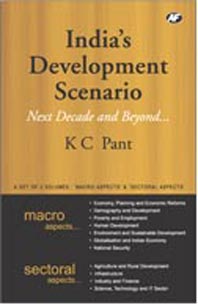
India's Development Scenario
Next Decade and Beyond....(A Set of 2 Volumes)
K.C. Pant (Ed.)
Next Decade and Beyond....(A Set of 2 Volumes)
About the Book
There has been a tendency in recent years to treat the development strategy followed by India for the first forty odd years after independence as an undifferentiated continuum. Nothing could be farther from the truth, points out K.C. Pant. He emphasises that India’s development strategies have evolved from Plan to Plan in response to the objective conditions of the economy and some of these changes have been strikingly bold and original, others more modest; but change there has been.
Right since independence, we have equated development with industrialisation. The role of the agricultural sector in generating demand for industrial goods, through a wide dispersal of purchasing power, has been seriously under-estimated in the past. It is now clear that unless the incomes of the majority of our people who are engaged in agriculture grow rapidly, acceleration in the growth of industry and most services will simply not be possible. Therefore, unless our agricultural sector grows sufficiently fast, we face the spectre of growing unemployment and of even greater underemployment of our work force. This would place an intolerable burden on the fabric of our society and may eventually thwart all our development efforts.
The Tenth Five Year Plan, therefore, reflects a subtle shift in our development perspective. The agricultural sector can no longer be treated as being a residual or peripheral component of our growth path, but must take centre-stage of all our development efforts. Our experience since the mid-1980s, and more particularly since the initiation of economic reforms in the early 1990s, strongly indicates that the Indian industrial sector has reached a stage of maturity whereby it no longer requires focussed attention of the Government, whether for promotion or protection. But the quality of governance has deteriorated so much that the Planning Commission now considers governance as one of the most important constraint to growth, and a separate chapter is being devoted to this issue in the Tenth Plan.
This publication – a set of two volumes authored by none other than K.C. Pant (Deputy Chairman Planning Commission, Government of India) – provides an all comprehensive picture of India’s development experience during the last 50 years of planning and a vision for the future. Ninety-six chapters, in eleven sections, covering both the ‘macro aspects’ and ‘sectoral aspects’ of development, provide the reader insights into the development experience of the Indian Economy, particularly since the period of economic reforms, and also a vision for the next decade and beyond.
About the Author(s) / Editor(s)
K.C. Pant is presently Deputy Chairman, Planning Com-mission, Government of India.
Born at Bhowali, Nainital District, Uttar Pradesh, K.C. Pant studied at St. Joseph’s College, Nainital (Uttaranchal), and is a Gold Medalist from Lucknow University (M.Sc).
He was Member of Parliament from 1962 onwards for twenty six years (both Lok Sabha and Rajya Sabha) and has held several portfolios in the Union Council of Ministers, from time to time, including Finance, Home, Defence, Irrigation and Power, Energy, Steel & Mines, Heavy Engineering, Education, Science and Technology, Atomic Energy, Electronics and Space.
He was Chairman of the 10th Finance Commission. Presently, he is Chairman, Centre for Research and Information Systems for the Non-Aligned and Other Developing Countries (RIS), New Delhi; Chairman, G.B. Pant Social Science Institute, Allahabad; and, Co-Chairman, Indo-UK Round Table.
K.C. Pant has represented India in several International Forums from 1965 onwards. He has widely travelled in India and abroad.
Contents in Detail
Macro aspects...
Section I Economy, Planning and Economic Reforms
1.Imperatives of Development Planning :
The Indian Experience
2.India's Economy : Preparing for the
New Millennium
3.Vision of India's Development: The Role
of Planning Commission
4.India's Planning in the New Millennium
5.Planning in Market Economy
6.Issues Pertaining to National Planning
in the Country
7.Tenth Five Year Plan : 2002-07
8.India's Economic Reforms
9.Effective Governance in India
10.Role of the Voluntary Sector in
National Development
Section II Demography and Development
11.Population Dynamics : Choices and
Challenges
12.India's Population Policy
13.Infant Mortality
14.Health and Family Welfare
Section III Poverty and Employment
15.Employment Generation
16.Targeting Ten Million Employment
Opportunities per Year
17.Workforce Participation Rates for
Males and Females
18.Poverty Measurement, Monitoring
and Evaluation
19.State Level Reforms for Poverty Reduction
Section IV Human Development
20.Core Indicators of Human Development
21.National Human Development Report
22.Social Sector Issues
23.Social Development and Beyond
24.Social Security Policy: Challenges
Before India and South Asia
25.Social Security in India
26.Gender Budgeting
27.Education, Health and Social
Infrastructure
28.Towards a Society for All Ages
Section V Environment and Sustainable
Development
29.Energy, Environment and Development
30.Environmental Perspectives in
the Millennium
31.Sustainable Development and
Sustainable Life Styles
32.World Congress on Environment
Management
33.Indian Research on Environmental
Pollution
34.Architecture and Energy Management
for Environmental Sustainability
35.Transport Pricing for Promoting
Sustainable Development
Section VI Globalisation and Indian Economy
36.Global Economic Situation and
Indian Economy
37.Intellectual Property Rights
38.ASEAN - India Cooperation
39.Indonesia and India : A New Beginning
40.The Malaysian Experience of Handling
the 1997 Financial Crisis
41.India and UK as Partners in the
New Millennium
42.India-Asian Business Summit,
October 17, 2002
Section VII National Security
43.India Through the Ages
44.Asian Security in the 21st Century
45.Dimensions of India's Security Concern
46.National Security : The Maritime Aspect
Sectoral aspects...
Section I Agriculture and Rural Development
1.Planning for Agriculture: Challenges
and Opportunities in the 21st Century
2.Reforms in Indian Agriculture for Growth,
Equity and Sustainability
3.Rural Technology for Poverty Alleviation
4.Role of Research and Development in
Indian Agriculture
5.Planet Breeding : Retrospect and Prospects
6.Water Resources Management for
Sustainable Development
7.Rain Water Harvesting
8.Optimal Utilisation of Water Resources
9.Drainage and Food Control
10.Rural Water Supply Policy
11.Synergisation of Water Management
12.Natural Resources Management and
Watershed Development Programmes
13.Co-operatives in India's Economic Development
14.Panchayati Raj Institutions
15.Community Driven Management
and Decentralisation
16.Towards Hunger-free India
17.Food Security
18.WTO Agreement on Agriculture and
Food Management
19.Towards a Visible Subsidies Policy
Section II Infrastructure
20.Infrastructure in India's Economic
Development
21.Power Sector Reforms
22.Developing Power Market in India : 2010
23.Electricity for All
24.Investment Opportunities in
India's Energy Sector
25.Knowledge Partnership for a Green Planet
26.Household Energy, Indoor Air
Pollution and Health
27.India's Transportation System
Section III Industry
28.Public Sector Competitiveness
29.National Productivity Policy
30.Economic Reforms and Labour:Lesson for India
From the East Asian Experience
31.Unorganised Sector Labour: Social
Protection, Skill Development, and
Umbrella Legislation
32.Rural Industrialisation in India
33.WTO Agreements : Implications
and Impact on SMEs
34.India's Financial System
35.Industrial Sickness
36.Textile Industry
37.Rubber Industry: Technology Challenges
38.Minerals, Metals & Metallurgy in India's
Economic Development
39.Gandhian Strategies in Management
Section IV Science, Technology and IT Sector
40.Technological and Economic
Developments in India
41.Telecom & Information Technology
42.Convergence of Power, IT and Telecom Sectors
43.IT Sector in India's Economic Development
44.Science and Technology in India's Economic Development
45.Engineering and Technological Challenges in the 21st Century
46.Internet Service Providers and New Telecom Policy
47.Knowledge Economy
48.E-Commerce
49.Information Technology in Transportation
50.Information Economy vis-a-vis Employment Dynamics
| Publisher | AF Press |
| Publication Date | 2003 |
| Number of Pages | 778 |
| ISBN |
8171882900 |
Academic Foundation (AF), based in New Delhi, is India’s leading independent publisher of academic/scholarly books in Social Sciences, specialising in Economics—Development Economics and Indian Economy in particular, and allied subjects.
About the Book
There has been a tendency in recent years to treat the development strategy followed by India for the first forty odd years after independence as an undifferentiated continuum. Nothing could be farther from the truth, points out K.C. Pant. He emphasises that India’s development strategies have evolved from Plan to Plan in response to the objective conditions of the economy and some of these changes have been strikingly bold and original, others more modest; but change there has been.
Right since independence, we have equated development with industrialisation. The role of the agricultural sector in generating demand for industrial goods, through a wide dispersal of purchasing power, has been seriously under-estimated in the past. It is now clear that unless the incomes of the majority of our people who are engaged in agriculture grow rapidly, acceleration in the growth of industry and most services will simply not be possible. Therefore, unless our agricultural sector grows sufficiently fast, we face the spectre of growing unemployment and of even greater underemployment of our work force. This would place an intolerable burden on the fabric of our society and may eventually thwart all our development efforts.
The Tenth Five Year Plan, therefore, reflects a subtle shift in our development perspective. The agricultural sector can no longer be treated as being a residual or peripheral component of our growth path, but must take centre-stage of all our development efforts. Our experience since the mid-1980s, and more particularly since the initiation of economic reforms in the early 1990s, strongly indicates that the Indian industrial sector has reached a stage of maturity whereby it no longer requires focussed attention of the Government, whether for promotion or protection. But the quality of governance has deteriorated so much that the Planning Commission now considers governance as one of the most important constraint to growth, and a separate chapter is being devoted to this issue in the Tenth Plan.
This publication – a set of two volumes authored by none other than K.C. Pant (Deputy Chairman Planning Commission, Government of India) – provides an all comprehensive picture of India’s development experience during the last 50 years of planning and a vision for the future. Ninety-six chapters, in eleven sections, covering both the ‘macro aspects’ and ‘sectoral aspects’ of development, provide the reader insights into the development experience of the Indian Economy, particularly since the period of economic reforms, and also a vision for the next decade and beyond.
About the Author(s) / Editor(s)
K.C. Pant is presently Deputy Chairman, Planning Com-mission, Government of India.
Born at Bhowali, Nainital District, Uttar Pradesh, K.C. Pant studied at St. Joseph’s College, Nainital (Uttaranchal), and is a Gold Medalist from Lucknow University (M.Sc).
He was Member of Parliament from 1962 onwards for twenty six years (both Lok Sabha and Rajya Sabha) and has held several portfolios in the Union Council of Ministers, from time to time, including Finance, Home, Defence, Irrigation and Power, Energy, Steel & Mines, Heavy Engineering, Education, Science and Technology, Atomic Energy, Electronics and Space.
He was Chairman of the 10th Finance Commission. Presently, he is Chairman, Centre for Research and Information Systems for the Non-Aligned and Other Developing Countries (RIS), New Delhi; Chairman, G.B. Pant Social Science Institute, Allahabad; and, Co-Chairman, Indo-UK Round Table.
K.C. Pant has represented India in several International Forums from 1965 onwards. He has widely travelled in India and abroad.
Contents in Detail
Macro aspects...
Section I Economy, Planning and Economic Reforms
1.Imperatives of Development Planning :
The Indian Experience
2.India's Economy : Preparing for the
New Millennium
3.Vision of India's Development: The Role
of Planning Commission
4.India's Planning in the New Millennium
5.Planning in Market Economy
6.Issues Pertaining to National Planning
in the Country
7.Tenth Five Year Plan : 2002-07
8.India's Economic Reforms
9.Effective Governance in India
10.Role of the Voluntary Sector in
National Development
Section II Demography and Development
11.Population Dynamics : Choices and
Challenges
12.India's Population Policy
13.Infant Mortality
14.Health and Family Welfare
Section III Poverty and Employment
15.Employment Generation
16.Targeting Ten Million Employment
Opportunities per Year
17.Workforce Participation Rates for
Males and Females
18.Poverty Measurement, Monitoring
and Evaluation
19.State Level Reforms for Poverty Reduction
Section IV Human Development
20.Core Indicators of Human Development
21.National Human Development Report
22.Social Sector Issues
23.Social Development and Beyond
24.Social Security Policy: Challenges
Before India and South Asia
25.Social Security in India
26.Gender Budgeting
27.Education, Health and Social
Infrastructure
28.Towards a Society for All Ages
Section V Environment and Sustainable
Development
29.Energy, Environment and Development
30.Environmental Perspectives in
the Millennium
31.Sustainable Development and
Sustainable Life Styles
32.World Congress on Environment
Management
33.Indian Research on Environmental
Pollution
34.Architecture and Energy Management
for Environmental Sustainability
35.Transport Pricing for Promoting
Sustainable Development
Section VI Globalisation and Indian Economy
36.Global Economic Situation and
Indian Economy
37.Intellectual Property Rights
38.ASEAN - India Cooperation
39.Indonesia and India : A New Beginning
40.The Malaysian Experience of Handling
the 1997 Financial Crisis
41.India and UK as Partners in the
New Millennium
42.India-Asian Business Summit,
October 17, 2002
Section VII National Security
43.India Through the Ages
44.Asian Security in the 21st Century
45.Dimensions of India's Security Concern
46.National Security : The Maritime Aspect
Sectoral aspects...
Section I Agriculture and Rural Development
1.Planning for Agriculture: Challenges
and Opportunities in the 21st Century
2.Reforms in Indian Agriculture for Growth,
Equity and Sustainability
3.Rural Technology for Poverty Alleviation
4.Role of Research and Development in
Indian Agriculture
5.Planet Breeding : Retrospect and Prospects
6.Water Resources Management for
Sustainable Development
7.Rain Water Harvesting
8.Optimal Utilisation of Water Resources
9.Drainage and Food Control
10.Rural Water Supply Policy
11.Synergisation of Water Management
12.Natural Resources Management and
Watershed Development Programmes
13.Co-operatives in India's Economic Development
14.Panchayati Raj Institutions
15.Community Driven Management
and Decentralisation
16.Towards Hunger-free India
17.Food Security
18.WTO Agreement on Agriculture and
Food Management
19.Towards a Visible Subsidies Policy
Section II Infrastructure
20.Infrastructure in India's Economic
Development
21.Power Sector Reforms
22.Developing Power Market in India : 2010
23.Electricity for All
24.Investment Opportunities in
India's Energy Sector
25.Knowledge Partnership for a Green Planet
26.Household Energy, Indoor Air
Pollution and Health
27.India's Transportation System
Section III Industry
28.Public Sector Competitiveness
29.National Productivity Policy
30.Economic Reforms and Labour:Lesson for India
From the East Asian Experience
31.Unorganised Sector Labour: Social
Protection, Skill Development, and
Umbrella Legislation
32.Rural Industrialisation in India
33.WTO Agreements : Implications
and Impact on SMEs
34.India's Financial System
35.Industrial Sickness
36.Textile Industry
37.Rubber Industry: Technology Challenges
38.Minerals, Metals & Metallurgy in India's
Economic Development
39.Gandhian Strategies in Management
Section IV Science, Technology and IT Sector
40.Technological and Economic
Developments in India
41.Telecom & Information Technology
42.Convergence of Power, IT and Telecom Sectors
43.IT Sector in India's Economic Development
44.Science and Technology in India's Economic Development
45.Engineering and Technological Challenges in the 21st Century
46.Internet Service Providers and New Telecom Policy
47.Knowledge Economy
48.E-Commerce
49.Information Technology in Transportation
50.Information Economy vis-a-vis Employment Dynamics
| Publisher | AF Press |
| Publication Date | 2003 |
| Number of Pages | 778 |
| ISBN |
8171882900 |
Couldn't load pickup availability
Share
-
Curated Collections By AF Press
-
Premium Print Quality
-
Author-Centric Publishing
-
Trusted by Readers Nationwide
India's Development Scenario