

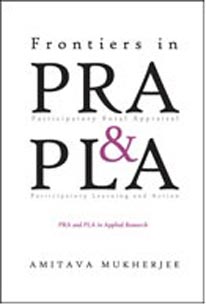
Frontiers in PRA and PLA
Amitav Mukherjee
About the Book
Community participation or people's participation in the process of development has entered into development lexicon permanently in the past 50 years. New methods, tools and approaches (variously called as Participatory Learning and Action (PLA), Participatory Rural Appraisal (PRA) or its earlier incarnation Rapid Rural Appraisal) to enlist people's participation, have been invented, improvised and developed by development practitioners and academicians all over the world.
This book is an unique exercise in exploration and synthesis, demonstrating and documenting the experiments which have revealed that the participatory tools, methods and approaches can be very efficiently used in several fields of human exploration, including organisation and institutional development, action research (on the need to adopt an inter-sectoral approach to dealing with development issues, on hunger, participatory poverty assessment, bio-diversity conservation and conflict resolution over sharing of resources), macro-policy evaluation and democratic processes. Each chapter, dealing with these issues, describes both the process followed in the application of participatory tools and methods in the respective field and the synthesis of the theory of participation with practice as well. The book will be an invaluable guide to practitioners, researchers, academicians and students of development economics and poverty planning.
About the Author(s) / Editor(s)
Dr. Amitava Mukherjee is currently the Senior Project Expert at the United Nations Economic & Social Commission for Asia and the Pacific (UNESCAP), Bangkok. Prior to which he was the Head of the United Nations Asian and Pacific Centre for Agricultural Engineering and Machinery, Beijing, China and Regional Advisor on Poverty Reduction and Chief Technical Advisor on Public Private Partnership, at UNESCAP, Bangkok. He has advised governments and/or its agencies and non-governmental organisations in Bangladesh, Cambodia, China, India, Indonesia, Lao PDR, Mongolia, Philippines, Pakistan, Timor-Leste, Sri Lanka and Central Asian countries (Azerbaijan, Kazakhstan, Kyrgyzstan, Tajikistan and Uzbekistan) and South Caucasian countries (Armenia and Georgia). Earlier he had worked extensively at the ground level in India and China and in the horn of Africa.
He has over 30 years of direct development experience especially in eliminating poverty and hunger; sustainable agriculture; community based planning; participatory development. He has a large number of professional reports, articles/papers and has over 35 books to his credit. He was the Team Leader of the Inter-divisional Task Force of UNESCAP which produced the Sustainable Agriculture and Food Security in Asia and the Pacific, 2009, (Bangkok, United Nations) for the 65th Annual Commission Session of United Nations Economic & Social Commission for Asia and the Pacific.
Contents in Detail
| Publisher | AF Press |
| Publication Date | 2009 |
| Number of Pages | 466 |
| ISBN |
9788171887248 |
Academic Foundation (AF), based in New Delhi, is India’s leading independent publisher of academic/scholarly books in Social Sciences, specialising in Economics—Development Economics and Indian Economy in particular, and allied subjects.
About the Book
Community participation or people's participation in the process of development has entered into development lexicon permanently in the past 50 years. New methods, tools and approaches (variously called as Participatory Learning and Action (PLA), Participatory Rural Appraisal (PRA) or its earlier incarnation Rapid Rural Appraisal) to enlist people's participation, have been invented, improvised and developed by development practitioners and academicians all over the world.
This book is an unique exercise in exploration and synthesis, demonstrating and documenting the experiments which have revealed that the participatory tools, methods and approaches can be very efficiently used in several fields of human exploration, including organisation and institutional development, action research (on the need to adopt an inter-sectoral approach to dealing with development issues, on hunger, participatory poverty assessment, bio-diversity conservation and conflict resolution over sharing of resources), macro-policy evaluation and democratic processes. Each chapter, dealing with these issues, describes both the process followed in the application of participatory tools and methods in the respective field and the synthesis of the theory of participation with practice as well. The book will be an invaluable guide to practitioners, researchers, academicians and students of development economics and poverty planning.
About the Author(s) / Editor(s)
Dr. Amitava Mukherjee is currently the Senior Project Expert at the United Nations Economic & Social Commission for Asia and the Pacific (UNESCAP), Bangkok. Prior to which he was the Head of the United Nations Asian and Pacific Centre for Agricultural Engineering and Machinery, Beijing, China and Regional Advisor on Poverty Reduction and Chief Technical Advisor on Public Private Partnership, at UNESCAP, Bangkok. He has advised governments and/or its agencies and non-governmental organisations in Bangladesh, Cambodia, China, India, Indonesia, Lao PDR, Mongolia, Philippines, Pakistan, Timor-Leste, Sri Lanka and Central Asian countries (Azerbaijan, Kazakhstan, Kyrgyzstan, Tajikistan and Uzbekistan) and South Caucasian countries (Armenia and Georgia). Earlier he had worked extensively at the ground level in India and China and in the horn of Africa.
He has over 30 years of direct development experience especially in eliminating poverty and hunger; sustainable agriculture; community based planning; participatory development. He has a large number of professional reports, articles/papers and has over 35 books to his credit. He was the Team Leader of the Inter-divisional Task Force of UNESCAP which produced the Sustainable Agriculture and Food Security in Asia and the Pacific, 2009, (Bangkok, United Nations) for the 65th Annual Commission Session of United Nations Economic & Social Commission for Asia and the Pacific.
Contents in Detail
| Publisher | AF Press |
| Publication Date | 2009 |
| Number of Pages | 466 |
| ISBN |
9788171887248 |

Couldn't load pickup availability
Share
-

Curated Collections By AF Press
-

Premium Print Quality
-

Author-Centric Publishing
-

Trusted by Readers Nationwide


Frontiers in PRA and PLA