


Understanding Global Economic Change
José Miguel Andreu‚ Rita Dulci Rahman
About the Book
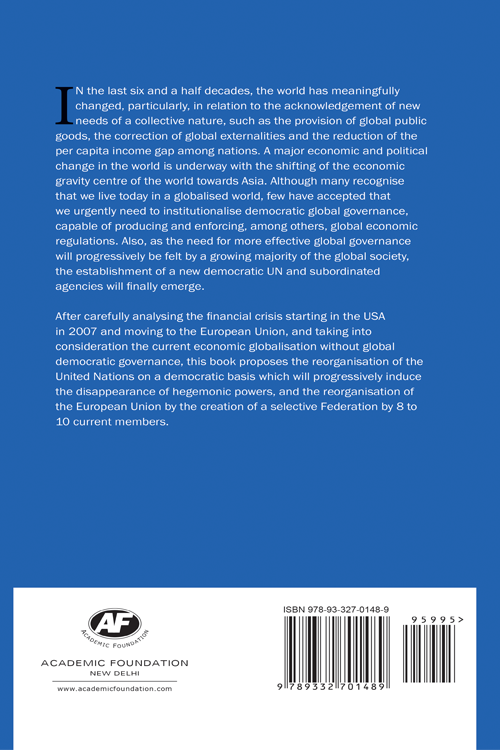
In the last six and a half decades, the world has meaningfully changed, particularly, in relation to the acknowledgement of new needs of a collective nature, such as the provision of global public goods, the correction of global externalities and the reduction of the per capita income gap among nations. A major economic and political change in the world is underway with the shifting of the economic gravity centre of the world towards Asia. Although many recognise that we live today in a globalised world, few have accepted that we urgently need to institutionalise democratic global governance, capable of producing and enforcing, among others, global economic regulations.
Also, as the need for more effective global governance will progressively be felt by a growing majority of the global society, the establishment of a new democratic UN and subordinated agencies will finally emerge.
After carefully analysing the financial crisis starting in the USA in 2007 and moving to the European Union, and taking into consideration the current economic globalisation without global democratic governance, this book proposes the reorganisation of the United Nations on a democratic basis which will progressively induce the disappearance of hegemonic powers, and the reorganisation of the European Union by the creation of a selective Federation by 8 to 10 current members.
About the Author(s) / Editor(s)
José Miguel Andreu was Professor of Economics at the University of Seville, Spain. He also taught Economics at the Universities of Bilbao, Alcala de Henares and UNED-Madrid, lecturing on introduction to macroeconomics, theory of economic growth and money and banking for more than 40 years.
In addition, he served as Economic Advisor to the Prime Minister of Spain from 1981-82, and from 2000-2003 he was posted to India as Head of the Commercial Office, in the Embassy of Spain, New Delhi. Along the years, Prof Andreu has published more than 150 articles and around 15 books on macroeconomics, banking and globalisation.
Rita Dulci Rahman is a sociologist and Dutch career diplomat. She has a Master in Socioeconomic Development from University of Leiden, Netherlands, and for several years was guest lecturer on “Introduction to Development Cooperation” at the same University. Along the years, she developed expertise in international relations, development cooperation, international trade, conflict resolution, and in the field of global governance. In addition, she chaired or has been member in several Dutch and European governmental and societal institutions involved in world affairs and sustainable global development. She is currently posted as Ambassador to Malta.
| Publisher | AF Press |
| Publication Date | 2014 |
| Number of Pages | 278 |
| ISBN |
9789332701489 |
Academic Foundation (AF), based in New Delhi, is India’s leading independent publisher of academic/scholarly books in Social Sciences, specialising in Economics—Development Economics and Indian Economy in particular, and allied subjects.
About the Book
In the last six and a half decades, the world has meaningfully changed, particularly, in relation to the acknowledgement of new needs of a collective nature, such as the provision of global public goods, the correction of global externalities and the reduction of the per capita income gap among nations. A major economic and political change in the world is underway with the shifting of the economic gravity centre of the world towards Asia. Although many recognise that we live today in a globalised world, few have accepted that we urgently need to institutionalise democratic global governance, capable of producing and enforcing, among others, global economic regulations.
Also, as the need for more effective global governance will progressively be felt by a growing majority of the global society, the establishment of a new democratic UN and subordinated agencies will finally emerge.
After carefully analysing the financial crisis starting in the USA in 2007 and moving to the European Union, and taking into consideration the current economic globalisation without global democratic governance, this book proposes the reorganisation of the United Nations on a democratic basis which will progressively induce the disappearance of hegemonic powers, and the reorganisation of the European Union by the creation of a selective Federation by 8 to 10 current members.
About the Author(s) / Editor(s)
José Miguel Andreu was Professor of Economics at the University of Seville, Spain. He also taught Economics at the Universities of Bilbao, Alcala de Henares and UNED-Madrid, lecturing on introduction to macroeconomics, theory of economic growth and money and banking for more than 40 years.
In addition, he served as Economic Advisor to the Prime Minister of Spain from 1981-82, and from 2000-2003 he was posted to India as Head of the Commercial Office, in the Embassy of Spain, New Delhi. Along the years, Prof Andreu has published more than 150 articles and around 15 books on macroeconomics, banking and globalisation.
Rita Dulci Rahman is a sociologist and Dutch career diplomat. She has a Master in Socioeconomic Development from University of Leiden, Netherlands, and for several years was guest lecturer on “Introduction to Development Cooperation” at the same University. Along the years, she developed expertise in international relations, development cooperation, international trade, conflict resolution, and in the field of global governance. In addition, she chaired or has been member in several Dutch and European governmental and societal institutions involved in world affairs and sustainable global development. She is currently posted as Ambassador to Malta.
| Publisher | AF Press |
| Publication Date | 2014 |
| Number of Pages | 278 |
| ISBN |
9789332701489 |

Couldn't load pickup availability
Share

-

Curated Collections By AF Press
-

Premium Print Quality
-

Author-Centric Publishing
-

Trusted by Readers Nationwide


Understanding Global Economic Change