


Central Banking for Emerging Market Economies(2nd Edition)
A. Vasudevan
About the Book
This version of the book Central Banking for Emerging Market Economies which first appeared in 2003 (Academic Foundation, New Delhi) is an update as also contextual. The global economic and financial crisis that emerged in 2007-08 and remains unresolved on a sustainable basis as of the third quarter of 2013, has led to questions about the relevance of central banks and in particular about the effectiveness of monetary policies in addressing the challenges. The integration of real and financial economies of the world has given a veneer of respectability to these questions. The crisis first engulfed the US and other advanced economies and subsequently impacted most emerging and developing economies in different degrees.
This contextual update shows that central banks continue to be relevant and essential for sound functioning of economies. Central banks require to pursue traditional functions relating to currency and payment systems and to being banker to the government and to banks as vigorously as before the crisis. They also need to adopt an oriented approach towards the pursuit of monetary policy for growth, inflation control and financial stability. The orientation has to do with monetary governance in a broad sense, a point that is best echoed in the author’s companion book: Monetary Governance in Search of New Space (2012, Academic Foundation). Central banking in its essence continues to be the art of the possible.
Praise for this book
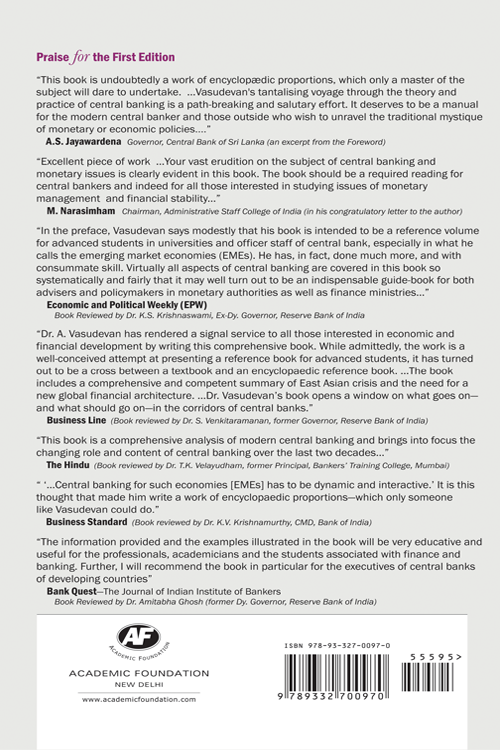
Praise for the First Edition
“This book is undoubtedly a work of encyclopædic proportions, which only a master of the subject will dare to undertake. ...Vasudevan's tantalising voyage through the theory and practice of central banking is a path-breaking and salutary effort. It deserves to be a manual for the modern central banker and those outside who wish to unravel the traditional mystique of monetary or economic policies....”
— A.S. Jayawardena Governor
Central Bank of Sri Lanka (an excerpt from the Foreword)
“Excellent piece of work ...Your vast erudition on the subject of central banking and monetary issues is clearly evident in this book. The book should be a required reading for central bankers and indeed for all those interested in studying issues of monetary management and financial stability...”
— M. Narasimham
“In the preface, Vasudevan says modestly that his book is intended to be a reference volume for advanced students in universities and officer staff of central bank, especially in what he calls the emerging market economies (EMEs). He has, in fact, done much more, and with consummate skill. Virtually all aspects of central banking are covered in this book so systematically and fairly that it may well turn out to be an indispensable guide-book for both advisers and policymakers in monetary authorities as well as finance ministries...”
— Economic and Political Weekly (EPW)
Book Reviewed by Dr. K.S. Krishnaswami,
Ex-Dy. Governor, Reserve Bank of India.
“Dr. A. Vasudevan has rendered a signal service to all those interested in economic and financial development by writing this comprehensive book. While admittedly, the work is a well-conceived attempt at presenting a reference book for advanced students, it has turned out to be a cross between a textbook and an encyclopaedic reference book. ...The book includes a comprehensive and competent summary of East Asian crisis and the need for a new global financial architecture. ...Dr. Vasudevan’s book opens a window on what goes on— and what should go on—in the corridors of central banks.”
— Business Line
(Book reviewed by Dr. S. Venkitaramanan,
former Governor, Reserve Bank of India)
“This book is a comprehensive analysis of modern central banking and brings into focus the changing role and content of central banking over the last two decades...”
— The Hindu
(Book reviewed by Dr. T.K. Velayudham, former Principal,
Bankers’ Training College, Mumbai)
“ ‘...Central banking for such economies [EMEs] has to be dynamic and interactive.’ It is this thought that made him write a work of encyclopaedic proportions—which only someone like Vasudevan could do.”
— Business Standard
(Book reviewed by Dr. K.V. Krishnamurthy,
CMD, Bank of India)
“The information provided and the examples illustrated in the book will be very educative and useful for the professionals, academicians and the students associated with finance and banking. Further, I will recommend the book in particular for the executives of central banks of developing countries”
— Bank Quest—The Journal of Indian Institute of Bankers
Book Reviewed by Dr. Amitabha Ghosh (former Dy. Governor,
Reserve Bank of India)
About the Author(s) / Editor(s)
Asuri Vasudevan retired as Executive Director in charge of economic research, monetary policy, statistics and information technology, Reserve Bank of India in 2000. He was associated with the Central Bank of Nigeria as Special Adviser to Governor on Monetary Policy (2010-12) and as Monetary Operations Adviser on an IMF assignment between 2006 and 2009. His book, Monetary Governance in Search of New Space was published in 2012 (Academic Foundation, New Delhi). He worked as Adviser to the Executive Director for India, IMF (1984-89) at Washington DC and was a member of the Task Forces relating to International Standards and Codes set up by the Financial Stability Forum, Basle (2000). He was member of India Delegations to the IMF-World Bank meetings (1984-89) and between 1993 and 2000. The author was also G-20 Central Bank Deputy in 1999 and 2000. Currently he is working on issues relating to economic and financial policies.
| Publisher | AF Press |
| Publication Date | 2014 |
| Number of Pages | 276 |
| ISBN |
9789332700970 |
Academic Foundation (AF), based in New Delhi, is India’s leading independent publisher of academic/scholarly books in Social Sciences, specialising in Economics—Development Economics and Indian Economy in particular, and allied subjects.
About the Book
This version of the book Central Banking for Emerging Market Economies which first appeared in 2003 (Academic Foundation, New Delhi) is an update as also contextual. The global economic and financial crisis that emerged in 2007-08 and remains unresolved on a sustainable basis as of the third quarter of 2013, has led to questions about the relevance of central banks and in particular about the effectiveness of monetary policies in addressing the challenges. The integration of real and financial economies of the world has given a veneer of respectability to these questions. The crisis first engulfed the US and other advanced economies and subsequently impacted most emerging and developing economies in different degrees.
This contextual update shows that central banks continue to be relevant and essential for sound functioning of economies. Central banks require to pursue traditional functions relating to currency and payment systems and to being banker to the government and to banks as vigorously as before the crisis. They also need to adopt an oriented approach towards the pursuit of monetary policy for growth, inflation control and financial stability. The orientation has to do with monetary governance in a broad sense, a point that is best echoed in the author’s companion book: Monetary Governance in Search of New Space (2012, Academic Foundation). Central banking in its essence continues to be the art of the possible.
Praise for this book
Praise for the First Edition
“This book is undoubtedly a work of encyclopædic proportions, which only a master of the subject will dare to undertake. ...Vasudevan's tantalising voyage through the theory and practice of central banking is a path-breaking and salutary effort. It deserves to be a manual for the modern central banker and those outside who wish to unravel the traditional mystique of monetary or economic policies....”
— A.S. Jayawardena Governor
Central Bank of Sri Lanka (an excerpt from the Foreword)
“Excellent piece of work ...Your vast erudition on the subject of central banking and monetary issues is clearly evident in this book. The book should be a required reading for central bankers and indeed for all those interested in studying issues of monetary management and financial stability...”
— M. Narasimham
“In the preface, Vasudevan says modestly that his book is intended to be a reference volume for advanced students in universities and officer staff of central bank, especially in what he calls the emerging market economies (EMEs). He has, in fact, done much more, and with consummate skill. Virtually all aspects of central banking are covered in this book so systematically and fairly that it may well turn out to be an indispensable guide-book for both advisers and policymakers in monetary authorities as well as finance ministries...”
— Economic and Political Weekly (EPW)
Book Reviewed by Dr. K.S. Krishnaswami,
Ex-Dy. Governor, Reserve Bank of India.
“Dr. A. Vasudevan has rendered a signal service to all those interested in economic and financial development by writing this comprehensive book. While admittedly, the work is a well-conceived attempt at presenting a reference book for advanced students, it has turned out to be a cross between a textbook and an encyclopaedic reference book. ...The book includes a comprehensive and competent summary of East Asian crisis and the need for a new global financial architecture. ...Dr. Vasudevan’s book opens a window on what goes on— and what should go on—in the corridors of central banks.”
— Business Line
(Book reviewed by Dr. S. Venkitaramanan,
former Governor, Reserve Bank of India)
“This book is a comprehensive analysis of modern central banking and brings into focus the changing role and content of central banking over the last two decades...”
— The Hindu
(Book reviewed by Dr. T.K. Velayudham, former Principal,
Bankers’ Training College, Mumbai)
“ ‘...Central banking for such economies [EMEs] has to be dynamic and interactive.’ It is this thought that made him write a work of encyclopaedic proportions—which only someone like Vasudevan could do.”
— Business Standard
(Book reviewed by Dr. K.V. Krishnamurthy,
CMD, Bank of India)
“The information provided and the examples illustrated in the book will be very educative and useful for the professionals, academicians and the students associated with finance and banking. Further, I will recommend the book in particular for the executives of central banks of developing countries”
— Bank Quest—The Journal of Indian Institute of Bankers
Book Reviewed by Dr. Amitabha Ghosh (former Dy. Governor,
Reserve Bank of India)
About the Author(s) / Editor(s)
Asuri Vasudevan retired as Executive Director in charge of economic research, monetary policy, statistics and information technology, Reserve Bank of India in 2000. He was associated with the Central Bank of Nigeria as Special Adviser to Governor on Monetary Policy (2010-12) and as Monetary Operations Adviser on an IMF assignment between 2006 and 2009. His book, Monetary Governance in Search of New Space was published in 2012 (Academic Foundation, New Delhi). He worked as Adviser to the Executive Director for India, IMF (1984-89) at Washington DC and was a member of the Task Forces relating to International Standards and Codes set up by the Financial Stability Forum, Basle (2000). He was member of India Delegations to the IMF-World Bank meetings (1984-89) and between 1993 and 2000. The author was also G-20 Central Bank Deputy in 1999 and 2000. Currently he is working on issues relating to economic and financial policies.
| Publisher | AF Press |
| Publication Date | 2014 |
| Number of Pages | 276 |
| ISBN |
9789332700970 |

Couldn't load pickup availability
Share

-

Curated Collections By AF Press
-

Premium Print Quality
-

Author-Centric Publishing
-

Trusted by Readers Nationwide


Central Banking for Emerging Market E...