


An Indian Social Democracy
Sunil Khilnani (Ed.)‚ Manmohan Malhoutra (Ed.)
About the Book
India's recent economic growth, in a society where most remain poor and benefits are unequally distributed, poses dilemmas for policy makers and analysts. Do rapid growth and widespread inequality necessarily go hand in hand ? Can inequality be lessened without impeding the growth essential to sustain social spending ? What is a sustainable pattern of growth ?
India, historically committed to a path of social democratic progress, is taking important steps to mitigate social risk and inequality: Examples include the National Rural Employment Guarantee Act, the Right to Education Act, legislation on food security, as well as introduction of innovative delivery mechanisms. Building on these initiatives, India's challenge now is to create an integrated political vision based on a three-fold commitment: to the values of social justice, to the instruments of markets, and to the processes of democracy.
Can India rise to this challenge ? What hurdles—cultural no less than political and economic—stand in the way of realising its social democratic ideals ? Are current priorities appropriate ? Such questions and how they might be addressed animate this remarkable twin volume collection.
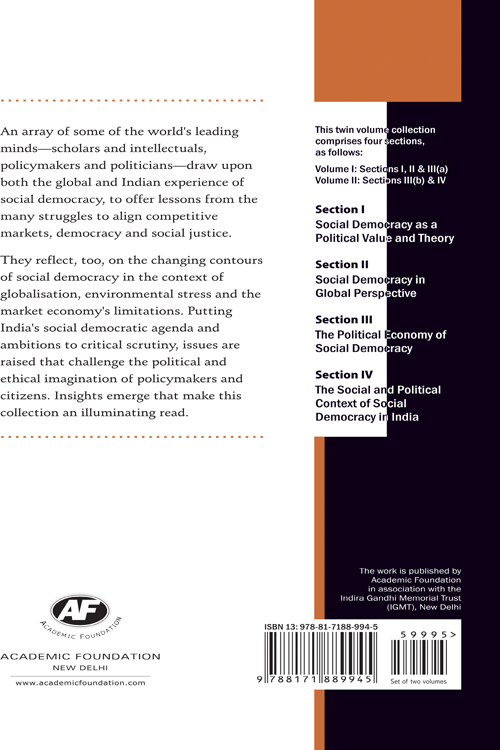
An array of some of the world's leading minds—scholars and intellectuals, policymakers and politicians—draw upon both the global and Indian experience of social democracy, to offer lessons from the many struggles to align competitive markets, democracy and social justice.
They reflect, too, on the changing contours of social democracy in the context of globalisation, environmental stress and the market economy's limitations. Putting India's social democratic agenda and ambitions to critical scrutiny, issues are raised that challenge the political and ethical imagination of policymakers and citizens. Insights emerge that make this collection an illuminating read.
About the Author(s) / Editor(s)
Sunil Khilnani is Avantha Professor and Director, India Institute at King's College, London. His research interests lie at the intersection of various fields: intellectual history and the study of political thought, the history of modern India, democratic theory in relation to its recent non-Western experiences, the politics of contemporary India, and strategic thought in the definition of India’s place in the world.
His publications include The Idea of India, translated into several languages, most recently Arabic and Tamil; and Civil Society: History and Possibilities (with Sudipta Kaviraj), as well as many essays and articles.
Manmohan (‘Moni’) Malhoutra is a Trustee of the Indira Gandhi Memorial Trust. A Rhodes scholar and a former member of the Indian Administrative Service (1961 to 1978) he worked with Prime Minister Indira Gandhi in her Secretariat from 1966-1973. He was Assistant Secretary General of the Commonwealth Secretariat, London (1981-1993), a member of the Board of International IDEA, Stockholm (1996-2005), and Secretary-General of the Rajiv Gandhi Foundation (2001-2007).
Contributors
Sonia Gandhi
Manmohan Singh
Joseph E Stiglitz
Jean Dreze
Pranab Bardhan
Montek S. Ahluwalia
Kaushik Basu
Sunil Khilnani
Anu Aga
Bina Agarwal
Sudipta Kaviraj
Mirai Chatterjee
Jonathan Cohn
Nitin Desai
Sri Mulyani Indrawati
Niraja Gopal Jayal
Vijay L. Kelkar
Chanda Kochhar
Michael Walton
Manish Sabharwal
Rohan Samarajiva
Kumar Mangalam Birla
Pratap Bhanu Mehta
Jamshyd Godrej
Pascal Lamy
Sudha Murty
Wang Hui
Sunita Narain
Nandan Nilekani
Kumi Naidoo
Joakim Palme
Rob Riemen
Nemat Shafik
Sudhir Agarwal
Anusha Rizvi
Pierre Rosanvallon
Aruna Roy
Rehman Sobhan
Erik Solheim
Steven Wilkinson
Yogendra Yadav
Contents in Detail
VOLUME I
Introduction
SUNIL KHILNANI
1. The Ideology of Social Democracy
SONIA GANDHI
2. Indian Social Democracy: Growth with Social Justice
MANMOHAN SINGH
Section I
Social Democracy as a Political Value and Theory
——— Background Papers ————————————
3. What is a Democratic Society?
PIERRE ROSANVALLON
4. Citizenship and Solidarity in Social Democracy
PRATAP BHANU MEHTA
5. The Idea of India as Social Democracy
SUNIL KHILNANI
——— Presentations and Discussions ————————
6. Introductory Remarks
MONTEK SINGH AHLUWALIA
7. Presentation by
PIERRE ROSANVALLON
8. Presentation by
PRATAP BHANU MEHTA
9. Presentation by
SUNIL KHILNANI
10. Discussion
Section II
Social Democracy in Global Perspective
——— Background Papers ————————————
11. Social Democracy and Globalisation
PASCAL LAMY
12. Social Democracy and the European Social Model:
Reflections on the Past, Present and Future
JOAKIM PALME
13. The Dialectics of Self-Reliance and
Opening: China’s Experience and Challenges
WANG HUI
14. The Strange Life of American Welfare
JONATHAN COHN
———— Presentations and Discussions ———————
15. Introductory Remarks
JOSEPH E. STIGLITZ
16. Presentation by
PASCAL LAMY
17. Presentation by
JOAKIM PALME
18. Presentation by
WANG HUI
19. Presentation by
JONATHAN COHN
20. Discussion
Section III
The Political Economy of Social Democracy
Section III (a)
——— Background Papers ————————————
21. Indian Social Democracy: The Resource Perspective
VIJAY KELKAR AND AJAY SHAH
22. Social Democracy, Capital and Growth
KAUSHIK BASU
23. Social Democracy and Environmental Protection
NITIN DESAI
——— Presentations and Discussions ————————
24. Introductory Remarks
NEMAT SHAFIK
25. Presentation by
VIJAY KELKAR
26. Presentation by
KAUSHIK BASU
27. Presentation by
NITIN DESAI
28. Discussion
Index
VOLUME II
Section III
The Political Economy of Social Democracy
Section III (b)
——— Background Papers ————————————
29. Inequality, Inefficiency, and the Challenges for
Social Democracy in India’s Economic Transition
PRANAB BARDHAN
30. Can a Social Democratic Resolution Resolve
Issues of Inequality and Growth for India?
MICHAEL WALTON
——— Presentations and Discussions ————————
31. Introductory Remarks
REHMAN SOBHAN
32. Presentation by
PRANAB BARDHAN
33. Presentation by
MICHAEL WALTON
34. Discussion
Section IV
The Social and Political Context of
Social Democracy in India
——— Background Papers ————————————
35. Decentralisation and the Prospects of
Social Democracy in India
NIRAJA GOPAL JAYAL
36. Social Democracy and Ethnic Cleavages
STEVEN I. WILKINSON
37. Indian Social Democracy and Questions of Culture
SUDIPTA KAVIRAJ
38. The Politics of Feasible Social Democracy
YOGENDRA YADAV
———— Presentations and Discussions ———————
39. Introductory Remarks
BINA AGARWAL
40. Presentation by
NIRAJA GOPAL JAYAL
41. Presentation by
STEVEN I. WILKINSON
42. Presentation by
YOGENDRA YADAV
43. Discussion
Afterword
A Social Democratic Agenda for a More Dynamic Indian Economy: Creating an Innovative and Learning Society
JOSEPH E. STIGLITZ
Contributors / Discussants
Index
| Publisher | AF Press |
| Publication Date | 2013 |
| Number of Pages | 428 |
| ISBN |
9788171889945 |
Academic Foundation (AF), based in New Delhi, is India’s leading independent publisher of academic/scholarly books in Social Sciences, specialising in Economics—Development Economics and Indian Economy in particular, and allied subjects.
About the Book
India's recent economic growth, in a society where most remain poor and benefits are unequally distributed, poses dilemmas for policy makers and analysts. Do rapid growth and widespread inequality necessarily go hand in hand ? Can inequality be lessened without impeding the growth essential to sustain social spending ? What is a sustainable pattern of growth ?
India, historically committed to a path of social democratic progress, is taking important steps to mitigate social risk and inequality: Examples include the National Rural Employment Guarantee Act, the Right to Education Act, legislation on food security, as well as introduction of innovative delivery mechanisms. Building on these initiatives, India's challenge now is to create an integrated political vision based on a three-fold commitment: to the values of social justice, to the instruments of markets, and to the processes of democracy.
Can India rise to this challenge ? What hurdles—cultural no less than political and economic—stand in the way of realising its social democratic ideals ? Are current priorities appropriate ? Such questions and how they might be addressed animate this remarkable twin volume collection.
An array of some of the world's leading minds—scholars and intellectuals, policymakers and politicians—draw upon both the global and Indian experience of social democracy, to offer lessons from the many struggles to align competitive markets, democracy and social justice.
They reflect, too, on the changing contours of social democracy in the context of globalisation, environmental stress and the market economy's limitations. Putting India's social democratic agenda and ambitions to critical scrutiny, issues are raised that challenge the political and ethical imagination of policymakers and citizens. Insights emerge that make this collection an illuminating read.
About the Author(s) / Editor(s)
Sunil Khilnani is Avantha Professor and Director, India Institute at King's College, London. His research interests lie at the intersection of various fields: intellectual history and the study of political thought, the history of modern India, democratic theory in relation to its recent non-Western experiences, the politics of contemporary India, and strategic thought in the definition of India’s place in the world.
His publications include The Idea of India, translated into several languages, most recently Arabic and Tamil; and Civil Society: History and Possibilities (with Sudipta Kaviraj), as well as many essays and articles.
Manmohan (‘Moni’) Malhoutra is a Trustee of the Indira Gandhi Memorial Trust. A Rhodes scholar and a former member of the Indian Administrative Service (1961 to 1978) he worked with Prime Minister Indira Gandhi in her Secretariat from 1966-1973. He was Assistant Secretary General of the Commonwealth Secretariat, London (1981-1993), a member of the Board of International IDEA, Stockholm (1996-2005), and Secretary-General of the Rajiv Gandhi Foundation (2001-2007).
Contributors
Sonia Gandhi
Manmohan Singh
Joseph E Stiglitz
Jean Dreze
Pranab Bardhan
Montek S. Ahluwalia
Kaushik Basu
Sunil Khilnani
Anu Aga
Bina Agarwal
Sudipta Kaviraj
Mirai Chatterjee
Jonathan Cohn
Nitin Desai
Sri Mulyani Indrawati
Niraja Gopal Jayal
Vijay L. Kelkar
Chanda Kochhar
Michael Walton
Manish Sabharwal
Rohan Samarajiva
Kumar Mangalam Birla
Pratap Bhanu Mehta
Jamshyd Godrej
Pascal Lamy
Sudha Murty
Wang Hui
Sunita Narain
Nandan Nilekani
Kumi Naidoo
Joakim Palme
Rob Riemen
Nemat Shafik
Sudhir Agarwal
Anusha Rizvi
Pierre Rosanvallon
Aruna Roy
Rehman Sobhan
Erik Solheim
Steven Wilkinson
Yogendra Yadav
Contents in Detail
VOLUME I
Introduction
SUNIL KHILNANI
1. The Ideology of Social Democracy
SONIA GANDHI
2. Indian Social Democracy: Growth with Social Justice
MANMOHAN SINGH
Section I
Social Democracy as a Political Value and Theory
——— Background Papers ————————————
3. What is a Democratic Society?
PIERRE ROSANVALLON
4. Citizenship and Solidarity in Social Democracy
PRATAP BHANU MEHTA
5. The Idea of India as Social Democracy
SUNIL KHILNANI
——— Presentations and Discussions ————————
6. Introductory Remarks
MONTEK SINGH AHLUWALIA
7. Presentation by
PIERRE ROSANVALLON
8. Presentation by
PRATAP BHANU MEHTA
9. Presentation by
SUNIL KHILNANI
10. Discussion
Section II
Social Democracy in Global Perspective
——— Background Papers ————————————
11. Social Democracy and Globalisation
PASCAL LAMY
12. Social Democracy and the European Social Model:
Reflections on the Past, Present and Future
JOAKIM PALME
13. The Dialectics of Self-Reliance and
Opening: China’s Experience and Challenges
WANG HUI
14. The Strange Life of American Welfare
JONATHAN COHN
———— Presentations and Discussions ———————
15. Introductory Remarks
JOSEPH E. STIGLITZ
16. Presentation by
PASCAL LAMY
17. Presentation by
JOAKIM PALME
18. Presentation by
WANG HUI
19. Presentation by
JONATHAN COHN
20. Discussion
Section III
The Political Economy of Social Democracy
Section III (a)
——— Background Papers ————————————
21. Indian Social Democracy: The Resource Perspective
VIJAY KELKAR AND AJAY SHAH
22. Social Democracy, Capital and Growth
KAUSHIK BASU
23. Social Democracy and Environmental Protection
NITIN DESAI
——— Presentations and Discussions ————————
24. Introductory Remarks
NEMAT SHAFIK
25. Presentation by
VIJAY KELKAR
26. Presentation by
KAUSHIK BASU
27. Presentation by
NITIN DESAI
28. Discussion
Index
VOLUME II
Section III
The Political Economy of Social Democracy
Section III (b)
——— Background Papers ————————————
29. Inequality, Inefficiency, and the Challenges for
Social Democracy in India’s Economic Transition
PRANAB BARDHAN
30. Can a Social Democratic Resolution Resolve
Issues of Inequality and Growth for India?
MICHAEL WALTON
——— Presentations and Discussions ————————
31. Introductory Remarks
REHMAN SOBHAN
32. Presentation by
PRANAB BARDHAN
33. Presentation by
MICHAEL WALTON
34. Discussion
Section IV
The Social and Political Context of
Social Democracy in India
——— Background Papers ————————————
35. Decentralisation and the Prospects of
Social Democracy in India
NIRAJA GOPAL JAYAL
36. Social Democracy and Ethnic Cleavages
STEVEN I. WILKINSON
37. Indian Social Democracy and Questions of Culture
SUDIPTA KAVIRAJ
38. The Politics of Feasible Social Democracy
YOGENDRA YADAV
———— Presentations and Discussions ———————
39. Introductory Remarks
BINA AGARWAL
40. Presentation by
NIRAJA GOPAL JAYAL
41. Presentation by
STEVEN I. WILKINSON
42. Presentation by
YOGENDRA YADAV
43. Discussion
Afterword
A Social Democratic Agenda for a More Dynamic Indian Economy: Creating an Innovative and Learning Society
JOSEPH E. STIGLITZ
Contributors / Discussants
Index
| Publisher | AF Press |
| Publication Date | 2013 |
| Number of Pages | 428 |
| ISBN |
9788171889945 |

Couldn't load pickup availability
Share

-

Curated Collections By AF Press
-

Premium Print Quality
-

Author-Centric Publishing
-

Trusted by Readers Nationwide


An Indian Social Democracy