


Exploding Aspirations
Rajiv Kumar
About the Book
The book is a collection of Rajiv Kumar’s widely read and appreciated columns in some of India’s leading newspapers over the last two years. The volume includes a specially written Introduction that provides a sharp and candid insight into multiple policy failures of the UPA II government and lays out the reform agenda for the incoming BJP government. The articles provide an incisive analysis of India’s turbulent economic journey over the last three years as the country lost both its policy direction and economic momentum. The short essays provide a rare ringside view of policy making and all its frailties from an author who has established himself as one of the most widely read columnists in India.
Praise for this book
“Rajiv Kumar is a true all-rounder in the field of economic policy, having occupied senior positions in government, in the private sector and in economic policy think tanks. His is an important voice that India’s policymakers must pay attention to. This collection of essays offers a critique of what went wrong with UPA-2 and ideas for returning India back to the high growth years of UPA-1.”
Sanjaya Baru, Honorary Senior Fellow, Centre for Policy Research, New Delhi
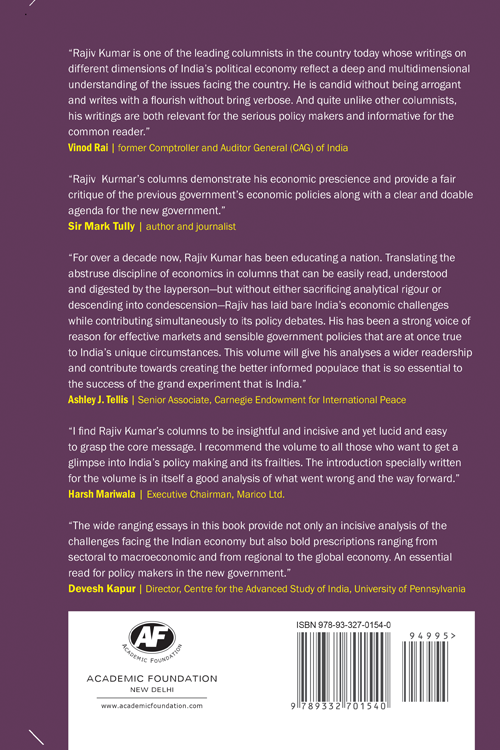
“Rajiv Kumar is one of the leading columnists in the country today whose writings on different dimensions of India’s political economy reflect a deep and multidimensional understanding of the issues facing the country. He is candid without being arrogant and writes with a flourish without bring verbose. And quite unlike other columnists, his writings are both relevant for the serious policy makers and informative for the common reader.”
Vinod Rai, former Comptroller and Auditor General (CAG) of India
“Rajiv Kurmar’s columns demonstrate his economic prescience and provide a fair critique condemnation of the previous government’s economic policies along with a clear and doable agenda for the new government.”
Sir Mark Tully, author and journalist
“For over a decade now, Rajiv Kumar has been educating a nation. Translating the abstruse discipline of economics in columns that can be easily read, understood and digested by the layperson—but without either sacrificing analytical rigor or descending into condescension—Rajiv has laid bare India’s economic challenges while contributing simultaneously to its policy debates. His has been a strong voice of reason for effective markets and sensible government policies that are at once true to India’s unique circumstances. This volume will give his analyses a wider readership and contribute towards creating the better informed populace that is so essential to the success of the grand experiment that is India.”
Ashley J. Tellis, Senior Associate, Carnegie Endowment for International Peace
“I find Rajiv Kumar’s columns, to be insightful and incisive and yet lucid and easy to grasp the core message. I recommend the volume to all those who want to get a glimpse into India’s policy making and its frailties. The introduction specially written for the volume is in itself a good analysis of what went wrong and the way forward.”
Harsh Mariwala, Executive Chairman, Marico Ltd.
“The wide ranging essays in this book provide not only an incisive analysis of the challenges facing the Indian economy but also bold prescriptions ranging from sectoral to macroeconomic and from regional to the global economy. An essential read for policy makers in the new government.”
Devesh Kapur, Director, Centre for the Advanced Study of India, University of Pennsylvania
About the Author(s) / Editor(s)
Rajiv Kumar, one of India’s most recognised economists, regularly advises the government on policy issues. He is India’s leading public intellectual whose widely read columns in major Indian newspapers offer candid and sharp insights into India’s evolving political economy. They are also read by leading policy makers.
He brings to his writings his vast and varied experience having worked in the Indian government as head of an economic policy think tank; in the ADB in Manila; and in India’s two largest national apex business associations. He has a DPhil in Economics from Oxford and PhD from Lucknow University.
Contents in detail
Introduction
I. Macroeconomic Issues
1. Beginning of Modi Era
2. Macroeconomic Concerns
3. Steadily towards an Economic Abyss
4. State of Denial
5. Needed a Credible Plan for Recovery
6. Growth Not the Rupee Needs Attention
7. Economy: No Recovery in Sight
8. Time for Hard and Right Decisions
9. The 2013-14 Budget: Workmanlike
and May Have Missed an Opportunity
10. On Thin Ice: Vote on Account 2014-15
11. Eleven Big Ideas for 2014
12. Nurturing the Sweet Spot
13. Targeting Inflation with Price Rigidities
14. Reserve Bank of India: Nothing New
15. Christening by Fire and an Opportunity Not to Be Missed
16. Well Begun but Not Quite Half Done
17. Time to Safeguard the Economy
18. LARR: A Mortal Blow for India’s Modernisation
19. Push Back the Luddites
20. Making a Win-Win Non-Populist Budget
21. Food Security Bill Will Hurt Not Help the Poor in India
22. Sonawane’s Sacrifice: Subsidies Sans Rationale
23. Creating New Entitlements:
The Wrong Way to Achieve Food Security
24. Food Security Bill: Its Hidden Costs and Consequences
25. Conditional Cash Transfers: The Time is Now
26. Building Indigenous Think Tanks
27. The Growing Trust Deficit
28. Lessons to Learn from the Uttarakhand Tragedy
II. Sectoral Issues
29. Indian Industry: The Next Frontier
30. Make Space for Private Investment in Agriculture
31. Retooling India’s Manufacturing Policy
32. Management by Crisis
33. Beyond FDI in Multi-brand Retail
34. Bring Back Privatisation Where Necessary
35. Business Lobbies Must Shape up for Growth
III. Reforms and the Political Process
36. Identity Politics: A Shameful, Dangerous Game
37. Governance Rot
38. Fighting the Corruption Demon
39. Let the Parliament Work!
40. Empowering the Aam Aadmi
41. Global Dimensions of Anna Hazare’s Movement
42. No Magic Formula for Gujarat’s Achievements
43. Lessons from the Semi-Final
44. BJP: Time for its Own Vision
IV. South Asia
45. Reimagining South Asia
46. Indo-Pak Trade Talks: Possible Breakthrough?
47. Dealing with Different Pakistans
48. Time to Be Bold
49. India-Pakistan Relations:
Why We Have to Be Pro-active
50. Calling Pakistan Army’s Bluff
51. Historical Opportunity for Mr Sharif
V. India and the Global Economy
52. India and Global Governance
53. Need for Structural Reforms to
Anchor the Economy amid Global Turmoil
54. BRICS: India’s Costly Timepass
55. Obama’s Second Term Augurs Well for India
| Publisher | AF Press |
| Publication Date | 2014 |
| Number of Pages | 260 |
| ISBN |
9789332701540 |
Academic Foundation (AF), based in New Delhi, is India’s leading independent publisher of academic/scholarly books in Social Sciences, specialising in Economics—Development Economics and Indian Economy in particular, and allied subjects.
About the Book
The book is a collection of Rajiv Kumar’s widely read and appreciated columns in some of India’s leading newspapers over the last two years. The volume includes a specially written Introduction that provides a sharp and candid insight into multiple policy failures of the UPA II government and lays out the reform agenda for the incoming BJP government. The articles provide an incisive analysis of India’s turbulent economic journey over the last three years as the country lost both its policy direction and economic momentum. The short essays provide a rare ringside view of policy making and all its frailties from an author who has established himself as one of the most widely read columnists in India.
Praise for this book
“Rajiv Kumar is a true all-rounder in the field of economic policy, having occupied senior positions in government, in the private sector and in economic policy think tanks. His is an important voice that India’s policymakers must pay attention to. This collection of essays offers a critique of what went wrong with UPA-2 and ideas for returning India back to the high growth years of UPA-1.”
Sanjaya Baru, Honorary Senior Fellow, Centre for Policy Research, New Delhi
“Rajiv Kumar is one of the leading columnists in the country today whose writings on different dimensions of India’s political economy reflect a deep and multidimensional understanding of the issues facing the country. He is candid without being arrogant and writes with a flourish without bring verbose. And quite unlike other columnists, his writings are both relevant for the serious policy makers and informative for the common reader.”
Vinod Rai, former Comptroller and Auditor General (CAG) of India
“Rajiv Kurmar’s columns demonstrate his economic prescience and provide a fair critique condemnation of the previous government’s economic policies along with a clear and doable agenda for the new government.”
Sir Mark Tully, author and journalist
“For over a decade now, Rajiv Kumar has been educating a nation. Translating the abstruse discipline of economics in columns that can be easily read, understood and digested by the layperson—but without either sacrificing analytical rigor or descending into condescension—Rajiv has laid bare India’s economic challenges while contributing simultaneously to its policy debates. His has been a strong voice of reason for effective markets and sensible government policies that are at once true to India’s unique circumstances. This volume will give his analyses a wider readership and contribute towards creating the better informed populace that is so essential to the success of the grand experiment that is India.”
Ashley J. Tellis, Senior Associate, Carnegie Endowment for International Peace
“I find Rajiv Kumar’s columns, to be insightful and incisive and yet lucid and easy to grasp the core message. I recommend the volume to all those who want to get a glimpse into India’s policy making and its frailties. The introduction specially written for the volume is in itself a good analysis of what went wrong and the way forward.”
Harsh Mariwala, Executive Chairman, Marico Ltd.
“The wide ranging essays in this book provide not only an incisive analysis of the challenges facing the Indian economy but also bold prescriptions ranging from sectoral to macroeconomic and from regional to the global economy. An essential read for policy makers in the new government.”
Devesh Kapur, Director, Centre for the Advanced Study of India, University of Pennsylvania
About the Author(s) / Editor(s)
Rajiv Kumar, one of India’s most recognised economists, regularly advises the government on policy issues. He is India’s leading public intellectual whose widely read columns in major Indian newspapers offer candid and sharp insights into India’s evolving political economy. They are also read by leading policy makers.
He brings to his writings his vast and varied experience having worked in the Indian government as head of an economic policy think tank; in the ADB in Manila; and in India’s two largest national apex business associations. He has a DPhil in Economics from Oxford and PhD from Lucknow University.
Contents in detail
Introduction
I. Macroeconomic Issues
1. Beginning of Modi Era
2. Macroeconomic Concerns
3. Steadily towards an Economic Abyss
4. State of Denial
5. Needed a Credible Plan for Recovery
6. Growth Not the Rupee Needs Attention
7. Economy: No Recovery in Sight
8. Time for Hard and Right Decisions
9. The 2013-14 Budget: Workmanlike
and May Have Missed an Opportunity
10. On Thin Ice: Vote on Account 2014-15
11. Eleven Big Ideas for 2014
12. Nurturing the Sweet Spot
13. Targeting Inflation with Price Rigidities
14. Reserve Bank of India: Nothing New
15. Christening by Fire and an Opportunity Not to Be Missed
16. Well Begun but Not Quite Half Done
17. Time to Safeguard the Economy
18. LARR: A Mortal Blow for India’s Modernisation
19. Push Back the Luddites
20. Making a Win-Win Non-Populist Budget
21. Food Security Bill Will Hurt Not Help the Poor in India
22. Sonawane’s Sacrifice: Subsidies Sans Rationale
23. Creating New Entitlements:
The Wrong Way to Achieve Food Security
24. Food Security Bill: Its Hidden Costs and Consequences
25. Conditional Cash Transfers: The Time is Now
26. Building Indigenous Think Tanks
27. The Growing Trust Deficit
28. Lessons to Learn from the Uttarakhand Tragedy
II. Sectoral Issues
29. Indian Industry: The Next Frontier
30. Make Space for Private Investment in Agriculture
31. Retooling India’s Manufacturing Policy
32. Management by Crisis
33. Beyond FDI in Multi-brand Retail
34. Bring Back Privatisation Where Necessary
35. Business Lobbies Must Shape up for Growth
III. Reforms and the Political Process
36. Identity Politics: A Shameful, Dangerous Game
37. Governance Rot
38. Fighting the Corruption Demon
39. Let the Parliament Work!
40. Empowering the Aam Aadmi
41. Global Dimensions of Anna Hazare’s Movement
42. No Magic Formula for Gujarat’s Achievements
43. Lessons from the Semi-Final
44. BJP: Time for its Own Vision
IV. South Asia
45. Reimagining South Asia
46. Indo-Pak Trade Talks: Possible Breakthrough?
47. Dealing with Different Pakistans
48. Time to Be Bold
49. India-Pakistan Relations:
Why We Have to Be Pro-active
50. Calling Pakistan Army’s Bluff
51. Historical Opportunity for Mr Sharif
V. India and the Global Economy
52. India and Global Governance
53. Need for Structural Reforms to
Anchor the Economy amid Global Turmoil
54. BRICS: India’s Costly Timepass
55. Obama’s Second Term Augurs Well for India
| Publisher | AF Press |
| Publication Date | 2014 |
| Number of Pages | 260 |
| ISBN |
9789332701540 |

Couldn't load pickup availability
Share

-

Curated Collections By AF Press
-

Premium Print Quality
-

Author-Centric Publishing
-

Trusted by Readers Nationwide


Exploding Aspirations