


Sustainable Solid Waste Management
Urvashi Dhamija
About the Book
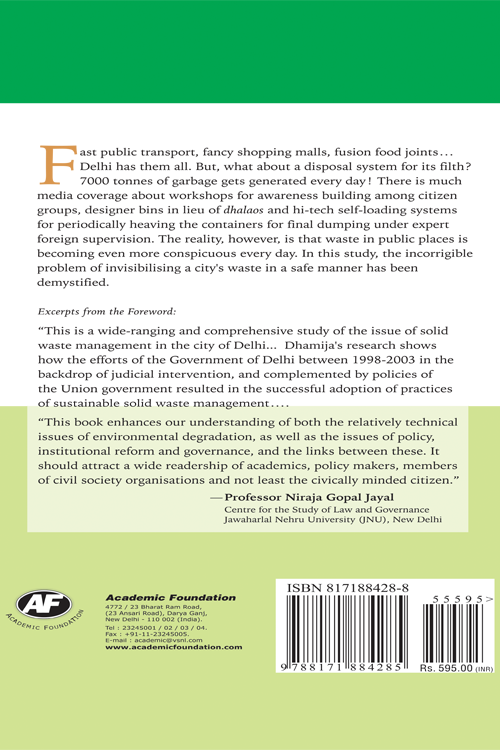
Fast public transport, fancy shopping malls, fusion food joints... Delhi has them all. But, what about a disposal system for its filth ? 7000 tonnes of garbage gets generated every day ! There is much media coverage about workshops for awareness building among citizen groups, designer bins in lieu of dhalaos and hi-tech self-loading systems for periodically heaving the containers for final dumping under expert foreign supervision. The reality, however, is that waste in public places is becoming even more conspicuous every day. In this study, the incorrigible problem of invisibilising a city's waste in a safe manner has been demystified.
The ancient city of Delhi which is growing fast into a global metropolis has to cope up with the massive problem of managing solid waste in a sustainable manner. Dr. Dhamija’s meticulous study that combines technological and adminstrative dimensions with human sensibility keeping the interests of the less privileged people in mind, will be of immense help to citizens, scholars as well as urban planners.”
— Manoranjan Mohanty
Formerly Professor of Political Science,
University of Delhi
For policy makers and practitioners in the field of urban solid-waste management, this study by Dr. Urvashi Dhamija explores the structures, policies, and issues relating to Delhi during the period 1998 to 2003. The study is relevant to most other urban centres in India, which are grappling with the burgeoning problems of municipal solid waste. The lessons learnable from Delhi can be applied to the other cities and towns in which 270 million people live.”
— Professor George Koreth
Director, Asian Centre for Organisation
Research and Development, New Delhi.
About the Author(s) / Editor(s)
Urvashi Dhamija grew up in Delhi. She is a Reader, Department of Political Science, Miranda House, University of Delhi. She is a founder member of M.H. Vatavaran, the society for environmental concerns, in the college.
Contents in Detail
| Publisher | AF Press |
| Publication Date | 2006 |
| Number of Pages | 264 |
| ISBN |
8171884288 |
Academic Foundation (AF), based in New Delhi, is India’s leading independent publisher of academic/scholarly books in Social Sciences, specialising in Economics—Development Economics and Indian Economy in particular, and allied subjects.
About the Book
Fast public transport, fancy shopping malls, fusion food joints... Delhi has them all. But, what about a disposal system for its filth ? 7000 tonnes of garbage gets generated every day ! There is much media coverage about workshops for awareness building among citizen groups, designer bins in lieu of dhalaos and hi-tech self-loading systems for periodically heaving the containers for final dumping under expert foreign supervision. The reality, however, is that waste in public places is becoming even more conspicuous every day. In this study, the incorrigible problem of invisibilising a city's waste in a safe manner has been demystified.
The ancient city of Delhi which is growing fast into a global metropolis has to cope up with the massive problem of managing solid waste in a sustainable manner. Dr. Dhamija’s meticulous study that combines technological and adminstrative dimensions with human sensibility keeping the interests of the less privileged people in mind, will be of immense help to citizens, scholars as well as urban planners.”
— Manoranjan Mohanty
Formerly Professor of Political Science,
University of Delhi
For policy makers and practitioners in the field of urban solid-waste management, this study by Dr. Urvashi Dhamija explores the structures, policies, and issues relating to Delhi during the period 1998 to 2003. The study is relevant to most other urban centres in India, which are grappling with the burgeoning problems of municipal solid waste. The lessons learnable from Delhi can be applied to the other cities and towns in which 270 million people live.”
— Professor George Koreth
Director, Asian Centre for Organisation
Research and Development, New Delhi.
About the Author(s) / Editor(s)
Urvashi Dhamija grew up in Delhi. She is a Reader, Department of Political Science, Miranda House, University of Delhi. She is a founder member of M.H. Vatavaran, the society for environmental concerns, in the college.
Contents in Detail
| Publisher | AF Press |
| Publication Date | 2006 |
| Number of Pages | 264 |
| ISBN |
8171884288 |

Couldn't load pickup availability
Share

-

Curated Collections By AF Press
-

Premium Print Quality
-

Author-Centric Publishing
-

Trusted by Readers Nationwide


Sustainable Solid Waste Management