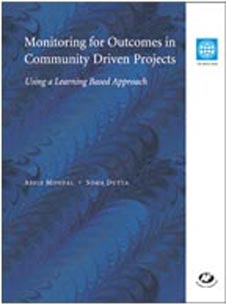
Monitoring for Outcomes and Impacts in Community Driven Projects
USING A LEARNING BASED APPROACH TO M&E
Ashis Mondal‚ Soma Dutta
USING A LEARNING BASED APPROACH TO M&E
About the Book
Community-Driven Development (CDD), in the World Bank parlance, refers to an approach where communities have direct control over key project decisions as well as management of investment funds. The CDD approach treats poor people as assets and partners in the development process, building on their institutions and resources. Monitoring and evaluation (M&E) in the CDD context can potentially be much more than an input-output-outcome monitoring and a reporting mechanism. This guidebook (a World Bank co-publication) is all about improving the implementation of CDD projects using M&E as a management tool. It is built on the contention that a ‘learning-based’ M&E system, which involves different project management levels and other stakeholders in a continuous process of ‘learning’, can help the project management make course corrections, guiding project strategy on an ongoing basis, ultimately leading to better project outcomes
About the Author(s) / Editor(s)
Ashis Mondal is founder Director of Action for Social Advancement (ASA), Bhopal, Madhya Pradesh, India.
Soma Dutta is a leading development consultant
Contents in Detail
List of Tables, Figures, Boxes and Annexures
Acknowledgements
Acronyms
Preface
Section I: Introducing the Learning-based M&E System
1.Introducing the Guidebook
About the Guidebook
Who Can Use the Guidebook?
The Basis of the Guidebook
M&E in CDD Projects
The Significance of a Learning-based M&E System in CDD Projects
Using the Guidebook
2.A Learning-based Approach to Monitoring and Evaluation
What is a Learning-based M&E System?
The ‘Learning Dimension’ of a Learning-based M&E System
Implementing a Learning-based M&E System:Some Common Pitfalls
The Learning-based M&E System in Action 2.4.1 Best Practices
in Application of LME
Making Learning-based M&E Systems Work: What Can You Do to
Encourage Learning within Your Projects and Organisations?
Section II: Strategies for Applying the Learning-based M&E System in CDD Projects
3.Strategies for Operationalising a Learning-based M&E Systems in CDD Projects
Strategy 1: Think Through and Set up the Learning-based M&E System during the Project Design Stage
Ensuring that the Design of the LME Framework is in Line with the Local Context
Engaging a Right Person/Agency to Guide the Borrower to Develop the LME Design
Ensuring Clarity and Proper Documentation of the Components of the System
Field-test the Proposed Framework for the LME System during Pilot Experiments
Strategy 2: Use Technical Studies (Social, Institutional, Environmental, etc.) to Guide Project Design
Strategy 3: From Design to Operationalisation: Provide Necessary Support to the Borrower during Implementation Phase
Demonstrating to the Implementing Agency the Value of a Learning-based Approach to M&E
Ensuring that the Necessary Institutional Setup and Capacities are in Place
Strategy 4: Provide Capacity Building and Handholding Support to the Community during Implementation Stage
Broad-basing Project Information
Building the Capacities of the CBOs to Perform their Project Functions
Strategy 5: Identify, Track and Act upon Unforeseen Project Issues
Strategy 6: Use Process Monitoring as a Management Tool during Project Implementation
Section III: Case Studies on Application of Learning-based M&E System
4.Achieving Better Project Outcomes through a Learning-based M&E System
Integrating Participatory Monitoring within the M&E System in a Large CDD Project:
The Kecamatan Development Project (KDP), Indonesia
The KDP M&E System
The Learning-based Monitoring and Evaluation System in KDP
Usefulness of the KDP LME System
Key Messages from the KDP LME System
Process Monitoring for Making Course Corrections:
Community Infrastructure Project (CIP), Pakistan
Setting up of the Process Monitoring System
Effectiveness of the Process Monitoring System
Key Messages
Community-based Monitoring: Kerala Rural Water Supply and
Sanitation Programme, India
The LME System of Jalanidhi
How Effective is Participatory Monitoring?
Key Messages
Using Process Monitoring Effectively:Sujala Watershed Project,
Karnataka, India
Process Monitoring in Sujala
How Effective is Process Monitoring in Sujala
Key Messages
Process Monitoring for Guiding Project Strategy: Andhra Pradesh DPIP, India
Approach to Process Monitoring
Conducting Process Monitoring: Steps
Translating Learning into Action
Key Messages
Learning from a Community Group: CIG Milans in the District Poverty
Initiatives Project (DPIP), Madhya Pradesh, India
The Genesis of CIG Milans and Learning Forums
Translating Learning into Action
Key Messages
| Publisher | AF Press |
| Publication Date | 2007 |
| Number of Pages | 98 |
| ISBN |
8171885853 |
Academic Foundation (AF), based in New Delhi, is India’s leading independent publisher of academic/scholarly books in Social Sciences, specialising in Economics—Development Economics and Indian Economy in particular, and allied subjects.
About the Book
Community-Driven Development (CDD), in the World Bank parlance, refers to an approach where communities have direct control over key project decisions as well as management of investment funds. The CDD approach treats poor people as assets and partners in the development process, building on their institutions and resources. Monitoring and evaluation (M&E) in the CDD context can potentially be much more than an input-output-outcome monitoring and a reporting mechanism. This guidebook (a World Bank co-publication) is all about improving the implementation of CDD projects using M&E as a management tool. It is built on the contention that a ‘learning-based’ M&E system, which involves different project management levels and other stakeholders in a continuous process of ‘learning’, can help the project management make course corrections, guiding project strategy on an ongoing basis, ultimately leading to better project outcomes
About the Author(s) / Editor(s)
Ashis Mondal is founder Director of Action for Social Advancement (ASA), Bhopal, Madhya Pradesh, India.
Soma Dutta is a leading development consultant
Contents in Detail
List of Tables, Figures, Boxes and Annexures
Acknowledgements
Acronyms
Preface
Section I: Introducing the Learning-based M&E System
1.Introducing the Guidebook
About the Guidebook
Who Can Use the Guidebook?
The Basis of the Guidebook
M&E in CDD Projects
The Significance of a Learning-based M&E System in CDD Projects
Using the Guidebook
2.A Learning-based Approach to Monitoring and Evaluation
What is a Learning-based M&E System?
The ‘Learning Dimension’ of a Learning-based M&E System
Implementing a Learning-based M&E System:Some Common Pitfalls
The Learning-based M&E System in Action 2.4.1 Best Practices
in Application of LME
Making Learning-based M&E Systems Work: What Can You Do to
Encourage Learning within Your Projects and Organisations?
Section II: Strategies for Applying the Learning-based M&E System in CDD Projects
3.Strategies for Operationalising a Learning-based M&E Systems in CDD Projects
Strategy 1: Think Through and Set up the Learning-based M&E System during the Project Design Stage
Ensuring that the Design of the LME Framework is in Line with the Local Context
Engaging a Right Person/Agency to Guide the Borrower to Develop the LME Design
Ensuring Clarity and Proper Documentation of the Components of the System
Field-test the Proposed Framework for the LME System during Pilot Experiments
Strategy 2: Use Technical Studies (Social, Institutional, Environmental, etc.) to Guide Project Design
Strategy 3: From Design to Operationalisation: Provide Necessary Support to the Borrower during Implementation Phase
Demonstrating to the Implementing Agency the Value of a Learning-based Approach to M&E
Ensuring that the Necessary Institutional Setup and Capacities are in Place
Strategy 4: Provide Capacity Building and Handholding Support to the Community during Implementation Stage
Broad-basing Project Information
Building the Capacities of the CBOs to Perform their Project Functions
Strategy 5: Identify, Track and Act upon Unforeseen Project Issues
Strategy 6: Use Process Monitoring as a Management Tool during Project Implementation
Section III: Case Studies on Application of Learning-based M&E System
4.Achieving Better Project Outcomes through a Learning-based M&E System
Integrating Participatory Monitoring within the M&E System in a Large CDD Project:
The Kecamatan Development Project (KDP), Indonesia
The KDP M&E System
The Learning-based Monitoring and Evaluation System in KDP
Usefulness of the KDP LME System
Key Messages from the KDP LME System
Process Monitoring for Making Course Corrections:
Community Infrastructure Project (CIP), Pakistan
Setting up of the Process Monitoring System
Effectiveness of the Process Monitoring System
Key Messages
Community-based Monitoring: Kerala Rural Water Supply and
Sanitation Programme, India
The LME System of Jalanidhi
How Effective is Participatory Monitoring?
Key Messages
Using Process Monitoring Effectively:Sujala Watershed Project,
Karnataka, India
Process Monitoring in Sujala
How Effective is Process Monitoring in Sujala
Key Messages
Process Monitoring for Guiding Project Strategy: Andhra Pradesh DPIP, India
Approach to Process Monitoring
Conducting Process Monitoring: Steps
Translating Learning into Action
Key Messages
Learning from a Community Group: CIG Milans in the District Poverty
Initiatives Project (DPIP), Madhya Pradesh, India
The Genesis of CIG Milans and Learning Forums
Translating Learning into Action
Key Messages
| Publisher | AF Press |
| Publication Date | 2007 |
| Number of Pages | 98 |
| ISBN |
8171885853 |
Couldn't load pickup availability
Share
-
Curated Collections By AF Press
-
Premium Print Quality
-
Author-Centric Publishing
-
Trusted by Readers Nationwide
Monitoring for Outcomes and Impacts i...