


Quantifying Under-nutrition in Rural India
Rekha Sharma
About the Book
This book provides an insight into the problem of malnutrition in rural India and among its 15 major states. Specifically, it quantifies nutrient deprivation not only in terms of traditional approach—calorie and protein deficiency—but extends it to micronutrients—vitamins and minerals. Other studies attempting to quantify the micronutrient deficiencies in India have typically focused on their clinical and sub-clinical manifestations; studies that quantify the magnitude of deprivation in nutrient intakes vis-à-vis RDAs are rare having limited geographical coverage.
Further, this study has analysed how the macro- and micro-nutrient intakes vary with income and how these are conditioned by education, occupational structure, household size and its composition, etc. It has also examined how the nutritional status of children under the age of 3 years varies with nutrient intake levels, socio-economic variables and environmental factors. It identifies key factors that are associated with the prevalence of underweight and anaemia among women and young children and also discusses the relevant policy implications. This is perhaps the first comprehensive analysis of micronutrient malnutrition in rural India using two rich data sets provided by NSSO and NFHS.
Praise for this book
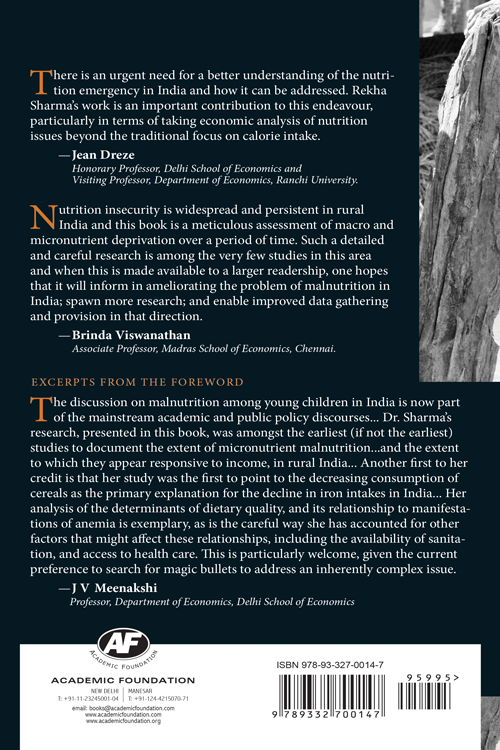
There is an urgent need for a better understanding of the nutrition emergency in India and how it can be addressed. Rekha Sharma’s work is an important contribution to this endeavour, particularly in terms of taking economic analysis of nutrition issues beyond the traditional focus on calorie intake.
— Jean Dreze
Honorary Professor, Delhi School of Economics and
Visiting Professor, Department of Economics, Ranchi University.
Nutrition insecurity is widespread and persistent in rural India and this book is a meticulous assessment of macro and micronutrient deprivation over a period of time. Such a detailed and careful research is among the very few studies in this area and when this is made available to a larger readership, one hopes that it will inform in ameliorating the problem of malnutrition in India; spawn more research; and enable improved data gathering and provision in that direction.
— Brinda Viswanathan
Associate Professor, Madras School of Economics, Chennai.
About the Author(s) / Editor(s)
Rekha Sharma is Associate Professor, Department of Economics, Sri Guru Gobind Singh College of Commerce, University of Delhi. She is MA, MPhil, PhD from Department of Economics, Delhi School of Economics, University of Delhi.
Dr Sharma has teaching experience of 25 years in University of Delhi and has taught papers related to microeconomics and its applications and development theory & experience.
Contents in Detail
Foreword
Acknowledgements
1. Introduction
1.1 Context and Objectives of the Study
1.2 An Approach to the Problem
1.3 Organisation of the Study
2. Review of Literature
2.1 Changes in the Diet Composition
2.2 Studies on Nutrient Demand Functions
2.3 Studies on Nutritional Status Production Function
3. Data Base
3.1 Consumer Expenditure Surveys
3.2 Deriving Nutrient Intakes using Food Composition Tables
3.3 The National Family Health Survey (NFHS-2)
3.4 Merging of NSS and NFHS Data Sets
3.5 Nutrients and their Functions
3.6 Consequences of Nutritional Deficiencies
4. Methodology
4.1 The Recommended Dietary Allowance
4.2 Computing Nutrient Deprivation
4.3 Nutrient Demand Functions
4.4 Correlates of Nutritional Status
5. Summarising Nutrient Intakes and Nutritional Status
5.1 Changes in Dietary Patterns
5.2 Trends in Macronutrients and Micronutrients
5.3 Bioavailability of Nutrients in Rural Indian Diet
5.4 Summarising the Nutritional Outcomes across States
5.5 Relating Nutrient Intakes to Nutritional Outcomes
5.6 A Summary of the Evidence
6. Correlates of Nutrient Intakes
6.1 The Response to Income
6.2 Occupational Status (Producer versusNon-producer Households)
6.3 Seasonality
6.4 Household Size and Composition
6.5 Intakes among Scheduled Caste (SC)
and Scheduled Tribe (ST) Households
6.6 The Role of Literacy
6.7 Head of the Household
6.8 Summary of the Main Results
7. Correlates of Nutritional Status
7.1 Correlates of Nutritional Status among
Children under the Age of 3 Years
7.2 Correlates of Nutritional Status among
Women and Children
7.3 A Summary of the Main Results
8. Conclusions
8.1 Results on Nutrient Deprivation
8.2 Results on Correlates of Nutrient Intakes
8.3 Results on Correlates of Nutritional Status
8.4 Policy Implications
Bibliography
| Publisher | AF Press |
| Publication Date | 2015 |
| Number of Pages | 220 |
| ISBN |
9789332700147 |
Academic Foundation (AF), based in New Delhi, is India’s leading independent publisher of academic/scholarly books in Social Sciences, specialising in Economics—Development Economics and Indian Economy in particular, and allied subjects.
About the Book
This book provides an insight into the problem of malnutrition in rural India and among its 15 major states. Specifically, it quantifies nutrient deprivation not only in terms of traditional approach—calorie and protein deficiency—but extends it to micronutrients—vitamins and minerals. Other studies attempting to quantify the micronutrient deficiencies in India have typically focused on their clinical and sub-clinical manifestations; studies that quantify the magnitude of deprivation in nutrient intakes vis-à-vis RDAs are rare having limited geographical coverage.
Further, this study has analysed how the macro- and micro-nutrient intakes vary with income and how these are conditioned by education, occupational structure, household size and its composition, etc. It has also examined how the nutritional status of children under the age of 3 years varies with nutrient intake levels, socio-economic variables and environmental factors. It identifies key factors that are associated with the prevalence of underweight and anaemia among women and young children and also discusses the relevant policy implications. This is perhaps the first comprehensive analysis of micronutrient malnutrition in rural India using two rich data sets provided by NSSO and NFHS.
Praise for this book
There is an urgent need for a better understanding of the nutrition emergency in India and how it can be addressed. Rekha Sharma’s work is an important contribution to this endeavour, particularly in terms of taking economic analysis of nutrition issues beyond the traditional focus on calorie intake.
— Jean Dreze
Honorary Professor, Delhi School of Economics and
Visiting Professor, Department of Economics, Ranchi University.
Nutrition insecurity is widespread and persistent in rural India and this book is a meticulous assessment of macro and micronutrient deprivation over a period of time. Such a detailed and careful research is among the very few studies in this area and when this is made available to a larger readership, one hopes that it will inform in ameliorating the problem of malnutrition in India; spawn more research; and enable improved data gathering and provision in that direction.
— Brinda Viswanathan
Associate Professor, Madras School of Economics, Chennai.
About the Author(s) / Editor(s)
Rekha Sharma is Associate Professor, Department of Economics, Sri Guru Gobind Singh College of Commerce, University of Delhi. She is MA, MPhil, PhD from Department of Economics, Delhi School of Economics, University of Delhi.
Dr Sharma has teaching experience of 25 years in University of Delhi and has taught papers related to microeconomics and its applications and development theory & experience.
Contents in Detail
Foreword
Acknowledgements
1. Introduction
1.1 Context and Objectives of the Study
1.2 An Approach to the Problem
1.3 Organisation of the Study
2. Review of Literature
2.1 Changes in the Diet Composition
2.2 Studies on Nutrient Demand Functions
2.3 Studies on Nutritional Status Production Function
3. Data Base
3.1 Consumer Expenditure Surveys
3.2 Deriving Nutrient Intakes using Food Composition Tables
3.3 The National Family Health Survey (NFHS-2)
3.4 Merging of NSS and NFHS Data Sets
3.5 Nutrients and their Functions
3.6 Consequences of Nutritional Deficiencies
4. Methodology
4.1 The Recommended Dietary Allowance
4.2 Computing Nutrient Deprivation
4.3 Nutrient Demand Functions
4.4 Correlates of Nutritional Status
5. Summarising Nutrient Intakes and Nutritional Status
5.1 Changes in Dietary Patterns
5.2 Trends in Macronutrients and Micronutrients
5.3 Bioavailability of Nutrients in Rural Indian Diet
5.4 Summarising the Nutritional Outcomes across States
5.5 Relating Nutrient Intakes to Nutritional Outcomes
5.6 A Summary of the Evidence
6. Correlates of Nutrient Intakes
6.1 The Response to Income
6.2 Occupational Status (Producer versusNon-producer Households)
6.3 Seasonality
6.4 Household Size and Composition
6.5 Intakes among Scheduled Caste (SC)
and Scheduled Tribe (ST) Households
6.6 The Role of Literacy
6.7 Head of the Household
6.8 Summary of the Main Results
7. Correlates of Nutritional Status
7.1 Correlates of Nutritional Status among
Children under the Age of 3 Years
7.2 Correlates of Nutritional Status among
Women and Children
7.3 A Summary of the Main Results
8. Conclusions
8.1 Results on Nutrient Deprivation
8.2 Results on Correlates of Nutrient Intakes
8.3 Results on Correlates of Nutritional Status
8.4 Policy Implications
Bibliography
| Publisher | AF Press |
| Publication Date | 2015 |
| Number of Pages | 220 |
| ISBN |
9789332700147 |

Couldn't load pickup availability
Share

-

Curated Collections By AF Press
-

Premium Print Quality
-

Author-Centric Publishing
-

Trusted by Readers Nationwide


Quantifying Under-nutrition in Rural ...