

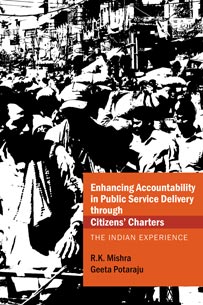
Enhancing Accountability in Public Service Delivery through Citizens’ Charters
R.K. Mishra‚ Geeta Potaraju
About the Book
Public services are used by majority of the Indian population, and the Government of India has been pushing reforms to bring in greater transparency, accountability and responsiveness in public service delivery. This book focuses on citizens’ charter which is one of the most effective tools used by governments world over to improve service delivery especially to the poor. Over a period of time, this concept has brought in a mindset change in both the govern-ment and the governed on the aspects of service delivery. It narrates the Indian experience of using citizens’ charter, at the Centre and states, as a tool for improving governance and bringing in greater efficiency and accountability.
The volume will be especially useful for scholars and students working in the area of governance and public policy, as also, policy-makers, civil society groups and individuals working on citizen-centric reforms.
About the Author(s) / Editor(s)
R.K. Mishra, Senior Professor and Director, Institute of Public Enterprise (IPE), Hyderabad, did his PhD from University of Rajasthan. A Visiting Fellow at London Business School (UK), he also studied for International Teachers programme at SDA Bocconi, Milan. Dr Mishra taught at the University of Bradford and was a Visiting Professor at Maison Des Sciences De L’ Hommes, Paris and Faculty of Economics, University of Ljubljana, Slovenia. He is a member of the UN Task Force on International Standards of Excellence in Public Administration and Education. He is special invite on OECD Working Group on Privatisation and Corporate Governance of SOEs and Asian Network of Corporate Governance. He is Non-Executive Director on some of the public and private enterprise boards in India. He has considerable experience of teaching and guiding research for doctoral degree in management, economics, public administration and commerce. His areas of interest include: corporate governance, international management, international finance, public-private partnership and restructuring and environmental administration.
Geeta Potaraju, Assistant Professor at the IPE, Hyderabad, is a PhD in Management with specialisation on public sector enterprises. She has over 15 years of experience in management and development consulting. Her areas of expertise include: participatory governance and civic engagement, health system strengthening, administrative reforms, institutional reforms, change management and capacity building. She has been involved in a number of key assignments with DFID, UNDP, World Bank, World Bank Institute, Family Health International, Government of India and state governments. She is an expert on participatory governance tools like citizens’ charters and community score cards, and has trained a number of officials from Government of India as well as other state governments on these tools.
Contents in Detail
| Publisher | AF Press |
| Publication Date | 2015 |
| Number of Pages | 178 |
| ISBN |
9789332703094 |
Academic Foundation (AF), based in New Delhi, is India’s leading independent publisher of academic/scholarly books in Social Sciences, specialising in Economics—Development Economics and Indian Economy in particular, and allied subjects.
About the Book
Public services are used by majority of the Indian population, and the Government of India has been pushing reforms to bring in greater transparency, accountability and responsiveness in public service delivery. This book focuses on citizens’ charter which is one of the most effective tools used by governments world over to improve service delivery especially to the poor. Over a period of time, this concept has brought in a mindset change in both the govern-ment and the governed on the aspects of service delivery. It narrates the Indian experience of using citizens’ charter, at the Centre and states, as a tool for improving governance and bringing in greater efficiency and accountability.
The volume will be especially useful for scholars and students working in the area of governance and public policy, as also, policy-makers, civil society groups and individuals working on citizen-centric reforms.
About the Author(s) / Editor(s)
R.K. Mishra, Senior Professor and Director, Institute of Public Enterprise (IPE), Hyderabad, did his PhD from University of Rajasthan. A Visiting Fellow at London Business School (UK), he also studied for International Teachers programme at SDA Bocconi, Milan. Dr Mishra taught at the University of Bradford and was a Visiting Professor at Maison Des Sciences De L’ Hommes, Paris and Faculty of Economics, University of Ljubljana, Slovenia. He is a member of the UN Task Force on International Standards of Excellence in Public Administration and Education. He is special invite on OECD Working Group on Privatisation and Corporate Governance of SOEs and Asian Network of Corporate Governance. He is Non-Executive Director on some of the public and private enterprise boards in India. He has considerable experience of teaching and guiding research for doctoral degree in management, economics, public administration and commerce. His areas of interest include: corporate governance, international management, international finance, public-private partnership and restructuring and environmental administration.
Geeta Potaraju, Assistant Professor at the IPE, Hyderabad, is a PhD in Management with specialisation on public sector enterprises. She has over 15 years of experience in management and development consulting. Her areas of expertise include: participatory governance and civic engagement, health system strengthening, administrative reforms, institutional reforms, change management and capacity building. She has been involved in a number of key assignments with DFID, UNDP, World Bank, World Bank Institute, Family Health International, Government of India and state governments. She is an expert on participatory governance tools like citizens’ charters and community score cards, and has trained a number of officials from Government of India as well as other state governments on these tools.
Contents in Detail
| Publisher | AF Press |
| Publication Date | 2015 |
| Number of Pages | 178 |
| ISBN |
9789332703094 |

Couldn't load pickup availability
Share
-

Curated Collections By AF Press
-

Premium Print Quality
-

Author-Centric Publishing
-

Trusted by Readers Nationwide


Enhancing Accountability in Public Se...