


Economically Speaking
Indira Rajaraman
About the Book
This collection of essays presents the unfolding of economic policy in India and the world over the momentous years from 2010 to 2015, under the overarching shadow of the great global crash of 2008, the aftershocks of which continue to rattle us to the present day. It was a period of brewing discontent which erupted into major street demonstrations in India against corruption in 2011, and the Occupy Wall Street movement in the developed world against corporate greed. Each essay investigates the structural underpinnings of a headline issue, trying to bring out connectivities across the seemingly unrelated. New entrants into the labour force, on their journey towards skills and jobs, will find that the book opens their eyes to how live issues of the day can be better understood when subordinated to economic examination and logic.
Praise for this book
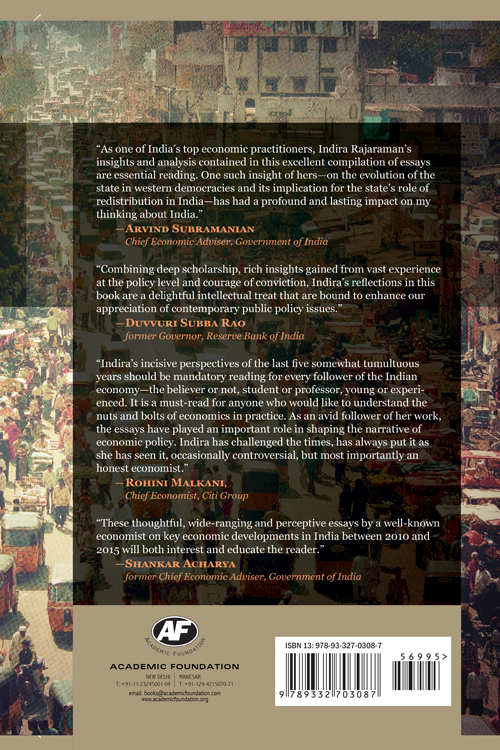
“As one of India’s top economic practitioners, Indira Rajaraman’s insights and analysis contained in this excellent compilation of essays are essential reading. One such insight of hers—on the evolution of the state in western democracies and its implication for the state’s role of redistribution in India—has had a profound and lasting impact on my thinking about India.”
—Arvind Subramanian
Chief Economic Adviser, Government of India
“Combining deep scholarship, rich insights gained from vast experience at the policy level and courage of conviction, Indira’s reflections in this book are a delightful intellectual treat that are bound to enhance our appreciation of contemporary public policy issues.”
—Duvvuri Subba Rao
former Governor, Reserve Bank of India
“Indira’s incisive perspectives of the last five somewhat tumultuous years should be mandatory reading for every follower of the Indian economy—the believer or not, student or professor, young or experienced. It is a must-read for anyone who would like to understand the nuts and bolts of economics in practice. As an avid follower of her work, the essays have played an important role in shaping the narrative of economic policy. Indira has challenged the times, has always put it as she has seen it, occasionally controversial, but most importantly an honest economist.”
—Rohini Malkani,
Chief Economist, Citi Group
“These thoughtful, wide-ranging and perceptive essays by a well-known economist on key economic developments in India between 2010 and 2015 will both interest and educate the reader.”
—Shankar Acharya
former Chief Economic Adviser, Government of India
About the Author(s) / Editor(s)
Indira Rajaraman, born in 1947, holds a BA (Honours) degree from Delhi University (1966); MA from Cornell University, USA (1968); and PhD from Cornell University, USA (awarded in January 1974). Prof Rajaraman was a Member of the Thirteenth Finance Commission, whose recommendations covered the fiscal years 2010-2015. From 1976 to 1994, she was on the Economics faculty of the Indian Institute of Management, Bangalore, and from 1994 until her retirement in 2007 she held the Reserve Bank of India Chair at the National Institute of Public Finance and Policy, Delhi.
Contents in Detail
| Publisher | AF Press |
| Publication Date | 2016 |
| Number of Pages | 290 |
| ISBN |
9789332703087 |
Academic Foundation (AF), based in New Delhi, is India’s leading independent publisher of academic/scholarly books in Social Sciences, specialising in Economics—Development Economics and Indian Economy in particular, and allied subjects.
About the Book
This collection of essays presents the unfolding of economic policy in India and the world over the momentous years from 2010 to 2015, under the overarching shadow of the great global crash of 2008, the aftershocks of which continue to rattle us to the present day. It was a period of brewing discontent which erupted into major street demonstrations in India against corruption in 2011, and the Occupy Wall Street movement in the developed world against corporate greed. Each essay investigates the structural underpinnings of a headline issue, trying to bring out connectivities across the seemingly unrelated. New entrants into the labour force, on their journey towards skills and jobs, will find that the book opens their eyes to how live issues of the day can be better understood when subordinated to economic examination and logic.
Praise for this book
“As one of India’s top economic practitioners, Indira Rajaraman’s insights and analysis contained in this excellent compilation of essays are essential reading. One such insight of hers—on the evolution of the state in western democracies and its implication for the state’s role of redistribution in India—has had a profound and lasting impact on my thinking about India.”
—Arvind Subramanian
Chief Economic Adviser, Government of India
“Combining deep scholarship, rich insights gained from vast experience at the policy level and courage of conviction, Indira’s reflections in this book are a delightful intellectual treat that are bound to enhance our appreciation of contemporary public policy issues.”
—Duvvuri Subba Rao
former Governor, Reserve Bank of India
“Indira’s incisive perspectives of the last five somewhat tumultuous years should be mandatory reading for every follower of the Indian economy—the believer or not, student or professor, young or experienced. It is a must-read for anyone who would like to understand the nuts and bolts of economics in practice. As an avid follower of her work, the essays have played an important role in shaping the narrative of economic policy. Indira has challenged the times, has always put it as she has seen it, occasionally controversial, but most importantly an honest economist.”
—Rohini Malkani,
Chief Economist, Citi Group
“These thoughtful, wide-ranging and perceptive essays by a well-known economist on key economic developments in India between 2010 and 2015 will both interest and educate the reader.”
—Shankar Acharya
former Chief Economic Adviser, Government of India
About the Author(s) / Editor(s)
Indira Rajaraman, born in 1947, holds a BA (Honours) degree from Delhi University (1966); MA from Cornell University, USA (1968); and PhD from Cornell University, USA (awarded in January 1974). Prof Rajaraman was a Member of the Thirteenth Finance Commission, whose recommendations covered the fiscal years 2010-2015. From 1976 to 1994, she was on the Economics faculty of the Indian Institute of Management, Bangalore, and from 1994 until her retirement in 2007 she held the Reserve Bank of India Chair at the National Institute of Public Finance and Policy, Delhi.
Contents in Detail
| Publisher | AF Press |
| Publication Date | 2016 |
| Number of Pages | 290 |
| ISBN |
9789332703087 |

Couldn't load pickup availability
Share

-

Curated Collections By AF Press
-

Premium Print Quality
-

Author-Centric Publishing
-

Trusted by Readers Nationwide


Economically Speaking