

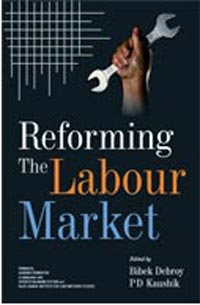
Reforming The Labour Market
Bibek Debroy (Ed.)‚ P.D. Kaushik (Ed.)
About the Book
Reforms are perpetually debated. If there are two areas of reform, which figure prominently in the liberalisation discourse, with strong views on both sides, those are privatisation (or disinvestments) of public sector enterprises and labour market reforms. The argument is that organised labour markets are unnecessarily rigid and thereby, artificially drive up capital intensity and make it difficult for India to exploit the comparative advantage in labour.
This volume is about labour markets, but there are also papers in it about the unorganised labour market, accounting for 92% of the labour force. Within the organised segment, flexibility in labour markets is usually interpreted as changes in the Industrial Disputes Act, requiring what is sometimes called, an automatic hire and fire policy. That labour market reform is much more than this narrow interpretation, comes out clearly from this collection of papers. As such, this volume should be of interest to all those interested in policy formulation in India, and researchers and students.
About the Author(s) / Editor(s)
Bibek Debroy is Director of the Rajiv Gandhi Institute for Contemporary Studies (RGICS), Rajiv Gandhi Foundation, New Delhi. He is a professional economist and was educated in Presidency College (Calcutta), Delhi School of Economics and Trinity College (Cambridge). He has worked at Presidency College (Calcutta), Gokhale Institute of Politics and Economics (Pune), Indian Institute of Foreign Trade (Delhi), National Council of Applied Economic Research (Delhi) and as Consultant, Department of Economic Affairs, Ministry of Finance, Government of India. He was also the Director for a project known as LARGE, set up by the Ministry of Finance and UNDP to examine legal reforms. He is the author of several books, papers and popular articles and has been Consulting Editor with Business Standard and Financial Express. He has been a member of government - appointed committees and has been listed in several biographies. He is presently a Member of the National Commission for the Promotion of Enterprises for the Small-Scale and Unorganised Sector and the National Manufacturing Competitiveness Council.
P.D. Kaushik is a Fellow at the RGICS. He is an engineer, MBA and Ph.D. During his Ph.D., he was awarded Jawahar Lal Nehru Fellowship. He has wide experience of industry and academics. He was also associated with consultancy work for the FAO, Commonwealth Secretariat and World Bank. He is a visiting faculty at leading business schools in Delhi. He has publications on policy issues emerging from electronic commerce and WTO. He has co-authored two books on the WTO.
Rajiv Gandhi Institute for Contemporary Studies (RGICS), New Delhi is part of the Rajiv Gandhi Foundation and functions as a think tank. The target audience of the RGICS includes parliamentarians, legislators and representatives of political parties, public policy makers and their advisers, the intelligentsia, the media and various interest groups. To interface with these groups, RGICS uses different modes of communication like books, monographs, working papers, symposia, discussions, talks and lectures. The RGICS research work is focused on international economic relations, law reforms, IT and economic reforms in India.
Friedrich Naumann Stiftung is a German non-profit institution primarily engaged in the strengthening of democratic and pluralist development both in the industrialised and the developing world. The Naumann Foundation has its activities spread over in more than 80 countries across the world.
The Friedrich Naumann Foundation promotes the principle of freedom in human dignity, both in Germany as well as abroad together with its partners - through political education, political advice and political dialogue. The Foundation has the following objectives :
To sensitise people on political issues and motivate them to get involved.
To provide liberal answers to the burning issues of the day, and to incorporate new findings and experiences - including those from other cultures - into liberal solutions.
To strive for cooperation in development through free international trade and through helping to establish free and responsible civic societies in developing countries.
To work towards worldwide victory of human and civil rights.
Wherever freedom, democracy and rule of law are just beginning to gain a foothold, the Friedrich Naumann Foundation is particularly called upon to lend its expertise and assume responsibility. As the only liberal organisation of its kind worldwide, the Foundation is active in many countries of the world, helping to lay the foundation for a future in freedom that bears responsibility for coming generations.
In South Asia, where the political situation is characterised by the sharpest of contrasts, the Foundation faces some important challenges to accompany and support the distinct endeavours to move from feudalistic structures to demo-cracy. The Foundation offers advice and training for people in positions of leadership. Liberal solutions are worked out for the problems of the region through workshops and studies. The Foundation always works in collabora-tion with local partners and active organisations operating in the national and regional level of South Asia.
Contributors
Bibek Debroy
Director, Rajiv Gandhi Institute for Contemporary Studies, New Delhi.
Arnold Packer
Chairperson, SCANS-2000 Center, The Johns Hopkins University, Baltimore, Maryland, USA.
Amir Ullah Khan
Fellow, India Development Foundation, Gurgaon.
C.S. Venkataratnam
Professor, Institute of Management Technology, Ghaziabad.
Arnab K. Hazra
Fellow, Rajiv Gandhi Institute for Contemporary Studies, New Delhi.
Surendra Nath
Addl. Chief Secretary (Agriculture), Government of Madhya Pradesh, Bhopal.
T.C.A. Anant
Professor, Delhi School of Economics, Delhi.
H. Mahadevan
Dy. General Secretary,All India Trade Union Congress (AITUC), New Delhi.
D. Shyam Babu
Fellow, Rajiv Gandhi Institute for Contemporary Studies, New Delhi.
P.D. Kaushik
Fellow, Rajiv Gandhi Institute for Contemporary Studies, New Delhi.
Amaresh Dubey
Associate Professor, North-Eastern Hill University (NEHU), Shillong.
Veronica Pala
Lecturer, St. Anthony's College, Shillong.
Eugene D. Thomas
Professor, North-Eastern Hill University, (NEHU), Shillong.
Contents in Detail
| Publisher | AF Press |
| Publication Date | 2005 |
| Number of Pages | 417 |
| ISBN |
8171884415 |
Academic Foundation (AF), based in New Delhi, is India’s leading independent publisher of academic/scholarly books in Social Sciences, specialising in Economics—Development Economics and Indian Economy in particular, and allied subjects.
About the Book
Reforms are perpetually debated. If there are two areas of reform, which figure prominently in the liberalisation discourse, with strong views on both sides, those are privatisation (or disinvestments) of public sector enterprises and labour market reforms. The argument is that organised labour markets are unnecessarily rigid and thereby, artificially drive up capital intensity and make it difficult for India to exploit the comparative advantage in labour.
This volume is about labour markets, but there are also papers in it about the unorganised labour market, accounting for 92% of the labour force. Within the organised segment, flexibility in labour markets is usually interpreted as changes in the Industrial Disputes Act, requiring what is sometimes called, an automatic hire and fire policy. That labour market reform is much more than this narrow interpretation, comes out clearly from this collection of papers. As such, this volume should be of interest to all those interested in policy formulation in India, and researchers and students.
About the Author(s) / Editor(s)
Bibek Debroy is Director of the Rajiv Gandhi Institute for Contemporary Studies (RGICS), Rajiv Gandhi Foundation, New Delhi. He is a professional economist and was educated in Presidency College (Calcutta), Delhi School of Economics and Trinity College (Cambridge). He has worked at Presidency College (Calcutta), Gokhale Institute of Politics and Economics (Pune), Indian Institute of Foreign Trade (Delhi), National Council of Applied Economic Research (Delhi) and as Consultant, Department of Economic Affairs, Ministry of Finance, Government of India. He was also the Director for a project known as LARGE, set up by the Ministry of Finance and UNDP to examine legal reforms. He is the author of several books, papers and popular articles and has been Consulting Editor with Business Standard and Financial Express. He has been a member of government - appointed committees and has been listed in several biographies. He is presently a Member of the National Commission for the Promotion of Enterprises for the Small-Scale and Unorganised Sector and the National Manufacturing Competitiveness Council.
P.D. Kaushik is a Fellow at the RGICS. He is an engineer, MBA and Ph.D. During his Ph.D., he was awarded Jawahar Lal Nehru Fellowship. He has wide experience of industry and academics. He was also associated with consultancy work for the FAO, Commonwealth Secretariat and World Bank. He is a visiting faculty at leading business schools in Delhi. He has publications on policy issues emerging from electronic commerce and WTO. He has co-authored two books on the WTO.
Rajiv Gandhi Institute for Contemporary Studies (RGICS), New Delhi is part of the Rajiv Gandhi Foundation and functions as a think tank. The target audience of the RGICS includes parliamentarians, legislators and representatives of political parties, public policy makers and their advisers, the intelligentsia, the media and various interest groups. To interface with these groups, RGICS uses different modes of communication like books, monographs, working papers, symposia, discussions, talks and lectures. The RGICS research work is focused on international economic relations, law reforms, IT and economic reforms in India.
Friedrich Naumann Stiftung is a German non-profit institution primarily engaged in the strengthening of democratic and pluralist development both in the industrialised and the developing world. The Naumann Foundation has its activities spread over in more than 80 countries across the world.
The Friedrich Naumann Foundation promotes the principle of freedom in human dignity, both in Germany as well as abroad together with its partners - through political education, political advice and political dialogue. The Foundation has the following objectives :
To sensitise people on political issues and motivate them to get involved.
To provide liberal answers to the burning issues of the day, and to incorporate new findings and experiences - including those from other cultures - into liberal solutions.
To strive for cooperation in development through free international trade and through helping to establish free and responsible civic societies in developing countries.
To work towards worldwide victory of human and civil rights.
Wherever freedom, democracy and rule of law are just beginning to gain a foothold, the Friedrich Naumann Foundation is particularly called upon to lend its expertise and assume responsibility. As the only liberal organisation of its kind worldwide, the Foundation is active in many countries of the world, helping to lay the foundation for a future in freedom that bears responsibility for coming generations.
In South Asia, where the political situation is characterised by the sharpest of contrasts, the Foundation faces some important challenges to accompany and support the distinct endeavours to move from feudalistic structures to demo-cracy. The Foundation offers advice and training for people in positions of leadership. Liberal solutions are worked out for the problems of the region through workshops and studies. The Foundation always works in collabora-tion with local partners and active organisations operating in the national and regional level of South Asia.
Contributors
Bibek Debroy
Director, Rajiv Gandhi Institute for Contemporary Studies, New Delhi.
Arnold Packer
Chairperson, SCANS-2000 Center, The Johns Hopkins University, Baltimore, Maryland, USA.
Amir Ullah Khan
Fellow, India Development Foundation, Gurgaon.
C.S. Venkataratnam
Professor, Institute of Management Technology, Ghaziabad.
Arnab K. Hazra
Fellow, Rajiv Gandhi Institute for Contemporary Studies, New Delhi.
Surendra Nath
Addl. Chief Secretary (Agriculture), Government of Madhya Pradesh, Bhopal.
T.C.A. Anant
Professor, Delhi School of Economics, Delhi.
H. Mahadevan
Dy. General Secretary,All India Trade Union Congress (AITUC), New Delhi.
D. Shyam Babu
Fellow, Rajiv Gandhi Institute for Contemporary Studies, New Delhi.
P.D. Kaushik
Fellow, Rajiv Gandhi Institute for Contemporary Studies, New Delhi.
Amaresh Dubey
Associate Professor, North-Eastern Hill University (NEHU), Shillong.
Veronica Pala
Lecturer, St. Anthony's College, Shillong.
Eugene D. Thomas
Professor, North-Eastern Hill University, (NEHU), Shillong.
Contents in Detail
| Publisher | AF Press |
| Publication Date | 2005 |
| Number of Pages | 417 |
| ISBN |
8171884415 |

Couldn't load pickup availability
Share
-

Curated Collections By AF Press
-

Premium Print Quality
-

Author-Centric Publishing
-

Trusted by Readers Nationwide


Reforming The Labour Market