

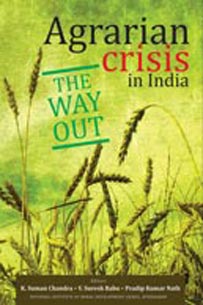
Agrarian Crisis in India
K. Suman Chandra (Ed.)‚ V. Suresh Babu (Ed.)‚ Pradip Kumar Nath (Ed.)
About the Book
Indian agriculture is presently at the crossroads in more than one sense. The share of agriculture in the GDP has been shrinking and has reached about 15 per cent, while it continues to provide livelihood support to more than two-thirds of the rural population. The slowdown in performance of the sector in the recent years is a cause for concern in the overall agenda for food and income security. More than 80 per cent of the farmers, mostly with marginal and small holdings, depend on agriculture as the primary activity and are highly vulnerable to multiple risks. The escalating cost of production and unremunerative and often volatile output prices have raised questions of viability of farming as a livelihood activity.
Several factors have contributed to the imbalance, of which the low agricultural productivity and its stagnation are notable. Among the supply side factors, declining factor productivity, degradation of soil and water resources due to intensive agriculture, inequitable access to input and imperfection in output market are prominent. The problem of lack of appropriate technology especially for vast areas of dryland and rainfed farming, the persistence of inadequate infrastructure and declining public investment have brought to the fore the issue of sustainability of agriculture. These are the areas of main focus of the contributions in the book. Besides helping in understanding the present state of Indian agriculture, the contributions in the book are expected to help evolve appropriate policy approaches.
Praise for this book
“Time and again, in many forums we have discussed the simmering agrarian crisis in various parts of India and concluded about its presence but rarely took the arguments to logical end.Here is an attempt to put the entire issue in correct perspective across the country that highlights the entire debate. This edited book provides a refreshing reading and a good understanding of the subject especially from the lenses of young researchers commented by seasoned academics and administrators. Such churning surely helps the policy makers. The method of presentation is inimitable and quite encouraging.”
R.S. Deshpande
Former Director, Institute for Social and Economic Change (ISEC), Bangalore.
“This book brings together a set of papers on India's agrarian crisis presented at a national seminar at the NIRD. The topics cover a number of crucial issues facing Indian agriculture today from stagnation of yields to erosion of farm incomes to farmers’ suicides—all these happening in a fast growing Indian economy. It underlines, in my opinion, not only the inadequate attention paid to agriculture but also a case of exclusionary growth. There is an urgent need to bring back agriculture and rural development at the centre stage of India's quest for inclusive development.”
K. P. Kannan
Development Economist and Former Director, Centre for Development Studies, Trivandrum.
About the Author(s) / Editor(s)
K. Suman Chandra is Professor & Head, Centre for Agrarian Studies and Disaster Mitigation, National Institute of Rural Development (NIRD), Hyderabad. His areas of specialisation include agrarian reforms in general and tenancy reforms in particular. A sociologist by training, he has extensive field work experience which served as the basis for training rural development functionaries over the last two decades. To his credit there are four books and several articles published in reputed journals.
V. Suresh Babu is Assistant Professor, Centre for Agrarian Studies and Disaster Mitigation, NIRD, Hyderabad. His areas of research include: agriculture, agro-forestry, bio-inputs, watersheds, wage and self-employment. Dr Babu has published several papers in reputed journals.
Pradip Kumar Nath is Adjunct Faculty, Centre for Agrarian Studies and Disaster Mitigation, NIRD, Hyderabad. Presently, he is actively engaged in research and training in the areas of disaster mitigation and agrarian issues. Trained in economics, he has to his credit few publications on regional disparity, folklore, and issues related to marginalised communities (SC & ST).
Contributors
Sudipta Bhattacharyya, Binod K. Das, K.K. Datta, Rajiv Dey, Shrikant Shaligram Kalamkar, Elumalai Kannan, E. Naveen Kumar, N. Kishore Kumar, R.V. Ramana Murthy, Ghanshyam Kumar Pandey, P.A. Lakshmi Prasanna, P. Prashanth, G.K. Rajesh, Chirala Sankar Rao, Shiv Raj Singh Rathore, M. Jagan Mohan Reddy, Anil Kumar Roy, Partha Saha, Swatahsiddha Sarkar, T. Satyanarayana, Sangeeta Shroff, Mamata Swain, Mrutyunjay Swain, Amarnath Tripathi.
| Publisher | AF Press |
| Publication Date | 2013 |
| Number of Pages | 526 |
| ISBN |
9789332700321 |
Academic Foundation (AF), based in New Delhi, is India’s leading independent publisher of academic/scholarly books in Social Sciences, specialising in Economics—Development Economics and Indian Economy in particular, and allied subjects.
About the Book
Indian agriculture is presently at the crossroads in more than one sense. The share of agriculture in the GDP has been shrinking and has reached about 15 per cent, while it continues to provide livelihood support to more than two-thirds of the rural population. The slowdown in performance of the sector in the recent years is a cause for concern in the overall agenda for food and income security. More than 80 per cent of the farmers, mostly with marginal and small holdings, depend on agriculture as the primary activity and are highly vulnerable to multiple risks. The escalating cost of production and unremunerative and often volatile output prices have raised questions of viability of farming as a livelihood activity.
Several factors have contributed to the imbalance, of which the low agricultural productivity and its stagnation are notable. Among the supply side factors, declining factor productivity, degradation of soil and water resources due to intensive agriculture, inequitable access to input and imperfection in output market are prominent. The problem of lack of appropriate technology especially for vast areas of dryland and rainfed farming, the persistence of inadequate infrastructure and declining public investment have brought to the fore the issue of sustainability of agriculture. These are the areas of main focus of the contributions in the book. Besides helping in understanding the present state of Indian agriculture, the contributions in the book are expected to help evolve appropriate policy approaches.
Praise for this book
“Time and again, in many forums we have discussed the simmering agrarian crisis in various parts of India and concluded about its presence but rarely took the arguments to logical end.Here is an attempt to put the entire issue in correct perspective across the country that highlights the entire debate. This edited book provides a refreshing reading and a good understanding of the subject especially from the lenses of young researchers commented by seasoned academics and administrators. Such churning surely helps the policy makers. The method of presentation is inimitable and quite encouraging.”
R.S. Deshpande
Former Director, Institute for Social and Economic Change (ISEC), Bangalore.
“This book brings together a set of papers on India's agrarian crisis presented at a national seminar at the NIRD. The topics cover a number of crucial issues facing Indian agriculture today from stagnation of yields to erosion of farm incomes to farmers’ suicides—all these happening in a fast growing Indian economy. It underlines, in my opinion, not only the inadequate attention paid to agriculture but also a case of exclusionary growth. There is an urgent need to bring back agriculture and rural development at the centre stage of India's quest for inclusive development.”
K. P. Kannan
Development Economist and Former Director, Centre for Development Studies, Trivandrum.
About the Author(s) / Editor(s)
K. Suman Chandra is Professor & Head, Centre for Agrarian Studies and Disaster Mitigation, National Institute of Rural Development (NIRD), Hyderabad. His areas of specialisation include agrarian reforms in general and tenancy reforms in particular. A sociologist by training, he has extensive field work experience which served as the basis for training rural development functionaries over the last two decades. To his credit there are four books and several articles published in reputed journals.
V. Suresh Babu is Assistant Professor, Centre for Agrarian Studies and Disaster Mitigation, NIRD, Hyderabad. His areas of research include: agriculture, agro-forestry, bio-inputs, watersheds, wage and self-employment. Dr Babu has published several papers in reputed journals.
Pradip Kumar Nath is Adjunct Faculty, Centre for Agrarian Studies and Disaster Mitigation, NIRD, Hyderabad. Presently, he is actively engaged in research and training in the areas of disaster mitigation and agrarian issues. Trained in economics, he has to his credit few publications on regional disparity, folklore, and issues related to marginalised communities (SC & ST).
Contributors
Sudipta Bhattacharyya, Binod K. Das, K.K. Datta, Rajiv Dey, Shrikant Shaligram Kalamkar, Elumalai Kannan, E. Naveen Kumar, N. Kishore Kumar, R.V. Ramana Murthy, Ghanshyam Kumar Pandey, P.A. Lakshmi Prasanna, P. Prashanth, G.K. Rajesh, Chirala Sankar Rao, Shiv Raj Singh Rathore, M. Jagan Mohan Reddy, Anil Kumar Roy, Partha Saha, Swatahsiddha Sarkar, T. Satyanarayana, Sangeeta Shroff, Mamata Swain, Mrutyunjay Swain, Amarnath Tripathi.
| Publisher | AF Press |
| Publication Date | 2013 |
| Number of Pages | 526 |
| ISBN |
9789332700321 |

Couldn't load pickup availability
Share
-

Curated Collections By AF Press
-

Premium Print Quality
-

Author-Centric Publishing
-

Trusted by Readers Nationwide


Agrarian Crisis in India