

The Reserve Bank of India (Part A & Part B)
Reserve Bank Of India (rbi)
About the Book
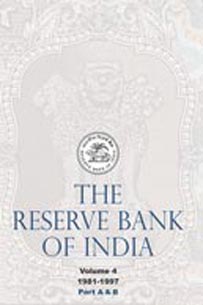
This fourth volume in the series of the history of the Reserve Bank of India covers the 16 eventful years from 1981 to 1997. It is published in two parts, which ideally should be read as a continuum.
Part A focuses on the transformation of the Indian economy from a regime of restrictions to progressive liberalisation. The 1980s were characterised by an expansionary fiscal policy accompanied by automatic monetisation of budgetary deficit that strained the conduct of monetary policy. Similarly, a heavily regulated banking system impaired efficiency. The domestic macroeconomic imbalances combined with deteriorating external conditions triggered the balance of payments (BoP) crisis of 1991. Subsequent reforms ushered in far reaching changes not only in the economy but also in central banking.
Part B of the volume captures the implementation of structural and financial sector reforms: fiscal correction and phasing out of automatic monetisation; development of government securities market; and greater integration among money, securities and foreign exchange markets. It also covers the transformation in banking with liberalisation and improvement in credit delivery. At the same time the Reserve Bank had to contend with a securities scam which led to the introduction of better control systems and strengthening of the payment and settlement systems.
With the introduction of financial sector reforms, the Reserve Bank adopted a more active communication strategy. The organisational structure of the Reserve Bank also changed in response to domestic necessities and international developments. The Bank embarked upon technological transformation and upgraded its systems and procedures to manage its operations effectively.
This volume is more than a mere narrative of the history of the Reserve Bank; it also provides valuable insights into India's economic development and policy during an eventful and significant period.
Praise for this book
“This [the period from 1981 to 1997] was by far one of the most challenging periods for the economy. This volume of history takes us through the difficult times when the Reserve Bank and the Government had to contend with unprecedented strains on the external payments situation. In response to the balance of payments crisis, the Government embarked on a wide-ranging programme of economic reforms that defined a marked reorientation of the philosophy of economic management of the country. The Reserve Bank was a partner in this exciting process, generating ideas, processing proposals and implementing reform initiatives.”
— Dr Duvvuri Subbarao
Governor
“The comprehensive economic reforms, mostly home-grown, that were launched in 1991, with support from multilateral institutions and implemented in a gradual and cautious manner enabled India to gain international credibility. The devaluation of the rupee in 1991 gave a fillip to exports. This, combined with wide-ranging liberalisation efforts in various sectors, helped rather quickly to restore macroeconomic balance in the economy. Policy measures such as the institution of the Liberalised Exchange Rate Management System (LERMS) as a prelude to current account convertibility in 1994, the switch from direct to indirect instruments to improve the efficacy of monetary policy, and developing financial markets for greater market integration facilitated the smooth transition of the economy towards a more dynamic and liberal regime.”
— Dr Bimal Jalan
Chairman, Advisory Committee, RBI History
Contents in Detail
| Publisher | AF Press |
| Publication Date | 2013 |
| Number of Pages | 712 |
| ISBN |
9788171889860 |
Academic Foundation (AF), based in New Delhi, is India’s leading independent publisher of academic/scholarly books in Social Sciences, specialising in Economics—Development Economics and Indian Economy in particular, and allied subjects.
About the Book
This fourth volume in the series of the history of the Reserve Bank of India covers the 16 eventful years from 1981 to 1997. It is published in two parts, which ideally should be read as a continuum.
Part A focuses on the transformation of the Indian economy from a regime of restrictions to progressive liberalisation. The 1980s were characterised by an expansionary fiscal policy accompanied by automatic monetisation of budgetary deficit that strained the conduct of monetary policy. Similarly, a heavily regulated banking system impaired efficiency. The domestic macroeconomic imbalances combined with deteriorating external conditions triggered the balance of payments (BoP) crisis of 1991. Subsequent reforms ushered in far reaching changes not only in the economy but also in central banking.
Part B of the volume captures the implementation of structural and financial sector reforms: fiscal correction and phasing out of automatic monetisation; development of government securities market; and greater integration among money, securities and foreign exchange markets. It also covers the transformation in banking with liberalisation and improvement in credit delivery. At the same time the Reserve Bank had to contend with a securities scam which led to the introduction of better control systems and strengthening of the payment and settlement systems.
With the introduction of financial sector reforms, the Reserve Bank adopted a more active communication strategy. The organisational structure of the Reserve Bank also changed in response to domestic necessities and international developments. The Bank embarked upon technological transformation and upgraded its systems and procedures to manage its operations effectively.
This volume is more than a mere narrative of the history of the Reserve Bank; it also provides valuable insights into India's economic development and policy during an eventful and significant period.
Praise for this book
“This [the period from 1981 to 1997] was by far one of the most challenging periods for the economy. This volume of history takes us through the difficult times when the Reserve Bank and the Government had to contend with unprecedented strains on the external payments situation. In response to the balance of payments crisis, the Government embarked on a wide-ranging programme of economic reforms that defined a marked reorientation of the philosophy of economic management of the country. The Reserve Bank was a partner in this exciting process, generating ideas, processing proposals and implementing reform initiatives.”
— Dr Duvvuri Subbarao
Governor
“The comprehensive economic reforms, mostly home-grown, that were launched in 1991, with support from multilateral institutions and implemented in a gradual and cautious manner enabled India to gain international credibility. The devaluation of the rupee in 1991 gave a fillip to exports. This, combined with wide-ranging liberalisation efforts in various sectors, helped rather quickly to restore macroeconomic balance in the economy. Policy measures such as the institution of the Liberalised Exchange Rate Management System (LERMS) as a prelude to current account convertibility in 1994, the switch from direct to indirect instruments to improve the efficacy of monetary policy, and developing financial markets for greater market integration facilitated the smooth transition of the economy towards a more dynamic and liberal regime.”
— Dr Bimal Jalan
Chairman, Advisory Committee, RBI History
Contents in Detail
| Publisher | AF Press |
| Publication Date | 2013 |
| Number of Pages | 712 |
| ISBN |
9788171889860 |

Couldn't load pickup availability
Share
-

Curated Collections By AF Press
-

Premium Print Quality
-

Author-Centric Publishing
-

Trusted by Readers Nationwide


The Reserve Bank of India (Part A & P...