

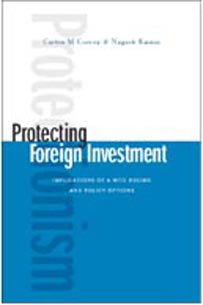
Protecting Foreign Investment
Carlos M. Correa (Ed.)‚ Nagesh Kumar (Ed.)
About the Book
Despite the mounting criticism that globalization is encountering, the developed countries continue to lose no opportunity to change the rules of the global economy in their favour, regardless of the impact on developing countries and the poor. This book examines one of the most important instances of this: the rich countries' insistence that the WTO not only launch a new round of the world trade negotiations but the rules which were supposed to be confined to trade issue now be extended by means of new agreements protecting foreign direct investment. What is being proposed would be at the expense of the freedom of developing countries to determine their own policies towards foreign capital in tune with their development policy objectives.
The two authors of this book have an intimate knowledge of WTO negotiating processes. They explain in detail the North's relentless determination to give privileged protection to the overseas investments of its transnational corporations. These initiatives have included, inter alia, the OECD's failed MAI initiatives, the World Bank-sponsored Multilateral Investment Guarantee Agency, and the WTO's General Agreements on Trade in Services (GATS) and Agreement on Trade related Investment Measures (TRIMS). The authors spell out their consequences for developing countries. They examine whether there is any real case of new multilateral framework on investment within the WTO. And they propose various options for developing countries to resist what amounts to a new form of Western protectionism, including how a development dimension could be incorporated in any new agreement, should the member countries decide to proceed with negotiations.
Protecting Foreign Investment provides invaluable information and analysis for diplomats and trade negotiators, policy makers and scholars, as well as civil society activists concerned with the impact of TNC investments on Development.
About the Author(s) / Editor(s)
Professor Carlos M. Correa is Director of the University of Buenos Aires Masters Programme on Science and Technology Policy and Management. Trained originally both as a lawyer and as an economist, he has made a speciality of technology and intellectual property rights. A former public servant (he was Under- Secretary of State for Informatics and Development, 1984–89, and the Argentinian Government’s official delegate to GATT and WIPO during the negotiations on intellectual property rights), he has also acted as a consultant to many international and regional organizations, including UNCTAD, UNIDO, WHO, FAO, ECLA, the Interamerican Development Bank, and the Secretariat of the Convention on Biological Diversity. He has also been a Visiting Professor at various universities in Latin America, Spain and Canada. He is the author of several books and articles in international journals on issues of technology and intellectual property, including Intellectual Property Rights, the WTO and Developing Countries: The TRIPs Agreement and Policy Options (Zed Books and Third World Network, 2000).
Professor Nagesh Kumar is Director General at the Research and Information System for Developing Countries, New Delhi. From 1993 to 1998, Dr Kumar served on the faculty of the United Nations University – Institute for New Technologies (UNU/INTECH), Maastricht, the Netherlands, and directed its research on FDI and technology transfers in developing countries. He has also served as a consultant to the World Bank, UNDP, UNCTAD, UNIDO, UN–ESCAP, ILO, among other organizations. He graduated with a PhD in Economics from the Delhi School of Economics, University of Delhi. He received the Exim Bank of India’s first International Trade Research Award and a GDN medal for best research in Tokyo for 2000. He serves as the Editor of the South Asia Economic Journal. Professor Kumar has written extensively on the developmental impact of MNEs and FDI, industrial and technology development policies, WTO issues, new technologies for development and on regional economic co-operation, among other themes. His recent books include Globalization, Foreign Direct Investment and Technology Transfers: Impact on and Prospects for Developing Countries (Routledge, 1998) and Globalization and the Quality of Foreign Direct Investment (OUP, 2002).
Contents in Detail
| Publisher | AF Press |
| Publication Date | 2003 |
| Number of Pages | 177 |
| ISBN |
8171883176 |
Academic Foundation (AF), based in New Delhi, is India’s leading independent publisher of academic/scholarly books in Social Sciences, specialising in Economics—Development Economics and Indian Economy in particular, and allied subjects.
About the Book
Despite the mounting criticism that globalization is encountering, the developed countries continue to lose no opportunity to change the rules of the global economy in their favour, regardless of the impact on developing countries and the poor. This book examines one of the most important instances of this: the rich countries' insistence that the WTO not only launch a new round of the world trade negotiations but the rules which were supposed to be confined to trade issue now be extended by means of new agreements protecting foreign direct investment. What is being proposed would be at the expense of the freedom of developing countries to determine their own policies towards foreign capital in tune with their development policy objectives.
The two authors of this book have an intimate knowledge of WTO negotiating processes. They explain in detail the North's relentless determination to give privileged protection to the overseas investments of its transnational corporations. These initiatives have included, inter alia, the OECD's failed MAI initiatives, the World Bank-sponsored Multilateral Investment Guarantee Agency, and the WTO's General Agreements on Trade in Services (GATS) and Agreement on Trade related Investment Measures (TRIMS). The authors spell out their consequences for developing countries. They examine whether there is any real case of new multilateral framework on investment within the WTO. And they propose various options for developing countries to resist what amounts to a new form of Western protectionism, including how a development dimension could be incorporated in any new agreement, should the member countries decide to proceed with negotiations.
Protecting Foreign Investment provides invaluable information and analysis for diplomats and trade negotiators, policy makers and scholars, as well as civil society activists concerned with the impact of TNC investments on Development.
About the Author(s) / Editor(s)
Professor Carlos M. Correa is Director of the University of Buenos Aires Masters Programme on Science and Technology Policy and Management. Trained originally both as a lawyer and as an economist, he has made a speciality of technology and intellectual property rights. A former public servant (he was Under- Secretary of State for Informatics and Development, 1984–89, and the Argentinian Government’s official delegate to GATT and WIPO during the negotiations on intellectual property rights), he has also acted as a consultant to many international and regional organizations, including UNCTAD, UNIDO, WHO, FAO, ECLA, the Interamerican Development Bank, and the Secretariat of the Convention on Biological Diversity. He has also been a Visiting Professor at various universities in Latin America, Spain and Canada. He is the author of several books and articles in international journals on issues of technology and intellectual property, including Intellectual Property Rights, the WTO and Developing Countries: The TRIPs Agreement and Policy Options (Zed Books and Third World Network, 2000).
Professor Nagesh Kumar is Director General at the Research and Information System for Developing Countries, New Delhi. From 1993 to 1998, Dr Kumar served on the faculty of the United Nations University – Institute for New Technologies (UNU/INTECH), Maastricht, the Netherlands, and directed its research on FDI and technology transfers in developing countries. He has also served as a consultant to the World Bank, UNDP, UNCTAD, UNIDO, UN–ESCAP, ILO, among other organizations. He graduated with a PhD in Economics from the Delhi School of Economics, University of Delhi. He received the Exim Bank of India’s first International Trade Research Award and a GDN medal for best research in Tokyo for 2000. He serves as the Editor of the South Asia Economic Journal. Professor Kumar has written extensively on the developmental impact of MNEs and FDI, industrial and technology development policies, WTO issues, new technologies for development and on regional economic co-operation, among other themes. His recent books include Globalization, Foreign Direct Investment and Technology Transfers: Impact on and Prospects for Developing Countries (Routledge, 1998) and Globalization and the Quality of Foreign Direct Investment (OUP, 2002).
Contents in Detail
| Publisher | AF Press |
| Publication Date | 2003 |
| Number of Pages | 177 |
| ISBN |
8171883176 |

Couldn't load pickup availability
Share
-

Curated Collections By AF Press
-

Premium Print Quality
-

Author-Centric Publishing
-

Trusted by Readers Nationwide


Protecting Foreign Investment