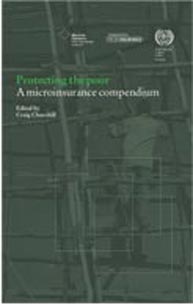
Protecting the poor
A microinsurance compendium
Craig Churchill
A microinsurance compendium
About the Book
This authoritative compendium brings together the latest thinking of leading academics, actuaries, and development professionals in the microinsurance field. The result is a practical, wide-ranging resource which provides the most thorough overview of the subject to date.
The book allows readers to benefit from the valuable lessons learned from a project launched by the CGAP Working Group on Microinsurance analysing operations around the world. Essential reading for insurance professionals, practitioners and anyone involved with offering insurance to low-income persons, this volume covers the many aspects of microinsurance in detail, including product design, marketing, premium collection and governance.
It also discusses the various institutional arrangements available for delivery such as the community- based approach, insurance companies owned by networks of savings and credit cooperatives and microfinance institutions.
The roles of key stakeholders are also explored and the book offers insightful strategies for achieving the right balance between coverage, costs and price.
Reviews
Insurance – among other financial services – is a powerful way to help poor people manage the myriad of risks that are part of their everyday lives. This comprehensive compendium comes at a key moment, as funders, governments, microfinance institutions and even commercial insurers are increasingly interested in insurance services for low-income people. Peppered with examples from over 20 case studies, this essential guide combines in-depth analysis with readability, a remarkable achievement on a topic of critical importance to improving the lives of the poor.
Elisabeth Littlefield
CEO, Consultative Group to Assist the Poor (CGAP)
The planning process has brought about significant and pronounced transformation in rural areas and among the disadvantaged sections of the population in India. This has paved the way for the financial sector to step in and extend their services more as a business opportunity than as an obligatory service. The Micro Insurance Regulations enacted by the Insurance Regulatory and Development Authority facilitate extension of insurance intermediation in a smooth and seamless manner and at affordable cost to meet the overarching objective of inclusive growth. The publication Protecting the Poor: A Microinsurance Compendium enables policy-makers, insurers, academics and NGOs an opportunity to study the various initiatives taken in different countries and profit from these experiences. I congratulate the publishers for bringing out this excellent compendium.
C.S. Rao
Chairman, Insurance Regulatory and
Development Authority (IRDA), India
Microinsurance is now a mainstream development topic. Research over the last 15 years shows clearly and consistently that the main reasons people fall below the poverty line are related to idiosyncratic risks such as the death of a wage earner or, more frequently, catastrophic health expenditures. Insurance, in conjunction with savings and credit, provides a mechanism whereby the working poor can retain their productive assets after such discontinuities. This compendium provides an invaluable summation of the state of the art and will hopefully encourage people with relevant skills and unfettered minds to look at what they can contribute to grassroots risk management.
Rodney Lester
Program Director, Financial Markets for
Social Safety Net, The World Bank
Poor households employ various strategies to protect against risk. These include building stocks of food or saving small amounts. Some risk situations are more predictable than others, and if the expected impact is small, it is easier for a poor household to prepare for these. However, events that are unexpected and that may cause significant damage in terms of lost income or increased expenditures pose high financial pressures to poor households. Availing microinsurance helps poor households better manage unexpected events such as accidents, serious illness, and death. Protecting the Poor builds on experiences and lessons made to-date and thus is an important step for innovations of the future.
Dr. Aristotle Alip,
President, CARD Bank, Philippines
About the Author(s) / Editor(s)
Craig Churchill joined the ILO’s Social Finance Programme in 2001. Craig has microfinance experience in both developed and developing countries having previously worked for Get Ahead Foundation in South Africa, ACCION International, the MicroFinance Network and Calmeadow. In his current position, he focuses primarily on the role of financial services that the poor can use to manage risks and reduce their vulnerability, including microinsurance. He serves as Chair of the CGAP Working Group on Microinsurance and on the editorial boards of the MicroBanking Bulletin and the Journal of Microfinance. Craig has authored and edited dozens of articles, papers and monographs on various microfinance topics including microinsurance, customer loyalty, organizational development and management, governance, lending methodologies, and regulation and supervision.
Contents in Detail
Acknowledgement
Table of Acronyms
Introduction
Part 1 Principles and practices
1.1 What is insurance for the poor? (Craig Churchill)
1 Defining microinsurance
2 The two faces of microinsurance
3 What a difference three words make
1.2 The demand for microinsurance (Monique Cohen and
Jennefer Sebstad)
1 Managing risk
2 The importance of understanding the demand for microinsurance
3 Current coping strategies: Strengths and weaknesses
4 Opportunities for microinsurance
5 Conclusion
1.3 The social protection perspective on microinsurance
(Christian Jacquier,Gabriele Ramm,Philippe Marcadent
and Valérie Schmitt-Diabate)
1 Introduction
2 What is social security? What is social protection?
3 What is microinsurance)
4 Potential and limitation of microinsurance as a social
protection mechanism
5 How can microinsurance be used to extend social protection?
6 Conclusion
Part 2 Microinsurance products and services
2.1 Challenges and strategies to extend health insurance to the
poor (Ralf Radermacher, Iddo Dror and Gerry Noble)
1 Product manufacturing
2 Product sales
3 Product servicing
4 Maintenance of long-term stability
5 Conclusion
2.2 Long-term savings and insurance (James Roth,
Denis Garand and Stuart Rutherford)
1 Providing savings to the poor
2 Long-term savings and insurance products for the poor
3 Key issues in offering long-term savings and insurance
4 Conclusions
2.3 Savings- and credit-linked insurance (Sven Enarsson,
Kjell Wirén and Gloria Almeyda)
1 Loan-linked products
2 Savings-linked insurance
3 Product design and delivery issues
4 Conclusions
2.4 Meeting the special needs of women and children
Mosleh Ahmed and Gabriele Ramm)
1 Special risks affecting women and children (girls and boys)
2 Microinsurance to address the special needs of women and children
3 Policy tasks to improve the strategic situation of women and children
4 Conclusions
Part 3 Microinsurance operations
3.1 Product design and insurance risk management
(John Wipf, Dominic Liber andCraig Churchill)
1 Market research
2 Eligibility
3 Terms and payment options
4 Benefits
5 Risk management and claims controls
6 Conclusions
3.2 Marketing microinsurance (Craig Churchill and Monique Cohen)
1 Main marketing messages
2 Marketing techniques
4 Marketing and mandatory insurance
5 Conclusion
3.3 Premium collection: Minimizing transaction costs and maximizing
customer service (Michael J. McCord, Grzegorz Buczkowski
and Priyanka Saksena)
1 Modes of premium collection
2 Collection frequency and timing
3 Client considerations
4 Premium collection controls
5 Conclusion
3.4 Claims processing (Michael J. McCord and Richard Leftley)
1 Introduction
2 Claims notification
3 Settlement
4 Controls
5 Claims considerations in product design
6 Conclusions
3.5 Pricing microinsurance products
(John Wipf and Denis Garand)
1 Database design requirements for pricing (and sound microinsurance
management)
2 Pricing components, key factors and methodology
3 Modelling techniques
4 Conclusions
3.6 Risk and financial management (Denis Garand and John Wipf)
1 The risks inherent in insurance products
2 Capital requirements
3 Reserves
4 Reinsurance
5 Investment management
6 Profit distribution
7 Conclusion
3.7 Organization development in microinsurance
(Craig Churchill and Richard Leftley)
1 Organizational structure: Where does
microinsurance fit in?
2 Recruitment: Where to access appropriate expertise
3 Training
4 Compensation
5 Institutional culture
6 Conclusions
3.8 Governance (Zahid Qureshi)
1 Governance in microinsurance
2 Board composition and expertise
3 The foundation stone
4 Microinsurance governance in practice
5 Conclusions
3.9 Loss control (Zahid Qureshi and Gerry Noble)
1 A retrospective look at loss prevention
2 Converging interests
3 Pinpointing prevention
4 Practising prevention
5 Minimization: A stitch in time
6 Evaluating the return on investment in prevention
7 Conclusions
3.10 Performance indicators and benchmarking
(Denis Garand and John Wipf)
1 Marketing and distribution
2 Financial management and viability
3 Efficiency and client value
4 Investment management
5 Conclusions
Part 4 Institutional options
4.1 Cooperatives and insurance: The mutual advantage
(Klaus Fischer and Zahid Qureshi)
1 Introduction
2 What is a mutual insurer?
3 The cooperative difference
4 Insurance development models and stages
5 Insurance products offered under the cooperative network model
6 Why mutuals develop networks and how they work
7 Advantages and disadvantages of the model
8 Conclusion
4.2 The partner-agent model: Challenges and opportunities
(Michael J. McCord)
1 Why a partner-agent model?
2 How the partner-agent model works
3 The good and the bad
4 Advantages and disadvantages
5 Conclusions
4.3 The community-based model: Mutual health organizations in
Africa(Bénédicte Fonteneau and Bruno Galland)
1 What is a community-based model?
2 Why was/is this approach implemented in West Africa?
3 What is the target group of the community-based model?
4 Do MHOs function (well) and make a significant impact?
5 What are the origins of the problems?
6 What is the added value of this model?
7 Conclusion
4.4 Institutional options for delivering health microinsurance
(Ralf Radermacher and Iddo Dror)
1 Institutional options
2 Value, interests and conflicts in the insurance business process
3 Conclusion
4.5 Beyond MFIs and community-based models: Institutional
alternatives (Richard Leftley and James Roth)
1 Risk-carrying alternatives
2 Administrative alternatives
3 Distribution alternatives
4 Conclusions
4.6 Retailers as microinsurance distribution channels
(James Roth and Doubell Chamberlain)
1 Why retailers? Which retailers?
2 Microinsurance distribution/Product combinations for retailers
3 Conclusions
4.7 Microinsurance: Opportunities and pitfalls for microfinance institutions
(Craig Churchill and James Roth)
1 Institutional arrangements
2 The type of insurance
3 Conclusions
Part 5 The role of other stakeholders
5.1 The role of donors (Alexia Latortue)
1 An analytical framework
2 Donor requirements to effectively support microinsurance
3 Types of donor support for microinsurance
4 Conclusion
5.2 An enabling regulatory environment for microinsurance
(Martina Wiedmaier-Pfister and Arup Chatterjee)
1 Background
2 Barriers in existing regulatory frameworks
3 Country experiences – preliminary insights
4 Conclusions
5.3 The promotional role of governments (Sabine Trommershäuser,
Roland Lindenthal and Rüdiger Krech)
1 Policy-making, participation and consensus-building
2 Creating an enabling environment
3 Strengthening institutions
4 Providing financial assistance
5 Concluding remarks
5.4 The role of insurers and reinsurers in supporting insurance for
the poor(David M. Dror and Thomas Wiechers)
1 The value proposition of reinsurance
2 Involvement of commercial insurers and reinsurers in microinsurance
3 What part of this value proposition can insurers and reinsurers deliver?
4 Recommendations
5 Conclusion
5.5 The provision of technical assistance
(Richard Leftley and Richard Lacasse)
1 Why is technical assistance required?
2 What does a TA provider do?
3 Who provides microinsurance technical assistance?
4 Conclusion: Providing quality technical assistance
Part 6 Conclusions
6.1 Strategies for sustainability (Craig Churchill and Denis Garand)
1 Limit benefits
2 Focus on efficiency
3 Diversify income sources
4 Good management
6.2 The future of microinsurance (Felipe Botero, Craig Churchill,
Michael J. McCord and Zahid Qureshi)
1 Microinsurance customers of the future
2 Microinsurance providers of the future
3 The regulatory landscape
4 The environment for microinsurance
5 Embracing the future
Appendix I: Description of microinsurance providers
Appendix II: About the authors
Bibliography
Index
List of tables
1 Microinsurance providers and products
2 Priority risks in selected countries
3 Coping strategy by risk
4 Examples of informal group-based insurance systems
5 Test for an insurable risk
6 Typology of microinsurance linkages
7 Overview of product manufacturing tasks and features
8 Overview of product sales tasks and features
9 Overview of product servicing tasks and features
10 Some key ratios of health microinsurers
11 Overview of the tasks to be undertaken to
maintain long-term stability
12 Two insurers with endowment products
13 CARD MBA’s loan protection plus family
funeral insurance
14 Different benefit classes for minimum/maximum
premiums at Yasiru
15 Market coverage of selected voluntary life
insurance products
16 VimoSEWA’s coverage and price in rupees
17 Benefits of LIC’s Janashree Bima Yojana
18 Benefits from UIIC’s UniMicro insurance scheme
19 Benefits of La Equidad’s Ampararmicroinsurance product
20 Coinsurance and payment ceiling of health microinsurers
21 Benefit amounts at CARD MBA
22 Rolling admission versus annual campaign
23 Marketing checklist for microinsurance managers
24 Comparison of premium collection modes
25 A sample of claims durations
26 Evolution of life mortality rate at VimoSEWA
27 Claims experience of VimoSEWA’s child benefit
28 Potential effect of investment mismatch on CARD’s
Provident Fund – An illustration
29 Average monthly earnings for frontline staff (US$)
30 Commissions on long-term policies at ALMAO and Tata-AIG
31 Non-life and life insurance loss prevention
32 Improved service enhances retention at VimoSEWA (India)
33 Selected examples of net income
34 Expense and claims rations for selected schemes
35 Rating of microinsurance schemes – An illustration
36 Case studies that correspond to the cooperative network model
37 Insurance products offered by SACCO networks
38 ASA’s cost per policy
39 ASA’s profit/loss per policy
40 Performance of four microinsurance schemes in Zambia
41 Advantages and disadvantages to the agent
compared to self-insuring
42 Advantages and disadvantages for an insurer
43 Advantages and disadvantages for low-income policy-holders
44 A comparison of premiums and benefits for selected MHOs
45 Basic motivations and primary interest through
the business process
46 HTG funeral insurance product
47 Does self-insurance provide greater client value?
48 Definition of microinsurance in India
49 Partnership factors for an insurance or reinsurance company
51 Advantages and disadvantages of long-term, on-site TA support
52 Continuing challenges that limit the expansion of microinsurance
53 Process automation transforms insurance operations
List of figures
1 Janus: The two faces of microinsurance
2 Impact of shocks on household income and assets
3 The impact of risks
4 The locus of microinsurance
5 A dynamic approach to extending social protection
through microinsurance
6 Health insurance product design
7 Claims model 1: Insurer pays healthcare provider
(third-party payment)
8 Claims model 2: Integrated healthcare and insurance provider
(internal financial transaction)
9 Claims model 3: Insurer reimburses clients’ out-of-pocket
healthcare expenses
10 Daughter’s wedding insurance plan: Delta Life
11 Marketing brochure: Yeshasvini
12 Guaranteed savings brochure: TUW SKOK
13 Three-step marketing process
14 Microinsurance drop-outs and access to microcredit
15 Typical claims settlement process for
Madison’s microinsurance product
16 The claims process at UMSGF
17 Microcare and Opportunity International claim form
18 CARD MBA timing of claims
19 Kharif Hungama sales prizes
20 Organizational chart of Tata-AIG
21 Illustrating Grameen’s 16 decisions
22 The circular logic of customer retention
23 Distribution of microinsurance products in
the SACCO network model
24 A mutual network structure with its portfolio
of functional subsidiaries
25 The MHO system
26 Types of health insurance provision
27a The partner-agent model
27b The partner-agent model with TPA
28 The charitable insurance model
29 The provider-driven model
30 The community-based/mutual model
31 Three components of insurance provision
32 Yeshasvini’s claim settlement process
33 Micro-agents, CRIGs and NGOs in the
premium-collection process
34 An analytical framework for donor support
for microinsurance
35 The Aid Effectiveness Star
36 The what, who and how of microinsurance technical assisatance
37 The RIMANSI model of technical assistance to MBAs
38 Striking a balance: The microinsurance challenge
39 Perspectives on the future
List of boxes
1 Microinsurance and the MDGs
2 Applying Prahalad’s “Twelve Principles
of Innovation for BOP Markets” to microinsurance
3 Impact of shocks on the rich and poor in Viet Nam
4 Risks and risk management in Malawi
5 Coping strategies in Viet Nam
6 Risk management and over-indebtedness in Georgia
7 Membership in multiple burial societies
8 High cost of funerals in Zambia
9 Understanding the demand for microinsurance
in Sri Lanka
10 We want to know more . .
11 The extension of social protection through
microinsurance in Colombia
12 Linkages in the Philippines
13 Developing balanced linkages in Senegal
14 The Global Social Trust
15 Cambodia’s Master Plan
16 An integrated approach to social
protection in Senegal
17 BRAC’s three-tier approach to providing
health services
18 CARD’s foray into annuities
19 Grameen’s deposit pension scheme (GPS)
20 Mis-selling in South Africa
21 Life insurance as an alternative to loan protection?
22 Illness cover in a credit life policy?
23 Shepherd’s Sugam Fund
24 Outreach at Yeshasvini
25 Family coverage at UMSFG
26 Lapses at Delta Life
27 Flat-rate pricing for Shepherd
28 Mass weddings
29 UHC definition of family in Uganda
30 Creating awareness: The experience of the South African Insurance
Association
31 UMSGF’s three-tiered marketing strategy
32 Regional differences in Zambia
33 Sales challenges at TUW SKOK
34 Linking insurance premiums to loans
35 Flexible premium payments for funeral
insurance in South Africa
36 Paying premiums in milk at Yeshasvini
37 Delta Life – combining microcredit
and microinsurance
38 Claim rejection: A case of insufficient
documentation in Zambia
39 Beneficiary frustration
40 Requirements for an advance payment at Columna
41 The many stops in claims settlement at Delta Life
42 Efficiencies of informal insurance
43 Claims adjustment and HIV/AIDS
44 Pricing problems
45 Database design problems
46 Importance of a health insurance MIS:
Experience of AssEF
47 VimoSEWA’s renewal rates
48 VimoSEWA’s claims processing
49 Actuarial reserves and capital defined
50 Management risk illustrations
51 Organization development: How not to do it
52 Criteria in the selection of micro-agents at Tata-AIG
53 Frontline staff at CARD MBA
54 TUW SKOK’s outsourcing model
55 What is corporate governance?
56 The four pillars of governance
57 Responsibilities of the board of directors
58 Trust is good, but control is better
59 Read the writing on the wall
60 Taking the societal perspective
61 Promoting well-being
62 Prevention through sister organizations: VimoSEWA
63 Coping with disaster: The Japanese experience
64 Microcare: Using insecticide-treated bed nets to reduce
malaria-related claims
65 Great value placed on insurance
66 What doomed Confederation Life of Canada?
67 Why cooperative insurance suits low-income markets
68 Management of lapses and claims:
The mutual difference
69 Selling an insurance concept in Ghana
70 Partner-agent premium collection checklist
71 ASA’s on-again off-again relationship with
the partner-agent model
72 Profiles of initiating organizations of MHOs
73 A variety of membership profiles
74 The target population of the rural MHOs
75 Union Technique de la Mutualité Malienne
76 Coordination Régionale des Mutuelles
de Santé de Thiès
77 Réseau Alliance Santé, Benin
78 MHO performance: Some trends
79 The power of collective action
80 Nkoranza Community Health Insurance Plan
81 Zambuko Trust, Zimbabwe
82 VimoSEWA’s claims committee
83 Retailers and rural areas
84 AFL/CIO’s Union Privilege Scheme
85 Reducing the vulnerability of the poor:
The case of Shepherd, India
86 Unleashing the catalytic role of the private
sector with public subsidy
87 Providing support through donor guarantees
88 FinScope surveys: Getting to know the market
89 Lessons learnt the hard way: Illustrations from India
90 Informal insurance in South Africa
91 Formalization of ALMAO
92 Insurance cooperatives in Malawi
93 Capital requirements in Peru
94 Requirements for agents and brokers
95 AIG Uganda
96 The Insurance Ombudsman Sri Lanka
97 Health service providers and mutual health
organizations (MHOs) in Mali
98 Stewardship in Guinea-Bissau
99 Facilitating links to UNDP in India
100 Subsidizing Yeshasvini Trust
101 Africa Re
102 What do microinsurers get out of reinsurance?
103 A short summary of the social reinsurance model
104 Actuarial reviews of microinsurance schemes
105 The 7 Cs of technical assistance
106 Technical assistance partnerships: DID and CIF
107 Management tools for microinsurance
108 Technological advances in banking services for the poor
| Publisher | AF Press |
| Publication Date | 2008 |
| Number of Pages | 654 |
| ISBN |
9788171886708 |
Academic Foundation (AF), based in New Delhi, is India’s leading independent publisher of academic/scholarly books in Social Sciences, specialising in Economics—Development Economics and Indian Economy in particular, and allied subjects.
About the Book
This authoritative compendium brings together the latest thinking of leading academics, actuaries, and development professionals in the microinsurance field. The result is a practical, wide-ranging resource which provides the most thorough overview of the subject to date.
The book allows readers to benefit from the valuable lessons learned from a project launched by the CGAP Working Group on Microinsurance analysing operations around the world. Essential reading for insurance professionals, practitioners and anyone involved with offering insurance to low-income persons, this volume covers the many aspects of microinsurance in detail, including product design, marketing, premium collection and governance.
It also discusses the various institutional arrangements available for delivery such as the community- based approach, insurance companies owned by networks of savings and credit cooperatives and microfinance institutions.
The roles of key stakeholders are also explored and the book offers insightful strategies for achieving the right balance between coverage, costs and price.
Reviews
Insurance – among other financial services – is a powerful way to help poor people manage the myriad of risks that are part of their everyday lives. This comprehensive compendium comes at a key moment, as funders, governments, microfinance institutions and even commercial insurers are increasingly interested in insurance services for low-income people. Peppered with examples from over 20 case studies, this essential guide combines in-depth analysis with readability, a remarkable achievement on a topic of critical importance to improving the lives of the poor.
Elisabeth Littlefield
CEO, Consultative Group to Assist the Poor (CGAP)
The planning process has brought about significant and pronounced transformation in rural areas and among the disadvantaged sections of the population in India. This has paved the way for the financial sector to step in and extend their services more as a business opportunity than as an obligatory service. The Micro Insurance Regulations enacted by the Insurance Regulatory and Development Authority facilitate extension of insurance intermediation in a smooth and seamless manner and at affordable cost to meet the overarching objective of inclusive growth. The publication Protecting the Poor: A Microinsurance Compendium enables policy-makers, insurers, academics and NGOs an opportunity to study the various initiatives taken in different countries and profit from these experiences. I congratulate the publishers for bringing out this excellent compendium.
C.S. Rao
Chairman, Insurance Regulatory and
Development Authority (IRDA), India
Microinsurance is now a mainstream development topic. Research over the last 15 years shows clearly and consistently that the main reasons people fall below the poverty line are related to idiosyncratic risks such as the death of a wage earner or, more frequently, catastrophic health expenditures. Insurance, in conjunction with savings and credit, provides a mechanism whereby the working poor can retain their productive assets after such discontinuities. This compendium provides an invaluable summation of the state of the art and will hopefully encourage people with relevant skills and unfettered minds to look at what they can contribute to grassroots risk management.
Rodney Lester
Program Director, Financial Markets for
Social Safety Net, The World Bank
Poor households employ various strategies to protect against risk. These include building stocks of food or saving small amounts. Some risk situations are more predictable than others, and if the expected impact is small, it is easier for a poor household to prepare for these. However, events that are unexpected and that may cause significant damage in terms of lost income or increased expenditures pose high financial pressures to poor households. Availing microinsurance helps poor households better manage unexpected events such as accidents, serious illness, and death. Protecting the Poor builds on experiences and lessons made to-date and thus is an important step for innovations of the future.
Dr. Aristotle Alip,
President, CARD Bank, Philippines
About the Author(s) / Editor(s)
Craig Churchill joined the ILO’s Social Finance Programme in 2001. Craig has microfinance experience in both developed and developing countries having previously worked for Get Ahead Foundation in South Africa, ACCION International, the MicroFinance Network and Calmeadow. In his current position, he focuses primarily on the role of financial services that the poor can use to manage risks and reduce their vulnerability, including microinsurance. He serves as Chair of the CGAP Working Group on Microinsurance and on the editorial boards of the MicroBanking Bulletin and the Journal of Microfinance. Craig has authored and edited dozens of articles, papers and monographs on various microfinance topics including microinsurance, customer loyalty, organizational development and management, governance, lending methodologies, and regulation and supervision.
Contents in Detail
Acknowledgement
Table of Acronyms
Introduction
Part 1 Principles and practices
1.1 What is insurance for the poor? (Craig Churchill)
1 Defining microinsurance
2 The two faces of microinsurance
3 What a difference three words make
1.2 The demand for microinsurance (Monique Cohen and
Jennefer Sebstad)
1 Managing risk
2 The importance of understanding the demand for microinsurance
3 Current coping strategies: Strengths and weaknesses
4 Opportunities for microinsurance
5 Conclusion
1.3 The social protection perspective on microinsurance
(Christian Jacquier,Gabriele Ramm,Philippe Marcadent
and Valérie Schmitt-Diabate)
1 Introduction
2 What is social security? What is social protection?
3 What is microinsurance)
4 Potential and limitation of microinsurance as a social
protection mechanism
5 How can microinsurance be used to extend social protection?
6 Conclusion
Part 2 Microinsurance products and services
2.1 Challenges and strategies to extend health insurance to the
poor (Ralf Radermacher, Iddo Dror and Gerry Noble)
1 Product manufacturing
2 Product sales
3 Product servicing
4 Maintenance of long-term stability
5 Conclusion
2.2 Long-term savings and insurance (James Roth,
Denis Garand and Stuart Rutherford)
1 Providing savings to the poor
2 Long-term savings and insurance products for the poor
3 Key issues in offering long-term savings and insurance
4 Conclusions
2.3 Savings- and credit-linked insurance (Sven Enarsson,
Kjell Wirén and Gloria Almeyda)
1 Loan-linked products
2 Savings-linked insurance
3 Product design and delivery issues
4 Conclusions
2.4 Meeting the special needs of women and children
Mosleh Ahmed and Gabriele Ramm)
1 Special risks affecting women and children (girls and boys)
2 Microinsurance to address the special needs of women and children
3 Policy tasks to improve the strategic situation of women and children
4 Conclusions
Part 3 Microinsurance operations
3.1 Product design and insurance risk management
(John Wipf, Dominic Liber andCraig Churchill)
1 Market research
2 Eligibility
3 Terms and payment options
4 Benefits
5 Risk management and claims controls
6 Conclusions
3.2 Marketing microinsurance (Craig Churchill and Monique Cohen)
1 Main marketing messages
2 Marketing techniques
4 Marketing and mandatory insurance
5 Conclusion
3.3 Premium collection: Minimizing transaction costs and maximizing
customer service (Michael J. McCord, Grzegorz Buczkowski
and Priyanka Saksena)
1 Modes of premium collection
2 Collection frequency and timing
3 Client considerations
4 Premium collection controls
5 Conclusion
3.4 Claims processing (Michael J. McCord and Richard Leftley)
1 Introduction
2 Claims notification
3 Settlement
4 Controls
5 Claims considerations in product design
6 Conclusions
3.5 Pricing microinsurance products
(John Wipf and Denis Garand)
1 Database design requirements for pricing (and sound microinsurance
management)
2 Pricing components, key factors and methodology
3 Modelling techniques
4 Conclusions
3.6 Risk and financial management (Denis Garand and John Wipf)
1 The risks inherent in insurance products
2 Capital requirements
3 Reserves
4 Reinsurance
5 Investment management
6 Profit distribution
7 Conclusion
3.7 Organization development in microinsurance
(Craig Churchill and Richard Leftley)
1 Organizational structure: Where does
microinsurance fit in?
2 Recruitment: Where to access appropriate expertise
3 Training
4 Compensation
5 Institutional culture
6 Conclusions
3.8 Governance (Zahid Qureshi)
1 Governance in microinsurance
2 Board composition and expertise
3 The foundation stone
4 Microinsurance governance in practice
5 Conclusions
3.9 Loss control (Zahid Qureshi and Gerry Noble)
1 A retrospective look at loss prevention
2 Converging interests
3 Pinpointing prevention
4 Practising prevention
5 Minimization: A stitch in time
6 Evaluating the return on investment in prevention
7 Conclusions
3.10 Performance indicators and benchmarking
(Denis Garand and John Wipf)
1 Marketing and distribution
2 Financial management and viability
3 Efficiency and client value
4 Investment management
5 Conclusions
Part 4 Institutional options
4.1 Cooperatives and insurance: The mutual advantage
(Klaus Fischer and Zahid Qureshi)
1 Introduction
2 What is a mutual insurer?
3 The cooperative difference
4 Insurance development models and stages
5 Insurance products offered under the cooperative network model
6 Why mutuals develop networks and how they work
7 Advantages and disadvantages of the model
8 Conclusion
4.2 The partner-agent model: Challenges and opportunities
(Michael J. McCord)
1 Why a partner-agent model?
2 How the partner-agent model works
3 The good and the bad
4 Advantages and disadvantages
5 Conclusions
4.3 The community-based model: Mutual health organizations in
Africa(Bénédicte Fonteneau and Bruno Galland)
1 What is a community-based model?
2 Why was/is this approach implemented in West Africa?
3 What is the target group of the community-based model?
4 Do MHOs function (well) and make a significant impact?
5 What are the origins of the problems?
6 What is the added value of this model?
7 Conclusion
4.4 Institutional options for delivering health microinsurance
(Ralf Radermacher and Iddo Dror)
1 Institutional options
2 Value, interests and conflicts in the insurance business process
3 Conclusion
4.5 Beyond MFIs and community-based models: Institutional
alternatives (Richard Leftley and James Roth)
1 Risk-carrying alternatives
2 Administrative alternatives
3 Distribution alternatives
4 Conclusions
4.6 Retailers as microinsurance distribution channels
(James Roth and Doubell Chamberlain)
1 Why retailers? Which retailers?
2 Microinsurance distribution/Product combinations for retailers
3 Conclusions
4.7 Microinsurance: Opportunities and pitfalls for microfinance institutions
(Craig Churchill and James Roth)
1 Institutional arrangements
2 The type of insurance
3 Conclusions
Part 5 The role of other stakeholders
5.1 The role of donors (Alexia Latortue)
1 An analytical framework
2 Donor requirements to effectively support microinsurance
3 Types of donor support for microinsurance
4 Conclusion
5.2 An enabling regulatory environment for microinsurance
(Martina Wiedmaier-Pfister and Arup Chatterjee)
1 Background
2 Barriers in existing regulatory frameworks
3 Country experiences – preliminary insights
4 Conclusions
5.3 The promotional role of governments (Sabine Trommershäuser,
Roland Lindenthal and Rüdiger Krech)
1 Policy-making, participation and consensus-building
2 Creating an enabling environment
3 Strengthening institutions
4 Providing financial assistance
5 Concluding remarks
5.4 The role of insurers and reinsurers in supporting insurance for
the poor(David M. Dror and Thomas Wiechers)
1 The value proposition of reinsurance
2 Involvement of commercial insurers and reinsurers in microinsurance
3 What part of this value proposition can insurers and reinsurers deliver?
4 Recommendations
5 Conclusion
5.5 The provision of technical assistance
(Richard Leftley and Richard Lacasse)
1 Why is technical assistance required?
2 What does a TA provider do?
3 Who provides microinsurance technical assistance?
4 Conclusion: Providing quality technical assistance
Part 6 Conclusions
6.1 Strategies for sustainability (Craig Churchill and Denis Garand)
1 Limit benefits
2 Focus on efficiency
3 Diversify income sources
4 Good management
6.2 The future of microinsurance (Felipe Botero, Craig Churchill,
Michael J. McCord and Zahid Qureshi)
1 Microinsurance customers of the future
2 Microinsurance providers of the future
3 The regulatory landscape
4 The environment for microinsurance
5 Embracing the future
Appendix I: Description of microinsurance providers
Appendix II: About the authors
Bibliography
Index
List of tables
1 Microinsurance providers and products
2 Priority risks in selected countries
3 Coping strategy by risk
4 Examples of informal group-based insurance systems
5 Test for an insurable risk
6 Typology of microinsurance linkages
7 Overview of product manufacturing tasks and features
8 Overview of product sales tasks and features
9 Overview of product servicing tasks and features
10 Some key ratios of health microinsurers
11 Overview of the tasks to be undertaken to
maintain long-term stability
12 Two insurers with endowment products
13 CARD MBA’s loan protection plus family
funeral insurance
14 Different benefit classes for minimum/maximum
premiums at Yasiru
15 Market coverage of selected voluntary life
insurance products
16 VimoSEWA’s coverage and price in rupees
17 Benefits of LIC’s Janashree Bima Yojana
18 Benefits from UIIC’s UniMicro insurance scheme
19 Benefits of La Equidad’s Ampararmicroinsurance product
20 Coinsurance and payment ceiling of health microinsurers
21 Benefit amounts at CARD MBA
22 Rolling admission versus annual campaign
23 Marketing checklist for microinsurance managers
24 Comparison of premium collection modes
25 A sample of claims durations
26 Evolution of life mortality rate at VimoSEWA
27 Claims experience of VimoSEWA’s child benefit
28 Potential effect of investment mismatch on CARD’s
Provident Fund – An illustration
29 Average monthly earnings for frontline staff (US$)
30 Commissions on long-term policies at ALMAO and Tata-AIG
31 Non-life and life insurance loss prevention
32 Improved service enhances retention at VimoSEWA (India)
33 Selected examples of net income
34 Expense and claims rations for selected schemes
35 Rating of microinsurance schemes – An illustration
36 Case studies that correspond to the cooperative network model
37 Insurance products offered by SACCO networks
38 ASA’s cost per policy
39 ASA’s profit/loss per policy
40 Performance of four microinsurance schemes in Zambia
41 Advantages and disadvantages to the agent
compared to self-insuring
42 Advantages and disadvantages for an insurer
43 Advantages and disadvantages for low-income policy-holders
44 A comparison of premiums and benefits for selected MHOs
45 Basic motivations and primary interest through
the business process
46 HTG funeral insurance product
47 Does self-insurance provide greater client value?
48 Definition of microinsurance in India
49 Partnership factors for an insurance or reinsurance company
51 Advantages and disadvantages of long-term, on-site TA support
52 Continuing challenges that limit the expansion of microinsurance
53 Process automation transforms insurance operations
List of figures
1 Janus: The two faces of microinsurance
2 Impact of shocks on household income and assets
3 The impact of risks
4 The locus of microinsurance
5 A dynamic approach to extending social protection
through microinsurance
6 Health insurance product design
7 Claims model 1: Insurer pays healthcare provider
(third-party payment)
8 Claims model 2: Integrated healthcare and insurance provider
(internal financial transaction)
9 Claims model 3: Insurer reimburses clients’ out-of-pocket
healthcare expenses
10 Daughter’s wedding insurance plan: Delta Life
11 Marketing brochure: Yeshasvini
12 Guaranteed savings brochure: TUW SKOK
13 Three-step marketing process
14 Microinsurance drop-outs and access to microcredit
15 Typical claims settlement process for
Madison’s microinsurance product
16 The claims process at UMSGF
17 Microcare and Opportunity International claim form
18 CARD MBA timing of claims
19 Kharif Hungama sales prizes
20 Organizational chart of Tata-AIG
21 Illustrating Grameen’s 16 decisions
22 The circular logic of customer retention
23 Distribution of microinsurance products in
the SACCO network model
24 A mutual network structure with its portfolio
of functional subsidiaries
25 The MHO system
26 Types of health insurance provision
27a The partner-agent model
27b The partner-agent model with TPA
28 The charitable insurance model
29 The provider-driven model
30 The community-based/mutual model
31 Three components of insurance provision
32 Yeshasvini’s claim settlement process
33 Micro-agents, CRIGs and NGOs in the
premium-collection process
34 An analytical framework for donor support
for microinsurance
35 The Aid Effectiveness Star
36 The what, who and how of microinsurance technical assisatance
37 The RIMANSI model of technical assistance to MBAs
38 Striking a balance: The microinsurance challenge
39 Perspectives on the future
List of boxes
1 Microinsurance and the MDGs
2 Applying Prahalad’s “Twelve Principles
of Innovation for BOP Markets” to microinsurance
3 Impact of shocks on the rich and poor in Viet Nam
4 Risks and risk management in Malawi
5 Coping strategies in Viet Nam
6 Risk management and over-indebtedness in Georgia
7 Membership in multiple burial societies
8 High cost of funerals in Zambia
9 Understanding the demand for microinsurance
in Sri Lanka
10 We want to know more . .
11 The extension of social protection through
microinsurance in Colombia
12 Linkages in the Philippines
13 Developing balanced linkages in Senegal
14 The Global Social Trust
15 Cambodia’s Master Plan
16 An integrated approach to social
protection in Senegal
17 BRAC’s three-tier approach to providing
health services
18 CARD’s foray into annuities
19 Grameen’s deposit pension scheme (GPS)
20 Mis-selling in South Africa
21 Life insurance as an alternative to loan protection?
22 Illness cover in a credit life policy?
23 Shepherd’s Sugam Fund
24 Outreach at Yeshasvini
25 Family coverage at UMSFG
26 Lapses at Delta Life
27 Flat-rate pricing for Shepherd
28 Mass weddings
29 UHC definition of family in Uganda
30 Creating awareness: The experience of the South African Insurance
Association
31 UMSGF’s three-tiered marketing strategy
32 Regional differences in Zambia
33 Sales challenges at TUW SKOK
34 Linking insurance premiums to loans
35 Flexible premium payments for funeral
insurance in South Africa
36 Paying premiums in milk at Yeshasvini
37 Delta Life – combining microcredit
and microinsurance
38 Claim rejection: A case of insufficient
documentation in Zambia
39 Beneficiary frustration
40 Requirements for an advance payment at Columna
41 The many stops in claims settlement at Delta Life
42 Efficiencies of informal insurance
43 Claims adjustment and HIV/AIDS
44 Pricing problems
45 Database design problems
46 Importance of a health insurance MIS:
Experience of AssEF
47 VimoSEWA’s renewal rates
48 VimoSEWA’s claims processing
49 Actuarial reserves and capital defined
50 Management risk illustrations
51 Organization development: How not to do it
52 Criteria in the selection of micro-agents at Tata-AIG
53 Frontline staff at CARD MBA
54 TUW SKOK’s outsourcing model
55 What is corporate governance?
56 The four pillars of governance
57 Responsibilities of the board of directors
58 Trust is good, but control is better
59 Read the writing on the wall
60 Taking the societal perspective
61 Promoting well-being
62 Prevention through sister organizations: VimoSEWA
63 Coping with disaster: The Japanese experience
64 Microcare: Using insecticide-treated bed nets to reduce
malaria-related claims
65 Great value placed on insurance
66 What doomed Confederation Life of Canada?
67 Why cooperative insurance suits low-income markets
68 Management of lapses and claims:
The mutual difference
69 Selling an insurance concept in Ghana
70 Partner-agent premium collection checklist
71 ASA’s on-again off-again relationship with
the partner-agent model
72 Profiles of initiating organizations of MHOs
73 A variety of membership profiles
74 The target population of the rural MHOs
75 Union Technique de la Mutualité Malienne
76 Coordination Régionale des Mutuelles
de Santé de Thiès
77 Réseau Alliance Santé, Benin
78 MHO performance: Some trends
79 The power of collective action
80 Nkoranza Community Health Insurance Plan
81 Zambuko Trust, Zimbabwe
82 VimoSEWA’s claims committee
83 Retailers and rural areas
84 AFL/CIO’s Union Privilege Scheme
85 Reducing the vulnerability of the poor:
The case of Shepherd, India
86 Unleashing the catalytic role of the private
sector with public subsidy
87 Providing support through donor guarantees
88 FinScope surveys: Getting to know the market
89 Lessons learnt the hard way: Illustrations from India
90 Informal insurance in South Africa
91 Formalization of ALMAO
92 Insurance cooperatives in Malawi
93 Capital requirements in Peru
94 Requirements for agents and brokers
95 AIG Uganda
96 The Insurance Ombudsman Sri Lanka
97 Health service providers and mutual health
organizations (MHOs) in Mali
98 Stewardship in Guinea-Bissau
99 Facilitating links to UNDP in India
100 Subsidizing Yeshasvini Trust
101 Africa Re
102 What do microinsurers get out of reinsurance?
103 A short summary of the social reinsurance model
104 Actuarial reviews of microinsurance schemes
105 The 7 Cs of technical assistance
106 Technical assistance partnerships: DID and CIF
107 Management tools for microinsurance
108 Technological advances in banking services for the poor
| Publisher | AF Press |
| Publication Date | 2008 |
| Number of Pages | 654 |
| ISBN |
9788171886708 |
Couldn't load pickup availability
Share
-
Curated Collections By AF Press
-
Premium Print Quality
-
Author-Centric Publishing
-
Trusted by Readers Nationwide
Protecting the poor